by Stephen P. Rogers
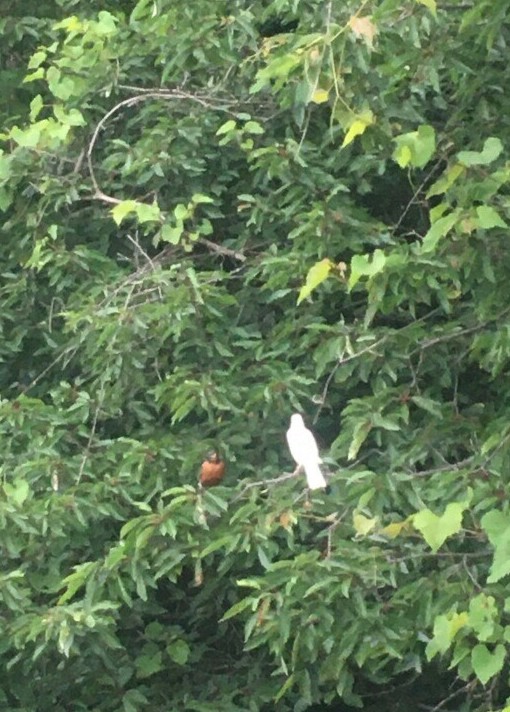
In nature there is always variation among individuals. In fact, the ability of an organism’s genes to pass along variation to a subsequent generation accounts for how species evolve. When enough variation develops among a group of individuals that are in some way isolated from other similar individuals, a new species might evolve. Often, however, a variation leads to such a unique set of features that the individual does not survive long enough to reproduce.
In June, I received a call from a person named Joseph who enjoys watching birds near his home in Plum Borough. He and a neighbor had been watching an albino American Robin in the field behind their apartment complex for a few days. One afternoon three standard colored Robins began harassing this albino and chased it rapidly towards the field’s wooded edge. When Joseph heard a ‘thunk’ as the bird hit a poplar tree, he put on his boots to search for it. After some effort he found the bird, unfortunately dead. He called the National Aviary to report his find, and a representative he spoke with forwarded his number to me. I visited Joseph to retrieve the rare specimen, and he later sent me pictures of the living bird as well as an immediate post-mortem image showing pink eyes, a feature which designates the creature as a true albino.
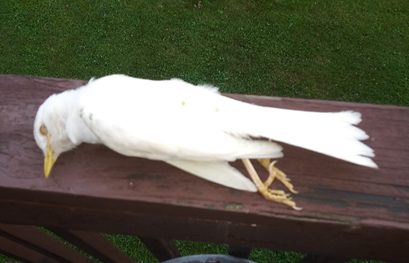
Adding the Albino Robin to the Museum Collection
I contacted Annie Lindsay, Powdermill Nature Reserve’s Banding Program Manager, to ask if she had ever seen an albino at the museum’s field research station. She had not, but reported some encounters with birds bearing leucistic feathers. The term refers to feathers without pigment. Sometimes birds who lose individual feathers when they are not molting replace a lost colored feather with one that is white. I have seen this phenomenon in some birds I have prepared. I have also occasionally prepared birds with leucism, a condition caused by a genetic mutation that results in a partial reduction of color in a bird’s plumage, resulting certain areas white and other areas the typical colors of the species.
Among the American Robins in the CMNH collection we have an example of both a full albino and a leucistic individual. Both are pictured below alongside a male and female robin in normal coloration. The leucistic bird had been watched for three years before it was found dead. This lifespan can be interpreted as evidence that other robins must have accepted its’ coloration.
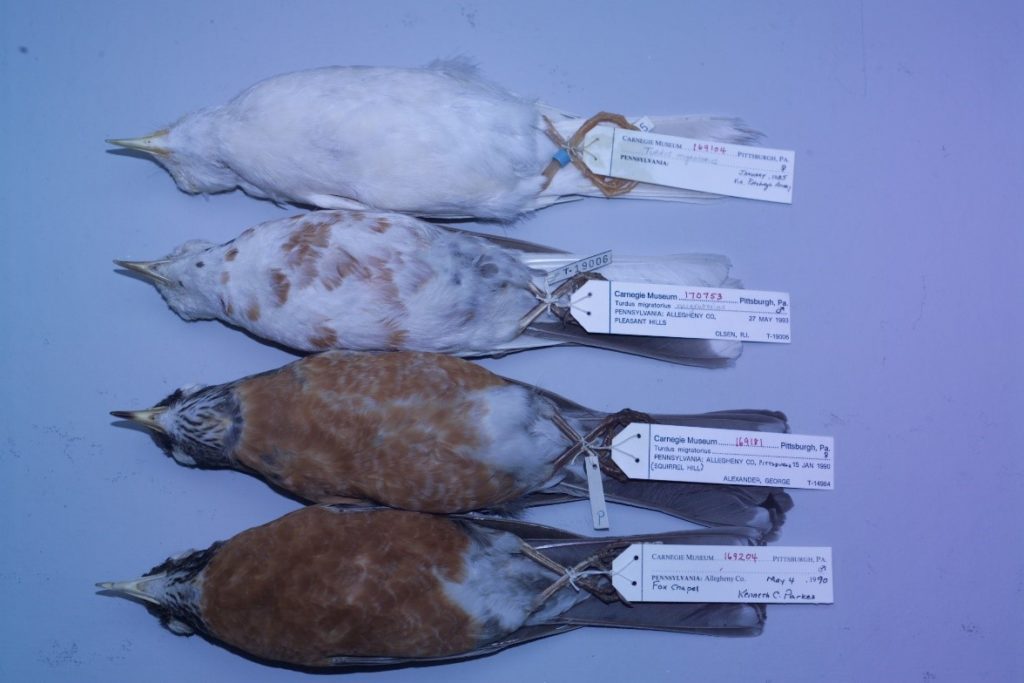
All of these birds are from the Pittsburgh area, a region which has been the primary source of birds added to the collection for many years. Typical collection addition situations involved vigilant bird watchers who found a bird that had been hit by a car (one of these individuals) or had been found dead near a window. Over the past 40 years I’ve transformed thousands of such feathered accident victims into museum specimens for current and future scientific studies. During this time, I’ve noticed a trend. If a person finds a dead bird, they may or may not contact the museum to see if we want the specimen. However, if it appears to be extra colorful, or rare by distribution, or in the case of the Plum Borough robin, albino, they may make a special effort to reach out to Carnegie Museum of Natural History. The albino American Robin is still in a museum freezer awaiting preparation. Perhaps it may become a taxidermy specimen rather than a study skin.
Stephen P. Rogers is Collection Manager in the Section of Birds at Carnegie Museum of Natural History. Museum employees are encouraged to blog about their unique experiences and knowledge gained from working at the museum.
Related Content
Carnegie Museum of Natural History Blog Citation Information
Blog author: Rogers, Stephen P.Publication date: October 21, 2021
