Let’s take a swim through the Western Interior Seaway! This area, also called the Cretaceous Seaway, was a shallow sea filled with abundant marine life. This sea was about 100 feet deep, like the Mediterranean, which enabled many forms of marine life to thrive. The Western interior Seaway existed during the mid-to late Cretaceous period (145-65 Mya). This body of water split the continent of North America into two land masses. These areas stretched from the Gulf of Mexico through the middle of North America. Several wonderful specimens of marine life have been found in Kansas, which was under water during the Cretaceous period.
Ready to go for a swim? As an interpreter, when I am educating visitors, as we approach the exhibit, we mimic swimming with our arms in the air and walk toward the display! That is always fun and gets our imagination ready! Here we go….
As we approach this Gallery, we see a diorama (a full size 3-D model of museum collection pieces) with an azure blue background. It really gives the impression that we are underwater! Luminescent lighting gently fluctuates creating a beautiful reflection, much like flowing water on the ground. In the background, softly echoing music plays and creates a floating sensation. as the light reflects.
Slowly, a large marine reptile comes into view. This is a creature called Dolichorhynchops bonneri (Dol-lee-kor-in-chops), meaning “long-nosed face.”
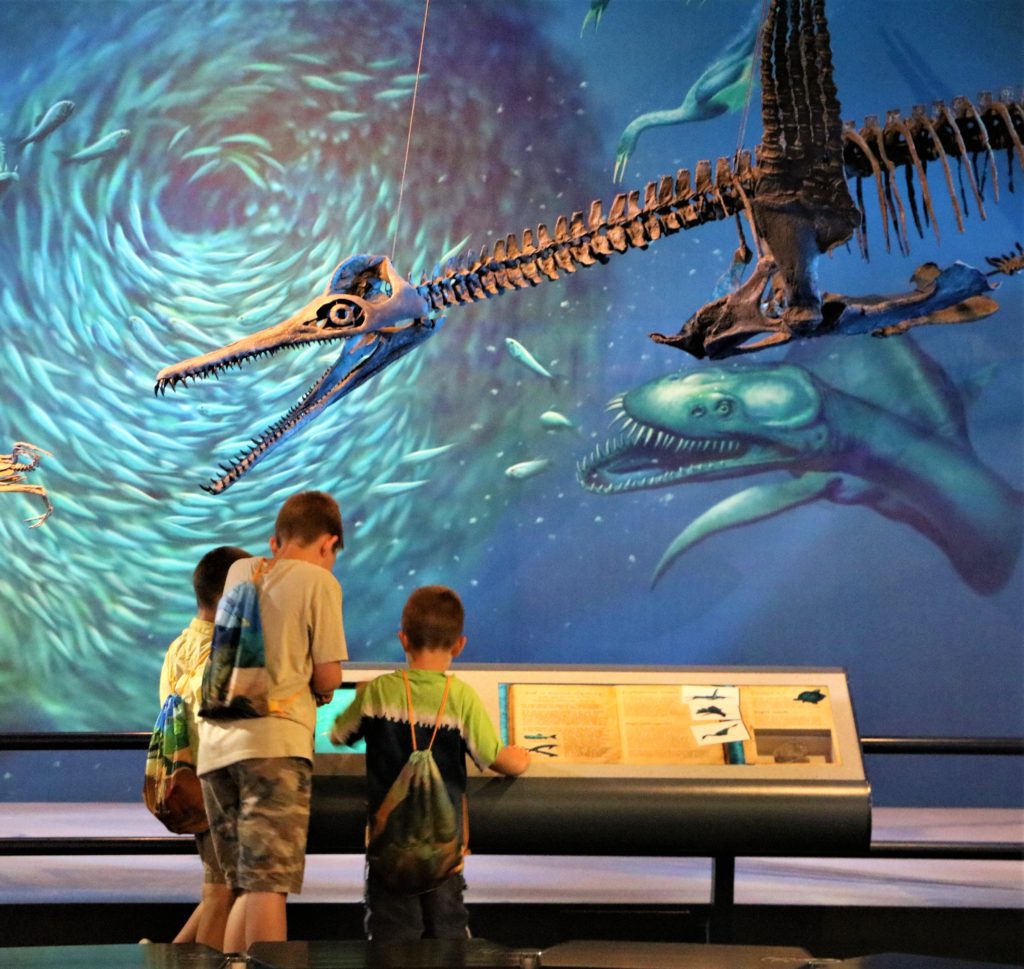
Let’s call it “Dolly” for short! Dolly is a Plesiosaur – primarily identified by its distinct characteristics: a short tail, long flippers and a flattened body structure which enables it to be a faster swimmer to catch its prey. The creature’s jaws are not thought to have a powerful bite force. The teeth are long and thin, not meant for tearing, but more for the ability to puncture soft, slippery prey. These creatures most likely swallowed their prey whole. In this diorama, Dolly appears to be pursuing a flightless bird with teeth called Hesperornis regalis (“western bird”) which had stout legs for swimming and tiny wings used for marine steering rather than flight. Dolly and Hesperornis regalis fossils were found in the late Cretaceous marine limestone of Kansas.
Our specimen of Dolichorhynchops bonneri is a cast. The fossil remains were recovered by George F. and Charles A. Sternberg from the Smoky Hill Chalk and Fort Hays Limestone-Kansas. The original is a type specimen on display at the Museum of Kansas. A type specimen, or “holotype” is a single specimen known to have been used to formally describe a species.
I hope you enjoyed our undersea adventure and I invite you to explore the numerous exciting areas of our museum. It’s a great place to learn about the past, present and future
Written by: Shari Bechtel is a Gallery Experience Presenter and Natural History Interpreter.
