By Tim Pearce
Carnivorous and predatory, killer cone snails (genus Conus) stun their prey by injecting peptide neurotoxins called conotoxins. These peptides are short proteins, mostly 12-30 amino acids long.
Of the approximately 600 species of cone snails, two species have killed humans: the geography cone (Conus geographus) and the textile cone (Conus textile). Those species occur in the South Pacific and Indian Oceans.
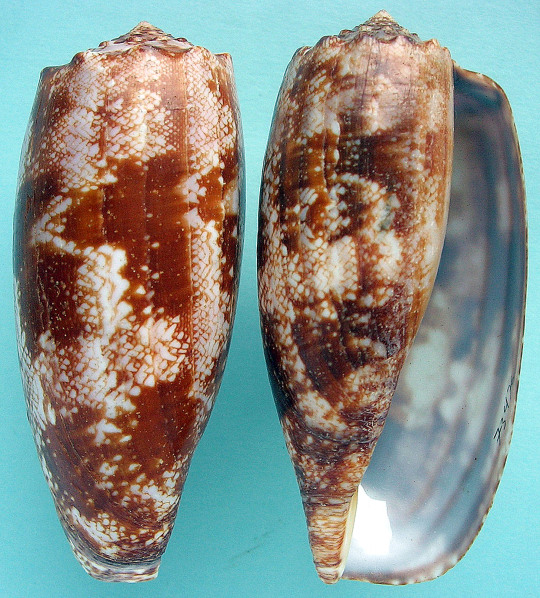
Each cone snail species produces more than 100 conotoxins, with an estimated 5% overlap in conotoxins among species [1]. Although only about 0.1% of these >50,000 peptides have been characterized, many have already been recognized to have pharmaceutical uses: six for pain, three for cardiovascular issues, one for epilepsy, and one for mood.
A potentially useful medicine from the venom of fish-eating cone snails is insulin, which acts faster than human insulin [2]. The cone snail insulin is a single molecule that acts within 5 minutes. In contrast, human insulin is stored as a cluster of six insulin molecules that must separate to become active, and separation can take 60 minutes (or 15-30 minutes for modified human insulin). The cone snail uses its insulin to immobilize fish by hypoglycemic shock (caused by extremely low blood sugar), making prey easier to catch. Researchers are studying cone snail insulin for ideas to make better insulin for use in humans.
Another medicine currently used in humans is the pain killer ziconotide (Prialt). It is more powerful than morphine, not addictive, and people don’t build up a tolerance. However, it doesn’t cross the blood-brain barrier so must be injected directly into spinal fluid. The FDA approved it in 2004 for end-of-life cases (pain management). Scattered reports suggest an odd side effect: people who take Prialt hear music in their heads. Researchers continue studying ways to get the peptide across the blood-brain barrier. Success could mean an alternative to opioid drugs, and potentially a powerful tool for solving the opioid crisis.
“Better living through snails!”
Fun Fact: Sunken ships provide habitat for many undersea creatures including cone snails.
Riddle: What lies at the bottom of the ocean and twitches?
Answer: A nervous wreck!
Timothy A. Pearce, PhD, is the head of the mollusks section at Carnegie Museum of Natural History. Museum employees are encouraged to blog about their unique experiences and knowledge gained from working at the museum.
Notes:
[1] Davis, J., Jones, A. & Lewis, R.J. 2009. Remarkable inter- and intra-species complexity of conotoxins revealed by LC/MS. Peptides, 30(7): 1222-1227.
[2] Safavi-Hemamia, H., Gajewiak, J., Karanth, S., Robinson, S.D., Ueberheide, B., Douglass, A.D., Schlegel, A., Imperial, J.S., Watkins, M., Bandyopadhyay, P.K., Yandell, M., Li, Q., Purcell, A.W., Norton, R.S., Ellgaard, L. & Olivera, B.M. 2015. Specialized insulin is used for chemical warfare by fish-hunting cone snails. Proceedings of the National Academy of Sciences, 112(6): 1743-1748.
