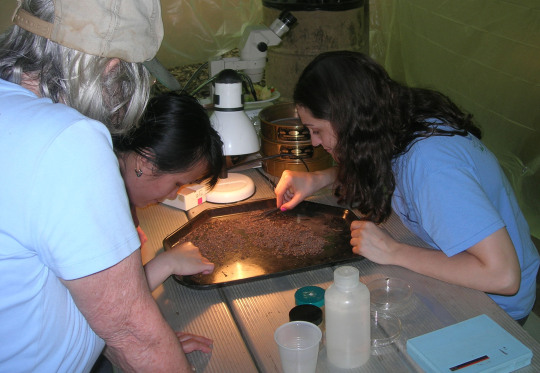
Tim Pearce (Curator of Collections, Mollusks) surveyed land snails in a BioBlitz organized this past weekend by the Mt. Lebanon Nature Conservancy at Robb Hollow Park in Mt. Lebanon. Other members of Carnegie Museum of Natural History who participated in the BioBlitz were Bonnie and Joe Isaac (Collection Manager and volunteer, respectively, Botany).
Pearce targeted five locations in Robb Hollow Park and found 10 species of gastropods, including a rare species, and two species that had not been found in Mt. Lebanon during previous BioBlitzes in 2003 and 2005 at Bird Park and Twin Hills Park. The two new records were the introduced slug Arion intermedius (common name: Hedgehog Arion) and a minute native snail, Columella simplex (High-spire Column).
The most exciting snail find is the rare snail, Glyphyalinia raderi (Maryland Glyph), living in Robb Hollow Park. This native species has been found in Pennsylvania only 18 times previously, in six counties in the southwestern part of the state. Most of the localities are associated with limestone in undisturbed natural areas, so the finding of this snail in Robb Hollow Park this year and in Twin Hills Park in 2005 are big surprises. Why is a rare snail living in these non-pristine urban parks? Furthermore, it is almost never found alive, but the two individuals seen in Robb Hollow park were both alive.
Ten species is a bit on the low side for a snail survey, but is better than Pearce expected. When he collected the samples, he noticed that (non-native) earthworms had consumed most of the duff layer of dead leaves, leaving very little food and living space for snails, so he initially didn’t have high hopes for finding many species. But he found ten, and happily, most of the snail species are native. “In urban settings, I often find a large proportion of introduced species, usually from Europe,” said Pearce. “But in Robb Hollow Park, seven of the ten species are native, which is a pretty good proportion.”
Timothy A. Pearce, PhD, is the head of the mollusks section at Carnegie Museum of Natural History.
Museum employees are encouraged to blog about their unique experiences and knowledge gained from working at the museum.
