by Chase Mendenhall
The search for the Ivory-billed Woodpecker (Campephilus principalis) continues. For decades this conspicuous woodpecker has generated pandemonium through eye-witness accounts, inconclusive recordings of their calls, blurry videos, and suspicious markings on trees. In the 1940s, the last known group of these woodpeckers disappeared after a battle to create a reserve was lost and their forest was logged. In the last 80 years, glimpses of these giant woodpeckers have been reported in their former range that spans from Texas to North Carolina and Illinois to Florida and Cuba—but no conclusive evidence has yet been confirmed and the stakes for rediscovery are high.
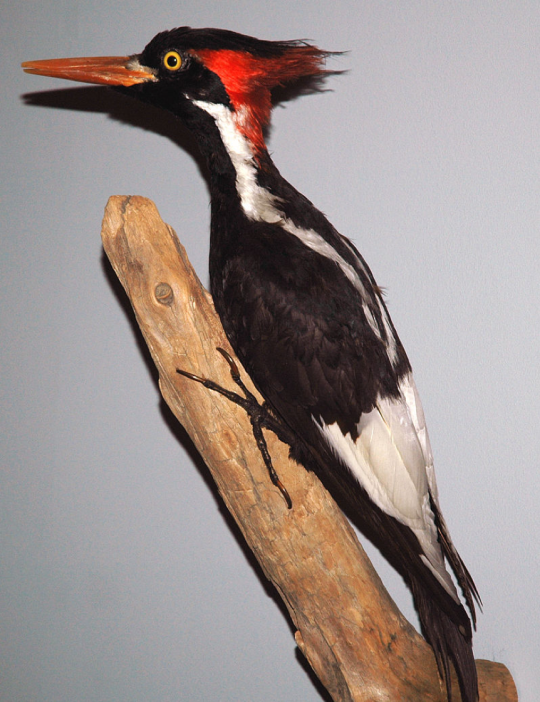
The so-called “Grail Bird” has haunted outdoor enthusiasts and ornithologists who have claimed to have seen one. To the estimated 60 million US citizens who watch birds as a profession or hobby, news of an Ivory-billed Woodpecker is a serious claim. In June 2005 a popular scientific magazine published a claim by 17 scientists that the Ivory-billed Woodpecker had been rediscovered. Pandemonium ensued, with small towns on the edges of southern swamps swelling with binoculars, spotting scopes, and people determined to find the holy grail of birds. While excitement spread of the possibility of being the first to see this bird, skeptical scientists emerged and deemed the video evidence inconclusive.
Despite the insidious disappointment surrounding sightings of the Ivory-billed Woodpecker, new reports continue to trickle in. In fact, the seven specimens at the Carnegie Museum of Natural History frequently receive visitors. Many are birders intrigued by the drama and, occasionally, some are confidentially gathering evidence to support their own claims of the bird’s existence.
Regardless of its status, the lore of the so-called “King of the Woodpeckers” has led to the creation of reserves, economically revitalized small swamp towns, and impassioned countless people to learn the field markings of the Pileated Woodpecker (Dryocopus pileatus)—a common relative often confused by amateurs as an Ivory-billed Woodpecker.
Chase Mendenhall is Assistant Curator of Birds, Ecology, and Conservation at Carnegie Museum of Natural History. Museum employees are encouraged to blog about their unique experiences and knowledge gained from working at the museum.
