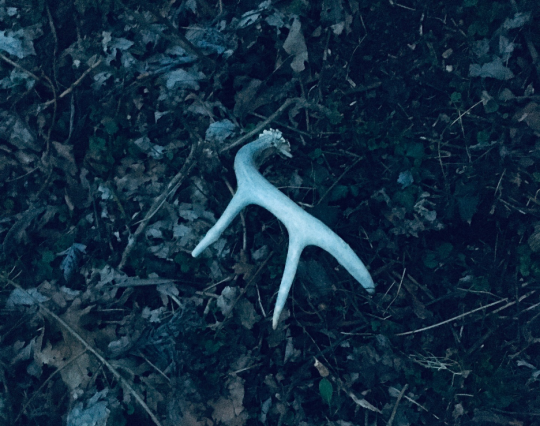
In the darkening woods of an early spring evening, the deer antler practically glowed. After retrieving and examining the bone-like left-side appendage, I walked a wide circle within my neighbor’s wooded property hoping to spot a matching right-side antler.
Male deer grow and shed antlers annually, a process driven by changes in daylight, and controlled, like so many biological operations, by the chemical signals of hormones. Antler to skull connections are solid during the breeding season but dropping testosterone levels eventually weaken the link. Because white-tailed deer bucks in our region frequently shed antlers by mid-January, my multi-point find might well have spent ten weeks on the ground.
As a museum educator I appreciate the potential of antlers as teaching tools. Science teachers often borrow sets of them to illustrate lessons about sexual selection in evolution, and in Discovery Basecamp, the museum’s object-centered learning center, visitors frequently pose for pictures holding white-tailed deer antlers just above their own ears.
The specimen pictured above has been put to a different use. It currently rests on the ground amidst a tangle of wild grapevine near where I originally found it. The location is a place where I can occasionally check the rate at which various rodents gnaw on the antler, and thereby recycle much of its calcium into the same system it was briefly pulled from.
Patrick McShea works in the Education and Visitor Experience department of Carnegie Museum of Natural History. Museum employees are encouraged to blog about their unique experiences and knowledge gained from working at the museum.
