by Joann Wilson
Archivists control time. During a recent visit to the Carnegie Museum of Natural History Library, Kelsea Collins, Carnegie Museum Library Cataloger, demonstrated the magic of archival restoration on a 118-year-old document. Kelsea, along with Marie Corrado, Carnegie Museum of Natural History Library Manager, guided me to a windowless, climate-controlled section of the Natural History Library. In this room, rows of hand bound documents, and other archival materials, rest at a constant 65–68-degrees Fahrenheit.
Cleaning Historic Documents
On a flat surface, ready for cleaning, lay an historic “wove” paper cable. “Wove” paper production was introduced in 1750 at a time when paper was made by hand. It is sometimes confused with another of material, known as “laid” paper. Both types are made from wood pulp. The type of mesh, used during manufacturing, generates the differing appearance. Wove paper has a more uniform look when held up to the light. Laid paper has lines, grooves, and sometimes, watermarks. By the early 1800’s, machines were introduced to make paper in greater quantities. Kelsea indicated that our 118-year-old document was likely made by machine, not by hand.
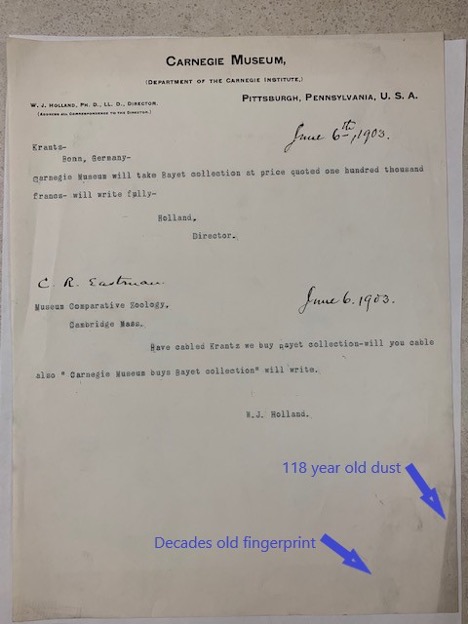
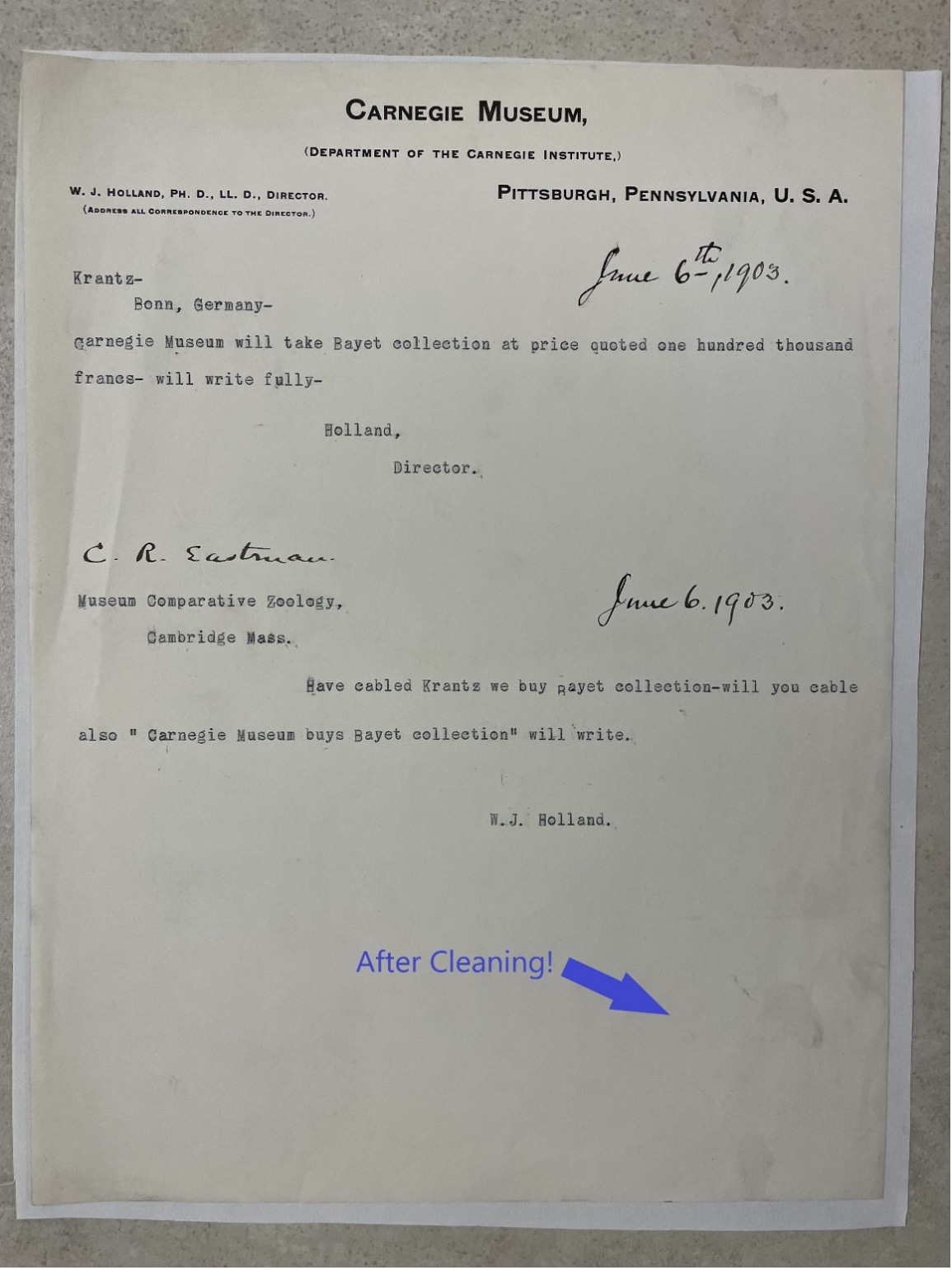
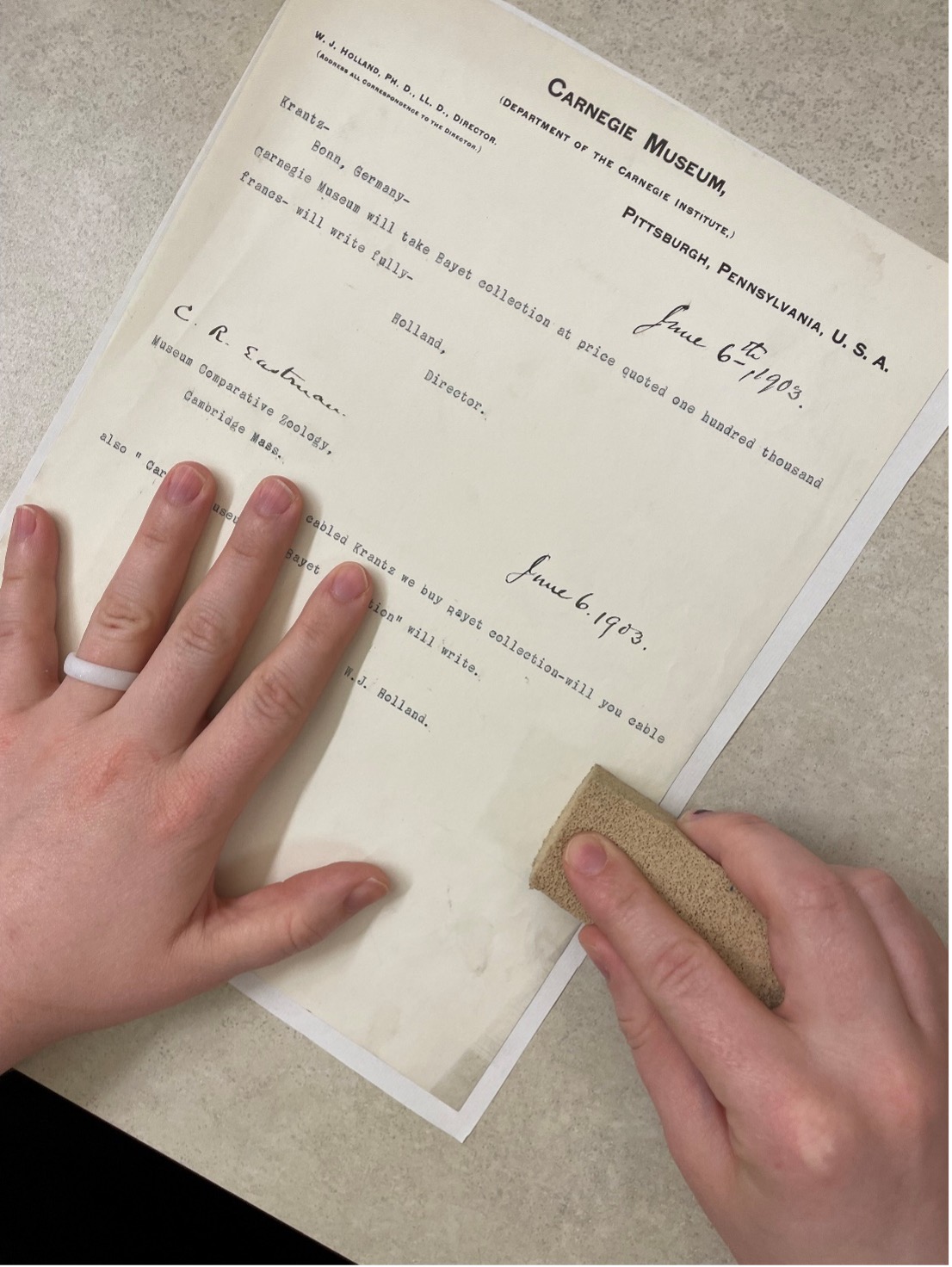
Having washed her hands, Kelsea was ready for restoration. Current practice from the Library of Congress recommends clean, dry hands, without gloves for the handling of rare and old documents. Nitrile and cotton gloves, used in previous decades, can easily rip fragile paper. In less than a minute, and with just a few gentle swipes of a dry, vulcanized rubber sponge, Kelsea removed discernible marks from the past. Long forgotten fingermarks faded and dust lines, possibly from coal, disappeared. Our document still has a trace of the century old fingerprints, but the dust lines are almost completely gone. Skilled archivists know when to stop.
So, the next time you see an old document, take a moment to see if there are traces of fingerprints or other marks from the past. Then remember the archivists and librarians that deftly decide, whether or not, to make time disappear.
Many thanks to Kelsea Collins, Carnegie Museum Library Cataloger and Marie Corrado, Carnegie Museum of Natural History Library Manager for taking the time to share this story. Joann Wilson is an Interpreter for the Education Department at Carnegie Museum of Natural History. Museum employees are encouraged to blog about their unique experiences and knowledge gained from working at the museum.
Related Content
Meet the Fossil Detectives in the Basement
Sharing Shipping Space with Amphibians and Reptiles
Carnegie Museum of Natural History Blog Citation Information
Blog author: Wilson, JoannPublication date: October 7, 2021
