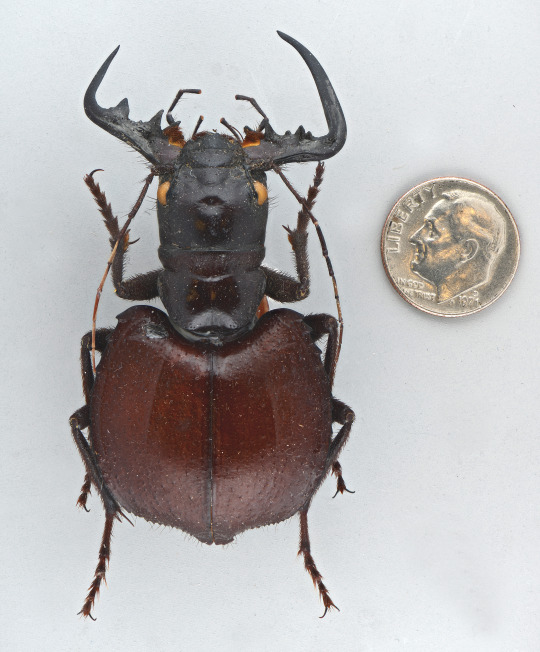
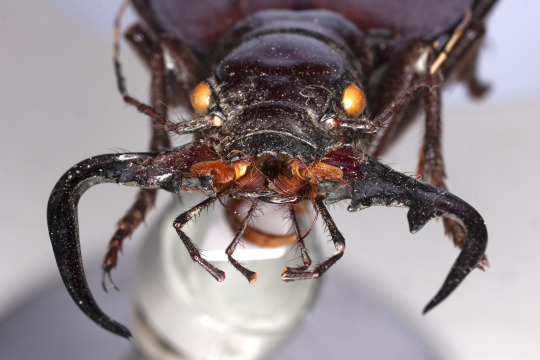
The Manticore. In ancient Persia, a scary, man-eating monster with the head of a man, the body of a lion, and the tail and sting of a scorpion. In nature, one of the most spectacular of God’s favorite creatures, beetles (there are more beetle species than anything else living today). The genus Manticora (“the one who devours men”) consists of 15 known species confined to the southern portions of Africa, mostly to the oldest geologic portions of that region, and mostly to open desert and dry savannah habitats. They are relatively primitive, flightless, predatory black tiger beetles of enormous size. The males of some species are particularly spectacular, with huge asymmetrical mandibles, reaching the extreme in Manticora imperator, with a toothed left mandible and a larger right mandible bent like a sickle (Figures 1-2). Mandibles in both sexes are used to attack prey, and, in males, also to combat other males and to clasp the female during copulation.
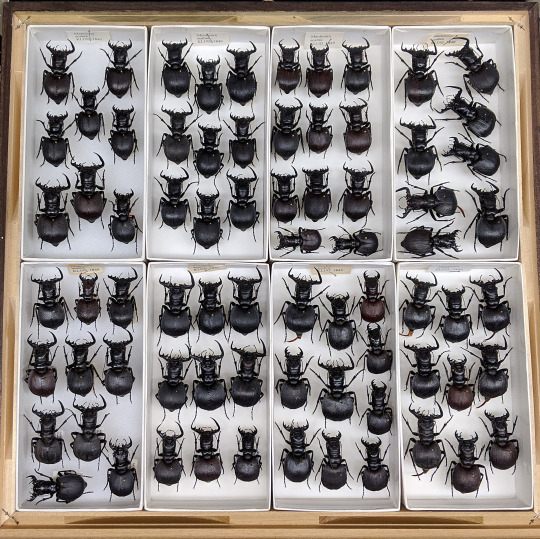
A recent donation gives Carnegie Museum of Natural History one of the best collections of these beetles in the world, nearly a thousand specimens, including all the species and subspecies. This includes many of the types (specimens designated to represent the species when an author names a new animal or plant). Long series of many of them (Figure 3) allows analysis of variation and distribution, addressing conservation issues, and has great potential for exhibit purposes. Some of the species are now threatened, not by collecting, but by construction and development over their very limited habitats and ranges.
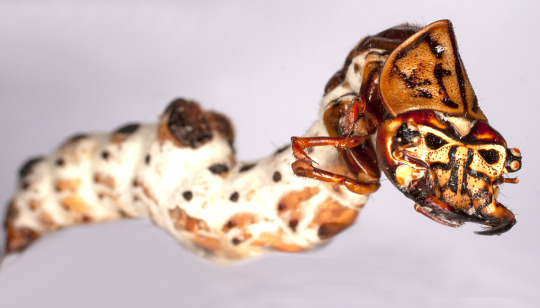
The larvae (Figure 4) look and behave more like tiger beetle larvae from other parts of the world, except that they are enormous. They dig a vertical burrow up to a meter in depth, depending on substrate, which they can drop down into when disturbed. The larval head is like a big armored plug with jaws attached. In attack mode, they block the burrow entrance with the head (making the hole difficult to see) and wait. There is also a large hook toward the rear on the larva’s back which makes it difficult for anything to dislodge it from the burrow. If something edible gets within striking distance, the larva throws its forebody out, grabs with its large jaws, and drags the prey into the burrow.
Adults hibernate underground in a large chamber at the end of a tunnel that can be as much as a meter and a half in length. Most are active from October to March after the summer rains, but they can wait a long time if necessary, until the unpredictable, erratic summer rains come. Activity is in the daytime, and they do not hesitate to attack other large armored beetles, or invertebrates that are larger than the attacker. You have perhaps seen giant millipedes the size of a bratwurst in various insect zoos? There is a filmed instance of a Manticora finishing off and eating a 10-12 inch millipede, though the beginning of the event was missed, and it is possible the millipede was already injured. These are probably not the normal preferred prey of these aggressive beetles (the millipedes, that is, not the bratwursts, which are not known to occur in the wild). But it still seems like quite a feat for an animal only about 20% the size of its dinner.
Bob Davidson is Collection Manager of Invertebrate Zoology at Carnegie Museum of Natural History. Museum employees are encouraged to blog about their unique experiences and knowledge gained from working at the museum.
