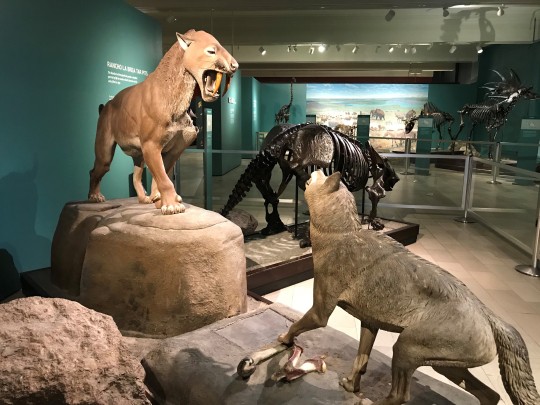
If you ever think you’ve found yourself in a sticky situation, it doesn’t compare to what this sabertooth tiger found itself in. This specimen of Smilodon, otherwise known as a sabertooth tiger, the Dire Wolf, and Harlan’s Ground Sloth at the museum were recovered from excavations at the La Brea Tar Pits.
Smilodon itself is the general name for three separate related species: Smilodon populator, Smilodon fatalis, and Smilodon gracilis. Despite their name, they’re not closely related to tigers or other big cats in the genus Panthera, which also includes lions, leopards, and jaguars. The three species mostly differ in size—while Smilodon gracilis typically weighed in at around 55-100 kg (100-220 lbs), Smilidon fatalis tipped the scales at 160-280 kg (350-600 lbs); approximately the same weight as a Siberian tiger.
All three species of Smilodon have elongated canine teeth. Some specimens have teeth measuring up to 11 centimeters (4.33 in.). However, these teeth are incredibly fragile. If the Smilodon were to hunt the same way as modern cats, they would have broken their canine teeth. Instead, it’s thought Smilodons would use their upper body strength to tackle the intended prey and then use their canines to puncture and tear away meat. Due to the distribution of fossils found, it is believed that they were most likely pack hunters.
Carnegie Museum of Natural History is proud to feature a Smilodon fatalis specimen, which had a roundabout journey 2,000 miles and approximately 11,000 years in the making.
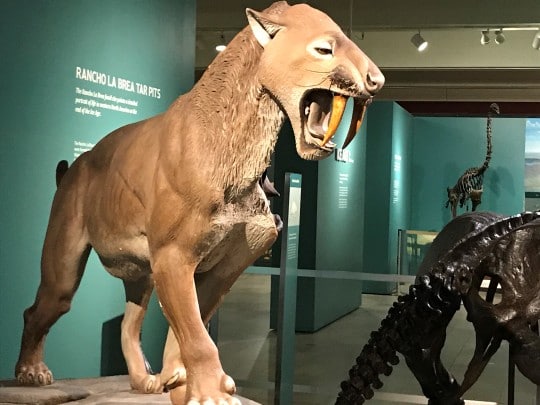
It all began at the La Brea Tar Pits—a series of naturally occurring asphalt pits where petroleum oozes from the ground. What makes the pits at La Brea unique is the fact they have been continuously active for 50,000 years. As history has progressed, modern-day Los Angeles has grown around them. The pits are now one of the only paleontological sites located inside of a major city in the world.
The Rancho La Brea Tar Pits are a virtual treasure-trove for fossils from the Ice Age. Over 100 excavations since the early 1900s have resulted in the recovery of over 3.5 million fossils from all manner of species, including over 2,000 individual sabre tooth tigers. This is due to the unique fossilizations process created by the pits themselves. As the tar oozes, pools, and warms on the ground, it becomes sticky; prey mammals can easily become stuck in as little as four centimeters (1.57 in.) and unable to move. A strong and healthy animal might be able to escape, but for the majority trapped in the tar, it was only a matter of time until they succumbed. Sometimes, a passing predator would hear a stuck animal and try to seize them first (such as Smilodon). This would often result in the predator becoming stuck as well, and both predator and prey would be found well-preserved thousands of years later.
Even today, the Rancho La Brea site is still actively producing fossils. A variety of flora and fauna have been preserved here, allowing us to have an unparalleled look at species from the end of the last major Ice Age. By studying these fossils from the past, scientists in turn can learn how things like climate change may affect us in the future.
Andrew Huntley is a Gallery Presenter in CMNH’s Lifelong Learning Department, as well as part of the Animal Husbandry staff for the Living Collection. Museum staff, volunteers, and interns are encouraged to blog about their unique experiences and knowledge gained from working at the museum.
