• Skip to primary navigation
  • Skip to main content
  • Skip to primary sidebar

Carnegie Museum of Natural History

One of the Four Carnegie Museums of Pittsburgh

  • Visit
    • Buy Tickets
    • Visitor Information
    • Exhibitions
    • Events
    • Dining at the Museum
    • Celebrate at the Museum
    • Powdermill Nature Reserve
    • Event Venue Rental
  • Learn
    • Field Trips
    • Educator Information
    • Programs at the Museum
    • Bring the Museum to You
    • Guided Programs FAQ
    • Programs Online
    • Climate and Rural Systems Partnership
  • Research
    • Scientific Sections
    • Science Stories
    • Science Videos
    • Senior Science & Research Staff
    • Museum Library
    • Science Seminars
    • Scientific Publications
    • Specimen and Artifact Identification
  • About
    • Mission & Commitments
    • Directors Team
    • Museum History
  • Tickets
  • Give
  • Shop

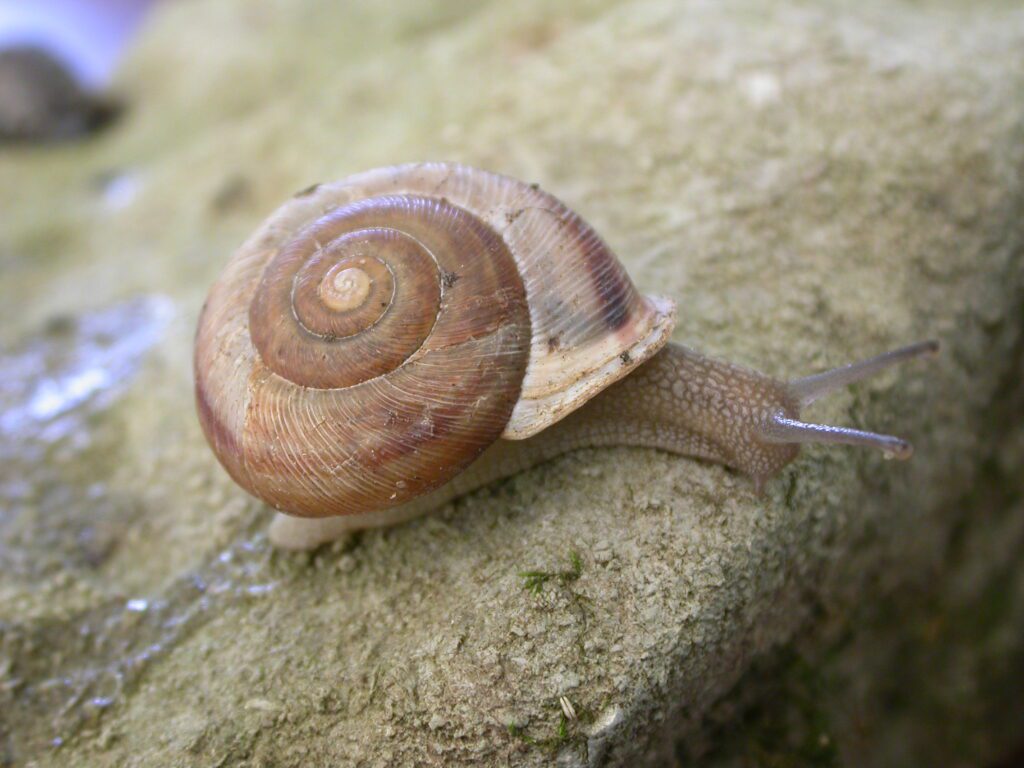
Allogona profunda

Image Usage Information

  • Florida Museum of Natural History
  • CC BY-NC 3.0 DEED
  • For additional information about this specimen: Gustav Paulay (paulay@flmnh.ufl.edu)

Family: Polygyridae

Common name: Broad-banded Forestsnail

Discovery: Say, 1821

Identification

Width: 25-33 mm
Height: 15-17 mm
Whorls: 5+

This snail has a robust heliciform shell with a wide umbilicus, a reflected peristome, and a broad reddish stripe. The stripe may be absent from long-dead shells, but the big, flattened shell with a “bump” of a basal lip tooth is easily recognized. The animal’s body is a medium to light gray.

Ecology

Allogona profunda is usually found in leaf litter in rich forests on floodplains or hilly terrain. Fieldwork in an oak-maple forest in Illinois found that overwintering A. profunda were completely inactive for nearly six months, not responding to brief periods of warm weather (Blinn, 1963). In the active season, snails moved to an area of a well-rotted log. In a second year of study, individuals returned to their previous overwintering site. Immature animals usually grew to maturity in their second active season, less often their third.

Taxonomy

Synonyms for A. profunda include Helix profunda, H. richardii, Mesodon profunda, Polygyra profunda, P. p. alba and unicolor, P. p. efasciata, P. p. strontiana, and P. p. pleistocenica.

Distribution

This species is found in the Midwestern states and in the interior of the Mid-Atlantic, though its distribution is patchy. Its range reaches north to New York (though it is introduced there) and Minnesota, and south to Tennessee and North Carolina. It is presumed extirpated in states further to the south – Louisiana, Arkansas, and Mississippi (NatureServe, 2012). In Virginia it is found in mostly western counties.

Conservation

NatureServe Global Rank: G5

sidebar

About

  • Mission & Commitments
  • Directors Team
  • Museum History

Get Involved

  • Volunteer
  • Membership
  • Carnegie Discoverers
  • Donate
  • Employment
  • Events

Bring a Group

  • Groups of 10 or More
  • Birthday Parties at the Museum
  • Field Trips

Powdermill

  • Powdermill Nature Reserve
  • Powdermill Field Trips
  • Powdermill Staff
  • Research at Powdermill

More Information

  • Image Permission Requests
  • Science Stories
  • Accessibility
  • Shopping Cart
  • Contact
  • Visitor Policies
One of the Four Carnegie Museums | © Carnegie Institute | Privacy Policy | Terms of Use | Accessibility
Rad works here logo