

Image Usage Information
Family: Discidae
Common name: Flamed Disk
Discovery: Say, 1816
Identification
Width: 18-23 mm
Height: 11-13 mm
Whorls: 5+
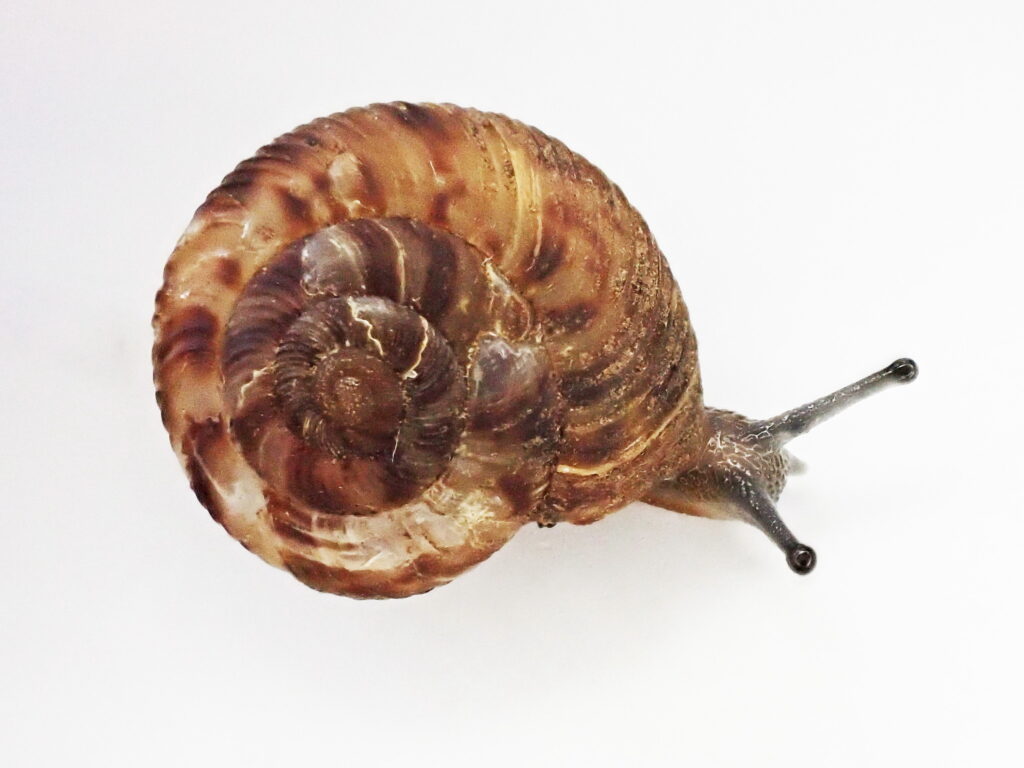
The large shell of the Flamed Disk is decorated with dark reddish-brown patches arranged in a pinwheel pattern upon a lighter brown background. The shell is heliciform with an open umbilicus, and the periphery is bluntly angular, but may vary to nearly round. The height of shells varies as well. The mucus is blood-red, but thin and watery. The animal’s body is gray above, becoming reddish at the mantle and foot edge.
Ecology
The habitats favored by A. alternata are usually hardwood or mixed wood forests. It can often be found on logs, in leaf litter, under bark, and among rocks. It is sometimes seen climbing tree trunks. Shells may become large and abundant upon limestone. Kutchka (1940) added, “in bog woods it often lives at the base of Arbor vitae and spruce,” and may aggregate beneath flat stones in summer and to overwinter. Hubricht (1985) said that this species is also found in more open habitat such as roadsides and railroad tracks. Jones (1935) reported that A. alternata buries itself by moving loose soil with its foot and pulling its shell into the depression.
Elwell & Ulmer (1971) detailed the habitats of A. alternata in Iowa, finding that it did not produce sperm until reaching 9mm diameter and did not oviposit until at least 13mm. In the wild these snails matured in their second or third summer. In a captive colony this snail burrowed into soil, gravel, or decayed wood and laid eggs 2-3mm in diameter at a depth of 1.5 to 2.5cm. The number of eggs laid by an individual varied from 2 to 25, but may have been as high as 40. Eggs that were left where they were laid hatched in 30-45 days, with almost all hatching. Predation by small mammals such as mice and chipmunks were a major cause of mortality. Cannibalism of eggs by adults was also observed. Near a lake in New York, Short-tailed Shrews (Blarina brevicauda) were a predator of this species, with both live cached snails and discarded snails found in shrew runs (Ingram, 1942).
Taxonomy
Recent work on the shells and genetics of Anguispira species shows a great deal of variation within the widespread A. alternata (Clutts, 2008). Shell shapes may overlap between A. alternata, A. jessica, and A. strongylodes, and color patterns may not be helpful in distinguishing these species. There are also some unique individuals within A. alternata that suggest the possibility of “hidden” cryptic species.
Synonyms of this animal’s name include Anguispira alternata palustris, A. alternata var. alba, Carocolla dubia, Helix radiata, H. alternata, H. scabra, H. infecta, and Pyramidula alternata.
Distribution
This animal is widespread in eastern North America, from southern Canada and the Maritime Provinces, south to the north ends of the Gulf States. In Virginia, A. alternata is reported mainly from the middle-to-western counties. Shell variations from place-to-place have led to a proliferation of recognized forms and varieties. One of those is A. alternata form angulata Pilsbry, 1948, which is more angular than typical forms and whose ridges may be coarser. This form is reported in Rockbridge County (Pilsbry 1946-48). Some old reports of A. alternata may be closely-related species that were misidentified.
Conservation
Anguispira alternata appears to have declined in the Northeast over several decades. Atmospheric acid deposition is implicated in this snail’s decline in Pennsylvania after approximately 1960 (Pearce and Arnold, 2016).
NatureServe Global Rank: G5.
Publication date: 2012, Updated 2/2018
