Image Usage Information
Family: Discidae
Common name: Greenbrier Tigersnail
Discovery: Dourson, 2015
Identification
Width: 15-18 mm
Height: 6-10 mm
Whorls: 5-6
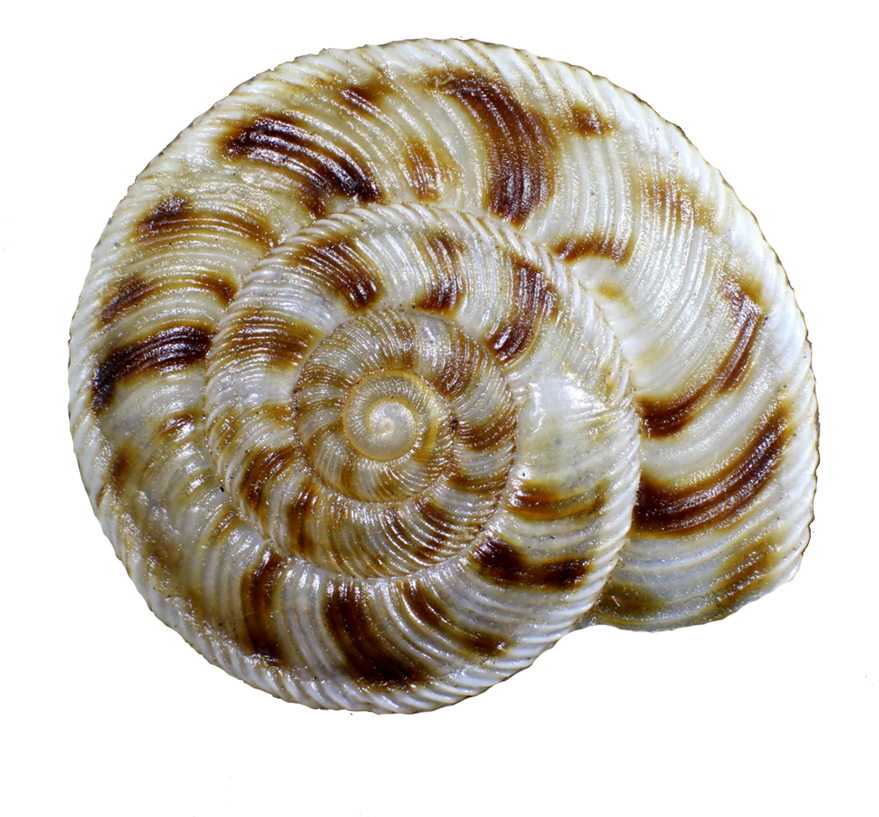
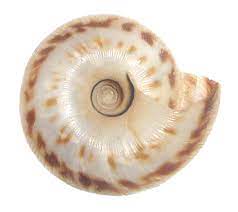
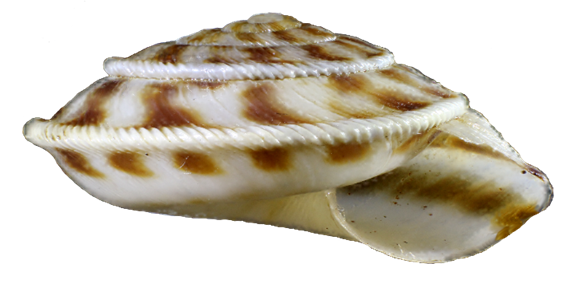
The defining feature of Anguispira stihleri is the extremely carinate “pinched” periphery. The shell is a depressed heliciform shape, umbilicate, and possesses a simple lip. The base color of the shell is white, stained by bold, rusty-brown blotches, some forming chevrons that are strongest on the tip and periphery but seen only as faded streaks on the base. The embryonic whorl has crisscrossed striae. Later whorls are sculptured with transverse ribs that are strongest on the first three whorls but becoming weakest on the last whorl. On the base the striae are weaker yet, with some shells being nearly smooth. Adult shells with at least 5 whorls have approximately 90 ribs (striae) on the last whorl. Spiral striae are a rather faint attribute.
Ecology
Anguispira stihleri is restricted to limestone clifflines and very occasionally, trees located near the rock structure. In clifflines, they may hide in crevices or under large boulders in eastern redcedar glades. The species seems to prefer dry, open cliff faces where little vegetation grows. The flattened shell may be an adaptation allowing it to move more freely in tight quarters. The diet of this snail would likely include a variety of cliffline fodder such as lichens, algae, sooty mold, cricket scat and decomposing fern fronds. It has been observed feeding on decaying leaves and stems of plants (Dourson, 2015).
Taxonomy
This globally-restricted land snail was originally discovered in 1993 by West Virginia Division of Natural Resources biologist Craig Stihler, for whom it is named. Anguispira stihleri is similar to A. cumberlandiana and A. alabama but is smaller, not as compressed and has a proportionately smaller umbilicus. It differs from A. picta in being smaller, less inflated, more lens-shaped, and having a smaller umbilicus. Anguispira stihleri populations are significantly disjunct from other endemic congeners, none of which are closer than 600 kilometers.
Distribution
An endemic to the state of West Virginia, this species is restricted to limestone bluffs and cedar glades above the Greenbrier River in Greenbrier County, West Virginia.
Conservation
NatureServe Global Rank: Not yet ranked, recommended G1. NatureServe State Rank: West Virginia, S1. This highly-restricted species may be imperiled.
Publication date: 5/2017
