
Image Usage Information
Family: Arionidae
Common name: Darkface Arion
Discovery: Mabille, 1868
Non-native
Identification
Length: up to 35 mm
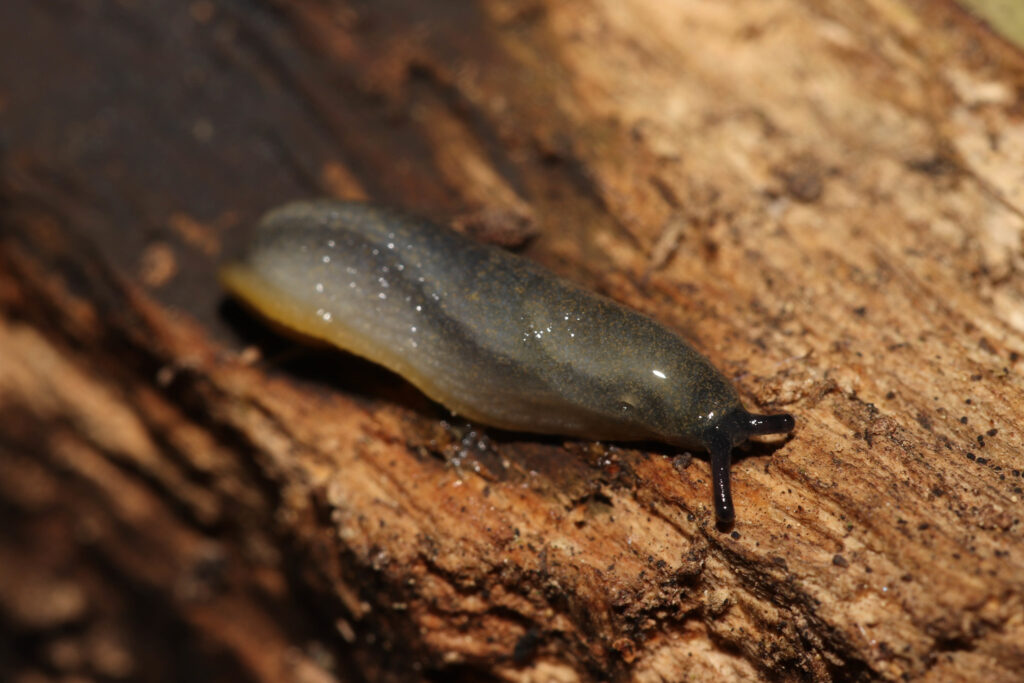
Arion distinctus has a black-blue body and blue-black to grey tentacles and head. Latitudinal stripes are set fairly low on the body, are clearly delimited on the top edge and blurred on the bottom edge, are convergent at their ends, and sometimes dip or break at the pneumostome (Davies, 1979; Wiktor, 1996). The sides below the bands are a similar color to the top (McDonnell et al., 2009).
Arion hortensis, A. distinctus, and A. owenii are a species complex that was originally recognized and divided by Davies (1977, 1979). A distinctus has blue-black to gray tentacles and head, rather than the reddish ones of A. hortensis, and the bands on its mantle are lower and convergent rather than divergent. Internal differences (spermatophore and genitalic features) are described in Davies (1977) and in Backeljau & Van Beeck (1986).
Ecology
The species tends to be synanthropic (Wiktor, 1996), occupying roadsides, gardens, wastelands, and floodplains. It takes shelter in wet places under living and dead plants (Grimm et al., 2009). It is a pest of root crops and gardens (South, 1992).
In the UK, individuals reach maturity in the fall and mainly mate in the spring and summer. They lay 50-70 eggs per cluster (Davies, 1979).
Taxonomy
References to A. hortensis and A. distinctus prior to 1978, when Davies revised the species complex (1977, 1979), should be regarded with caution (Wiktor, 1996).
Distribution
This European species was introduced to the west coast and mid-Atlantic US and to southwest and southeast Canada. It is recorded from Delaware (Newcastle Co.), Pennsylvania (Allegheny and Centre Counties), and West Virginia (Kanawha and Mercer Counties).
Conservation
NatureServe Global Rank: G5, Apparently secure.
Publication date: 6/2017
