Image Usage Information
Family: Arionidae
Common name: Orange-banded Arion
Discovery: Nilsson, 1823
Non-native
Identification
Length: 40-50 mm
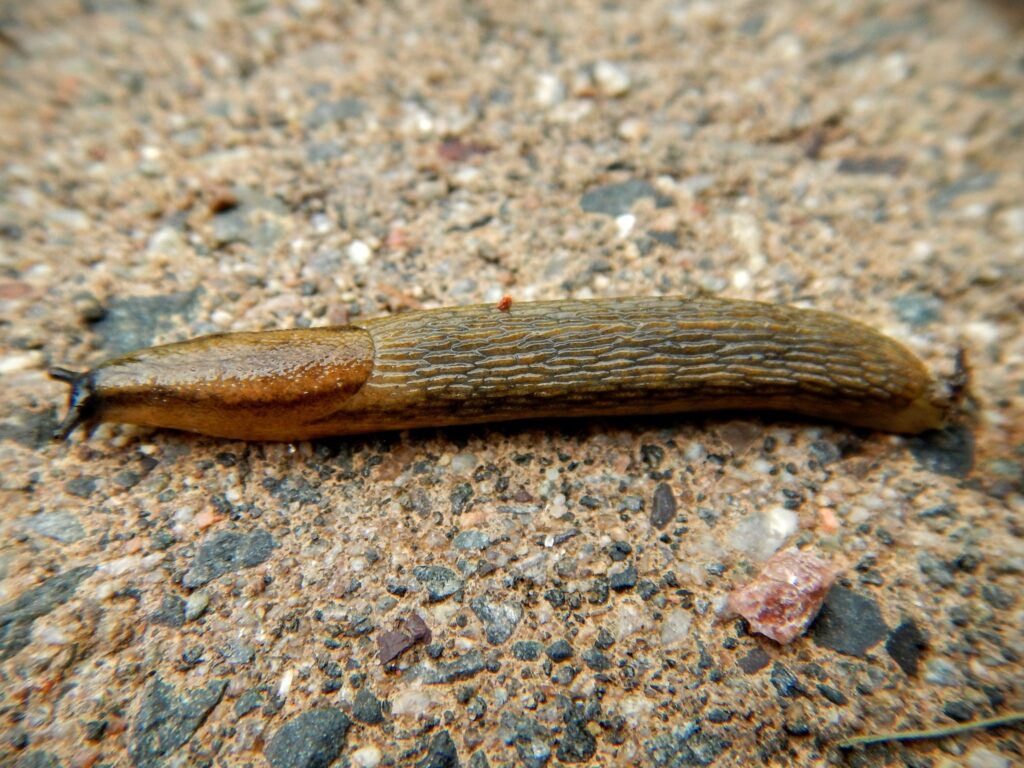
Arion fasciatus has a gray dorsum with paler sides that become white toward the foot fringe. Dark longitudinal bands, underlined by yellow stripes, are on the sides of its body and mantle. There is a keel formed by larger tubercles along its dorsal mid-line. Its sole is an opaque gray-white, and its body mucus is clear. The body is bell-shaped in cross-section (Quick, 1960; Kerney & Cameron, 1979).
A. circumscriptus and A. silvaticus are similar to A. fasciatus, but they are smaller, do not have yellow stripes, and have a wider oviduct internally. (However, note that coloration is an unreliable character because it is affected by diet (Jordaens et al., 2001).) Additional reproductive characters also distinguish the three species (see Grimm et al. 2009). A. subfuscus are similar to A. fasciatus but have orange-yellow body mucus and a different internal anatomy (Kerney & Cameron, 1979).
Ecology
The slug occupies habitat such as gardens, parks, wastelands, fields, cemeteries, the environs of buildings, and garbage dumps (Kerney & Cameron, 1979; Wiktor, 1996). It does not spread far into undisturbed habitat (Chichester & Getz, 1969). Shelter includes leaf litter, moss, and the underside of logs and rocks (Quick 1960). It can be a pest species of croplands and gardens (Grimm et al., 2009). In the late spring to fall, slugs lay clutches of up to 30 eggs (Quick, 1960).
Taxonomy
Synonyms are Limax fasciatus and Arion nilssoni.
Distribution
This European species has been introduced to much of the northeast and midwestern US and to southeast Canada, with additional records in the west and California. In the northeast US, A. fasciatus’ range spans from Maine to Maryland and West Virginia. (Note that museum records may incorrectly classify A. silvaticus and A. circumscriptus under A. fasciatus [Grimm et al., 2009].)
Conservation
NatureServe Global Rank: G5, Apparently secure.
Publication date: 6/2017
