Image Usage Information
Family: Arionidae
Common name: Chocolate Arion
Discovery: Linnaeus, 1758
Non-native
Identification
Length: up to 150 mm
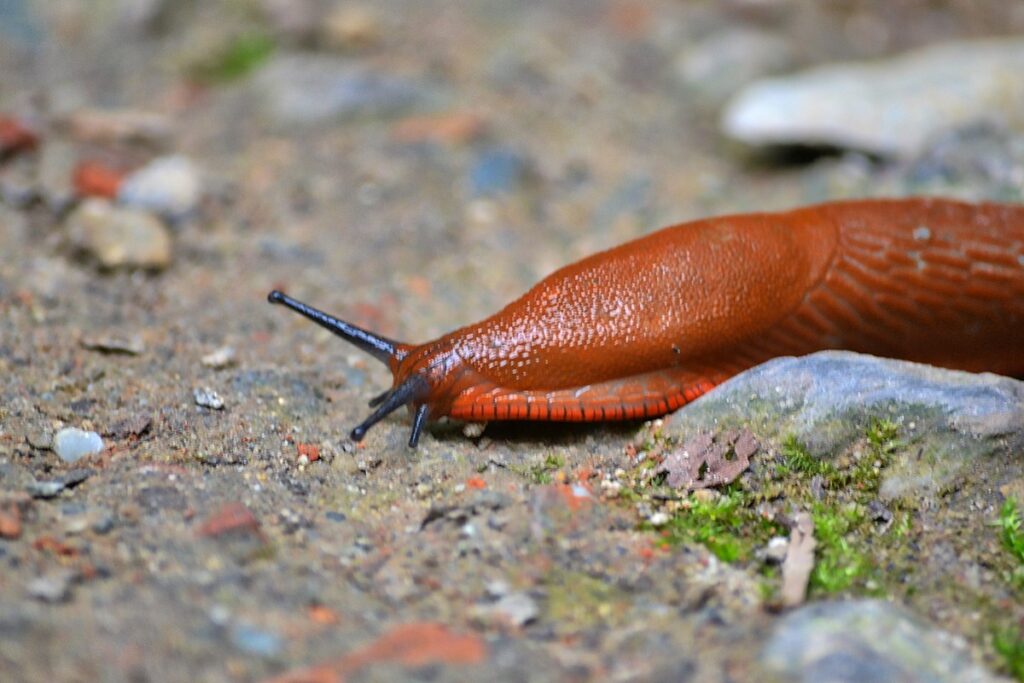
Arion rufus is a large Arion very similar in appearance to A. ater, of which it has been considered a subspecies historically. The body color of A. rufus ranges from orange to black. Its foot fringe is always somewhat orange and is crossed by dark transverse lines (Noble, 1992). The skin tubercles are large and the pneumostome prominent. The sticky body mucus may be clear or yellow. Its sole is gray.
Juveniles occasionally have longitudinal bands similar to those of other species of Arion. (Quick, 1960; Kerney & Cameron, 1979). Internally, the atrial ligula is much larger, wider, and less symmetrical than that of A. ater (Noble, 1992).
When disturbed by a potential enemy, A. rufus may contract into a hemisphere and rock from side to side (Quick, 1960).
Ecology
The ecology of A. ater is shared by A. rufus. These slugs occupy lowland forests, hedges, gardens, roadsides, wastelands, and bogs, up to 1800 m in altitude (Quick, 1960; Kerney & Cameron, 1979). They mainly shelter on living plants, with some occupying bare soil, dead plants, or fallen logs (Cameron, 1978). They are omnivores that feed on dead and live plants, fungus, dead animals, and feces (Graham, 1955; Chatfield, 1976). They can be significant plant pests (Grimm et al., 2009).
Reproduction occurs throughout the year (Grimm et al., 2009), and slugs lay up to 150 eggs per clutch (Quick 1960). Individuals may live one or two years (Grimm et al., 2009).
Taxonomy
The original published name was Limax rufus.
Distribution
Arion rufus is a European species that was introduced to the western US, a few locations in the eastern US, and southwest Canada. Museum locality records for the northeast US include Delaware (New Castle Co.), Maine (Somerset Co.), and Pennsylvania (Butler, Centre, and Washington Counties). In North America, all slugs in the Arion ater/rufus group were considered A. ater until recently (Grimm et al. 2009), so earlier records should be subject to confirmation.
Conservation
NatureServe Global Rank: G4, G5, Apparently secure.
Publication date: 6/2017

