Image Usage Information

Image Usage Information
Family: Arionidae
Common name: Dusky Arion
Discovery: Draparnaud, 1805
Non-native
Identification
Length: 50-70 mm
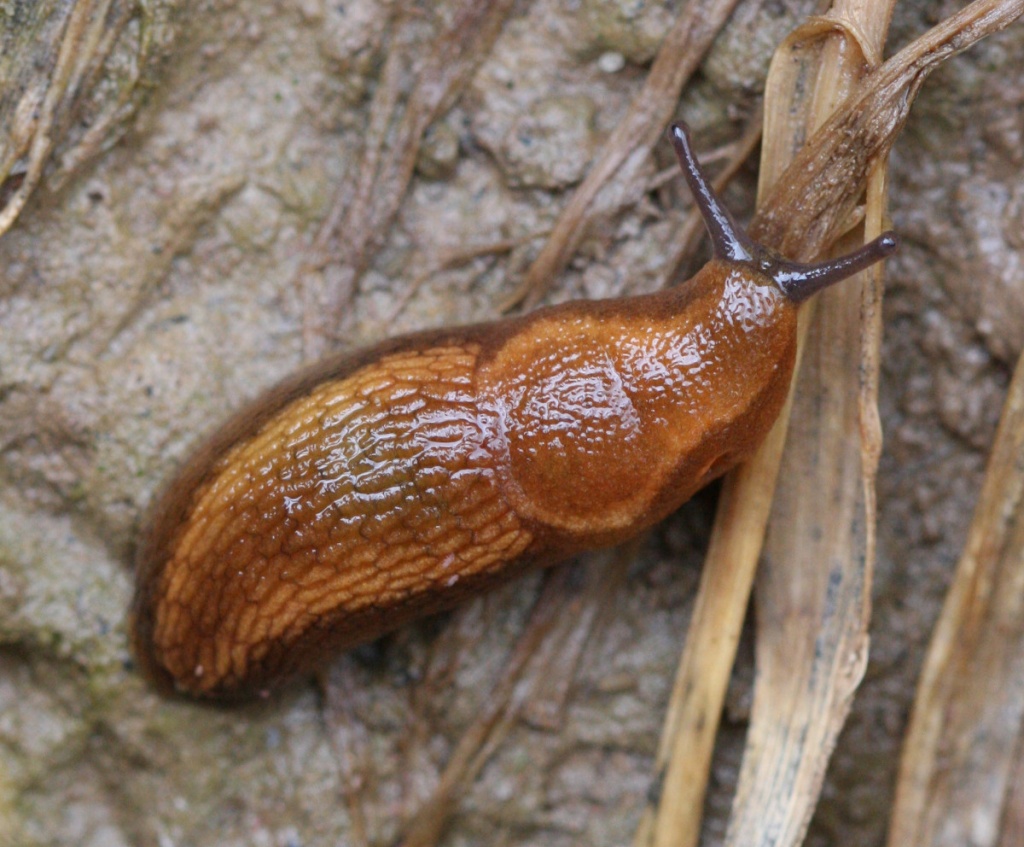
This slug is a light brown, light olive, yellow, or even orange above, with a diffuse dark stripe on each side. Its foot is light-colored, and the foot fringe usually bears thin, dark vertical stripes. The mucus is yellow or orange, and contributes much to its dorsal color, so an individual’s color may vary according to the concentration of it mucus. Wet or preserved specimens may be quite pale. Like others of its family, it has a mantle that covers the forward part of its upper surface.
There is also an unstriped form, often quite orange and having some dark reticulation on the lower head. It is more frequent in mountain forest habitats.
Ecology
Arion subfuscus is from northwest Europe and is the most widely-introduced non-native slug in eastern North America. It can exploit a variety of habitats, including yards, fields, wetlands, and forests. This species is usually found low on tree trunks, rocks, or logs, or on the ground, so it is not as arboreal as the larger philomycid slugs. It is rather omnivorous and may feed upon animal scats, dead insects and other animals, as well as algae and fungi, fresh or rotten vegetation or fruit.
In New York, fungi and decaying vegetation were the most frequent diet items of Arion subfuscus (Beyer and Saari, 1978). In a laboratory experiment, this slug, known to feed upon willow seedlings, found younger willow seedlings with lower tannin concentrations more palatable (Albrectsen et al, 2004).
In the Northeast this animal has an annual life cycle, and may overwinter as eggs or young (Chichester and Getz, 1973; Beyer and Saari, 1978). Two slugs mate by bringing their genital pores (on the right side) together and everting their atria, the initial part of the reproductive tract, to allow the exchange of spermatophores. A week after mating an egg mass of a dozen or more eggs is laid, and young hatch in four weeks. In N
Taxonomy
A synonym for Arion subfuscus is Limax subfuscus.
Distribution
In eastern North America, Arion subfuscus is found from southern Canada to South Carolina, and west to Wisconsin (NatureServe, 2013). It is also reported from western states.
Conservation
NatureServe Global Rank: G5
Publication date: 1/2013
