• Skip to primary navigation
  • Skip to main content
  • Skip to primary sidebar

Carnegie Museum of Natural History

One of the Four Carnegie Museums of Pittsburgh

  • Visit
    • Buy Tickets
    • Visitor Information
    • Exhibitions
    • Events
    • Dining at the Museum
    • Celebrate at the Museum
    • Powdermill Nature Reserve
    • Event Venue Rental
  • Learn
    • Field Trips
    • Educator Information
    • Programs at the Museum
    • Bring the Museum to You
    • Guided Programs FAQ
    • Programs Online
    • Climate and Rural Systems Partnership
  • Research
    • Scientific Sections
    • Science Stories
    • Science Videos
    • Senior Science & Research Staff
    • Museum Library
    • Science Seminars
    • Scientific Publications
    • Specimen and Artifact Identification
  • About
    • Mission & Commitments
    • Directors Team
    • Museum History
  • Tickets
  • Give
  • Shop

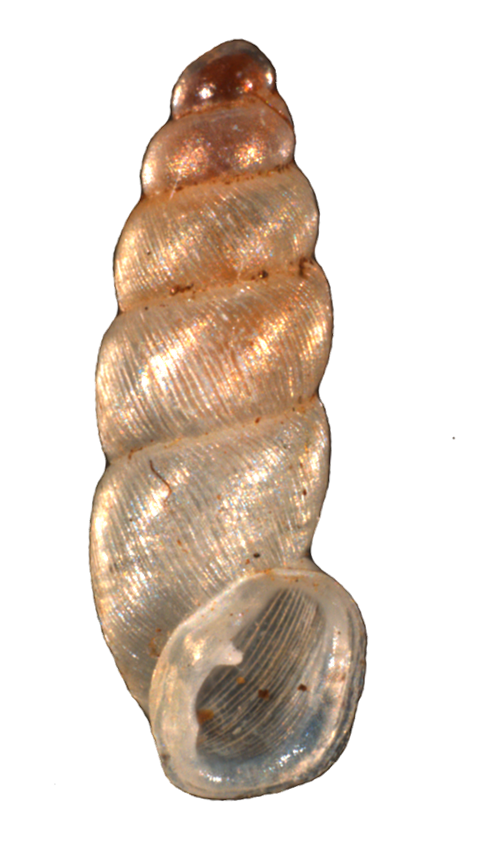
Carychium clappi

Image Usage Information

  • Dan Dourson
  • CC BY-NC 4.0 DEED

Family: Ellobiidae

Common name: Appalachian Thorn

Discovery: Hubricht, 1959

Identification

Width: 0.7-0.8 mm
Height: 1.7-2.0 mm
Whorls: 5+

The shell of Carychium clappi is whitish and elongate like its relatives, with close radial ridges. It is difficult or impossible to distinguish from its congener C. exile, raising the question of whether it is indeed a distinct species. According to Hubricht (1951) C. clappi may be distinguished by its larger size, whiter shell, and a less rounded, more angular top upon its ridges. The aperture is not heavily thickened within, as is usual in C. exile.

Ecology

Like C. exile, this snail can be found on wooded slopes and talus, buried in deep piles of leaves and in pits made by the roots of fallen trees. Despite having similar habitats, C. clappi, C. nannodes, and C. exile are rarely found together (Hubricht, 1985).

Taxonomy

Carychium clappi was originally described as Carychium costatum before being proposed as C. clappi (Hubricht, 1959).

Distribution

Carychium clappi is found throughout the southern Appalachian Mountains, from Pennsylvania in the north to Alabama in the south. In Virginia it is reported from counties throughout the western part of the state. Because it is very similar to or possibly the same species as C. exile, its range may not be correctly delineated.

Conservation

NatureServe Global Rank: G5, Secure.

sidebar

About

  • Mission & Commitments
  • Directors Team
  • Museum History

Get Involved

  • Volunteer
  • Membership
  • Carnegie Discoverers
  • Donate
  • Employment
  • Events

Bring a Group

  • Groups of 10 or More
  • Birthday Parties at the Museum
  • Field Trips

Powdermill

  • Powdermill Nature Reserve
  • Powdermill Field Trips
  • Powdermill Staff
  • Research at Powdermill

More Information

  • Image Permission Requests
  • Science Stories
  • Accessibility
  • Shopping Cart
  • Contact
  • Visitor Policies
One of the Four Carnegie Museums | © Carnegie Institute | Privacy Policy | Terms of Use | Accessibility
Rad works here logo