

Image Usage Information
Family: Helicidae
Common name: White-lip Garden Snail
Discovery: Müller, 1774
Identification
Width: 17-20.5 mm
Height: 13-18 mm
Whorls: 4-5+
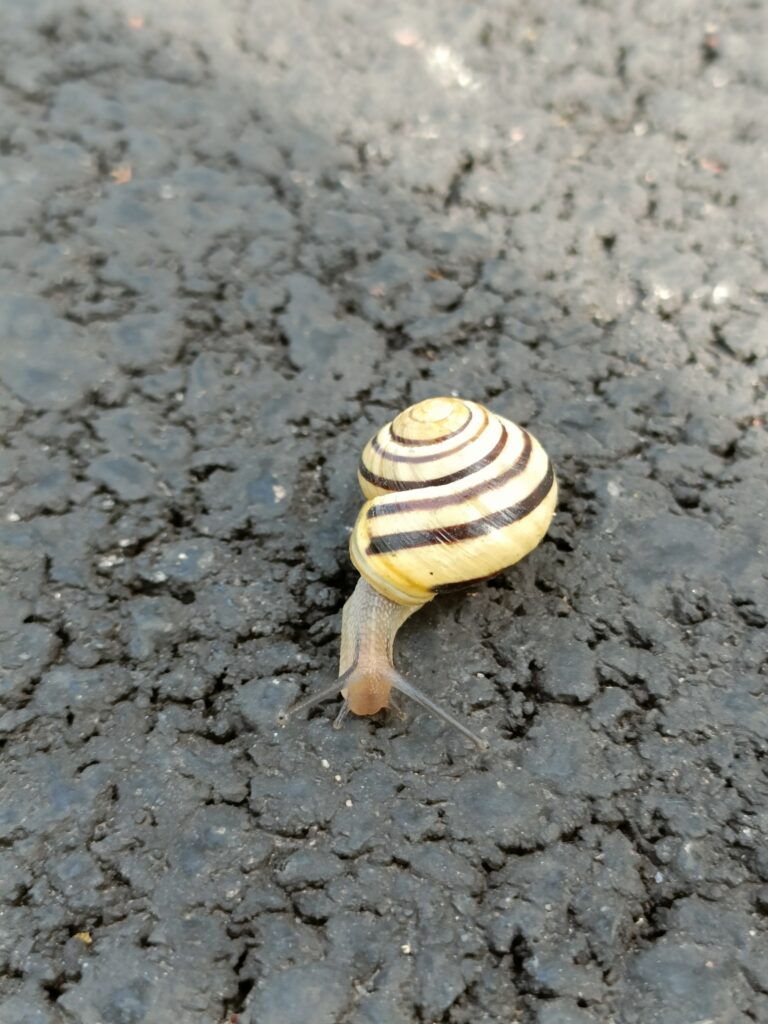
The glossy shell of Cepaea hortensis is a slightly depressed globe shape. It often has a banded shell, with one to five darker reddish-brown bands on a background color of yellow, but the color pattern varies and it may be unbanded. The umbilicus is covered by the lip, which is usually white and thickened within. Weak, irregular growth ridges cover the shell (Pilsbry 1948, Kerney and Cameron 1979). C. hortensis may be easily confused with C. nemoralis but the former is smaller, has weaker radial ridges, an aperture that is thickened within, and a lighter-colored lip.
Ecology
In Europe, C. hortensis is found in a variety of habitats, including dunes, woodland, grassy areas, and hedgerows. It favors damper and cooler habitats than its close relative Cepaea nemoralis.
On England’s Marlborough Downs, C. hortensis has invaded and diisplaces some populations of C. nemoralis (Cowie and Jones 1987). Their interaction appears to be primarily interference rather than resource competition.
Taxonomy
Cepaea hortensis has also been known as Helix hortensis, H. subglobosa, and Tachea hortensis.
Distribution
Cepaea hortensis is a native of Western Europe, but its introduction to North America dates to Pre-Columbian times (NatureServe). It is reported from a cave on the Gaspé Peninsula in sediments 12,000 years old (Pearce et al., 2010). This species is presently found on the Gaspé Penninsula (Hotopp, pers. obs.), islands off the coast of the North American seaboard and along the St. Lawrence River (Pilsbry 1948). It occurs as far north as Labrador, and though it has been reported from Virginia, its primary range extends only as far south as Long Island (Hubricht, 1985). Virginia records need to be verified.
Conservation
Conservation
NatureServe Global Rank: G5, Secure.
