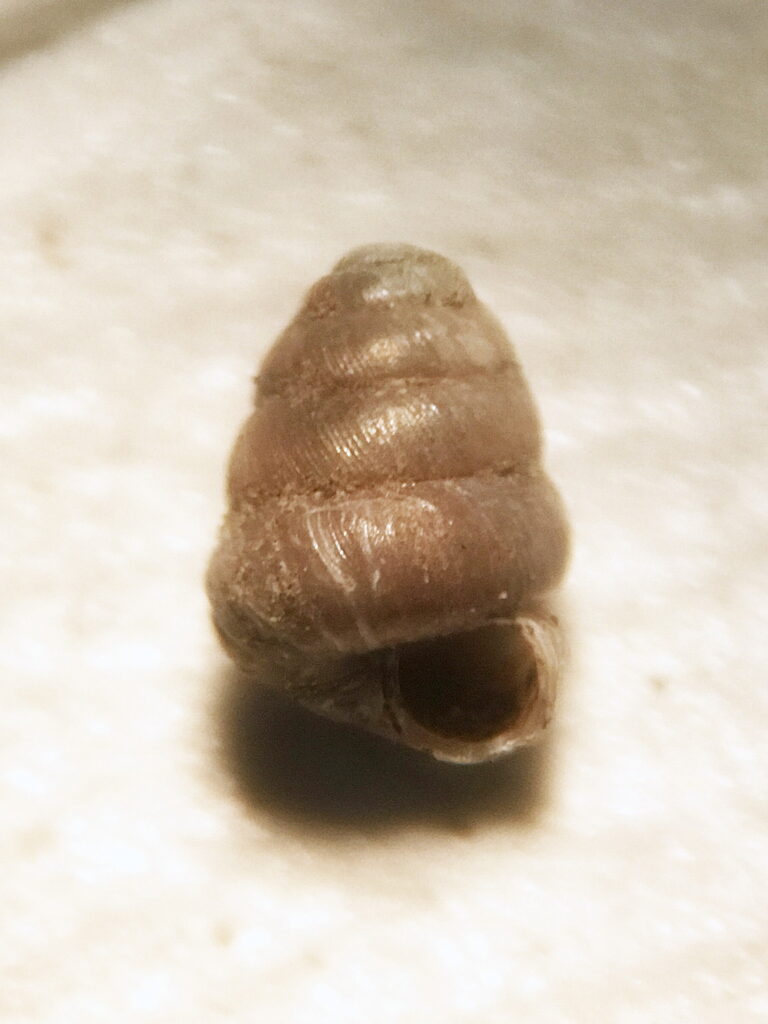


Image Usage Information
Family: Vertiginidae
Common name:
Discovery: Gould, 1840
Identification
Height: ~2.1 mm
Width: ~1.1 mm
Whorls: 5-7
Columella simplex appears similar to immature Vertigo with its small, brown shells that are considerably taller than they are wide but which lack apertural lamellae. Adult shells are most easily distinguished from immature Vertigo by possessing at least 5 whorls. Immature Columella with fewer whorls in many cases cannot be distinguished from immature Vertigo.
Columella “simplex” encompasses such a large variation of shell sizes, shapes, and shell surface sculptures that Pilsbry (1948), Oughton (1948), Hubricht (1985) and Nekola & Coles (2010) all suggest this name likely refers to a several-species complex. Large forms in this complex that occur on limestone outcrops across the central and eastern states (Nekola, 2004) have been commonly confused with Columella columella in the southwestern USA (Bequaert and Miller, 1973; Metcalf and Smartt, 1997).
Ecology
Across its range, C. simplex, as currently defined, is found in a wide variety of forested and open habitats, varying from subtropical to taiga, xeric to wet, and acidic to calcareous. In the north it is commonly found climbing on ferns and other herbaceous vegetation, up to a meter above the ground (in such situations leaf litter sieving underestimates population size). In the south, however, it most commonly occurs in leaf litter accumulations.
Taxonomy
Synonyms for this animal’s name include Pupa simplex and Columella edentula.
Distribution
Columella simplex, as currently defined, ranges from central Quebec and Labrador south to southern Alabama and Mississippi west to southern New Mexico and Arizona north to central Ontario, Manitoba, and Alberta and Anchorage, Alaska along the Pacific coast (Oughton, 1948; Nekola & Coles, 2010).
In Virginia, this species has been observed from across most of the state. Although not currently reported from the southeastern counties, its presence in the adjacent coastal plain of North Carolina suggests that it is present but simply overlooked in this region.
Conservation
NatureServe Global Rank: G5Q, Secure.
