• Skip to primary navigation
  • Skip to main content
  • Skip to primary sidebar

Carnegie Museum of Natural History

One of the Four Carnegie Museums of Pittsburgh

  • Visit
    • Buy Tickets
    • Visitor Information
    • Exhibitions
    • Events
    • Dining at the Museum
    • Celebrate at the Museum
    • Powdermill Nature Reserve
    • Event Venue Rental
  • Learn
    • Field Trips
    • Educator Information
    • Programs at the Museum
    • Bring the Museum to You
    • Guided Programs FAQ
    • Programs Online
    • Climate and Rural Systems Partnership
  • Research
    • Scientific Sections
    • Science Stories
    • Science Videos
    • Senior Science & Research Staff
    • Museum Library
    • Science Seminars
    • Scientific Publications
    • Specimen and Artifact Identification
  • About
    • Mission & Commitments
    • Directors Team
    • Museum History
  • Tickets
  • Give
  • Shop

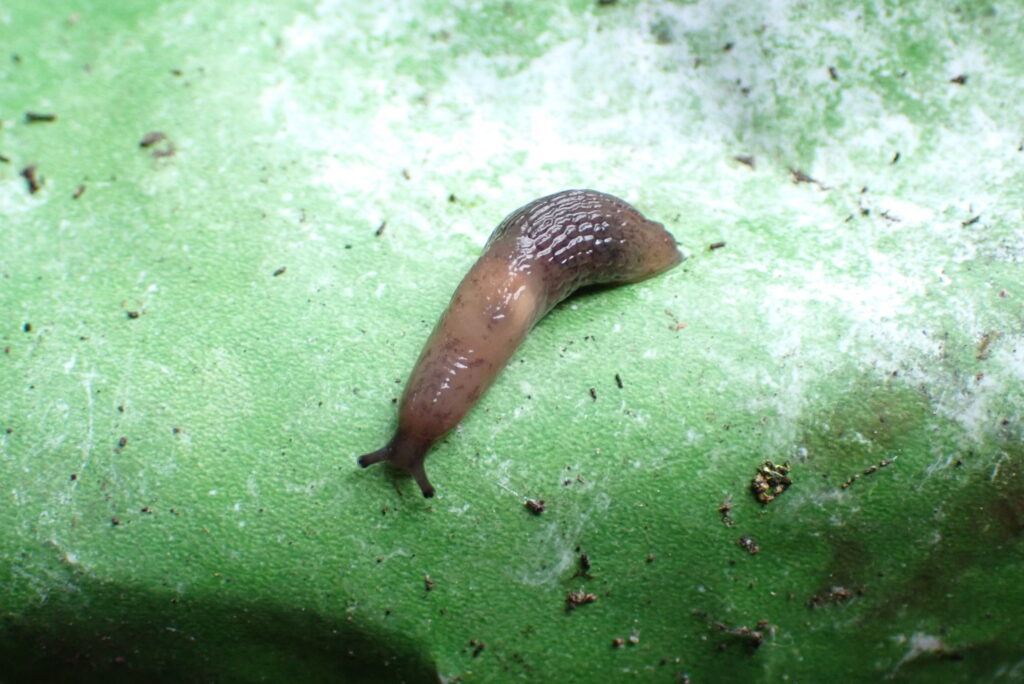
Deroceras invadens

Superior view of tramp snail with elongated mantle section, darker keel
Superior view of tramp snail with compacted mantle, in movement

Image Usage Information

  • Terry
  • CC BY-NC 4.0 DEED
  • Additional information about this specimen

Family: Agriolimacidae

Common name: Tramp snail

Discovery: Reise, Hutchinson, Schunack & Schlitt, 2011

Introduced Species

Identification

Length: 20-35 mm

Deroceras invadens adults are usually 20–35 mm long and vary from light greyish-brown to almost black. (Reise et al. 2011). The skin and flesh are fairly transparent, with a watery, colorless mucus (Reise et al. 2006). The respiratory pore is often, but not always, pale.

Deroceras invadens can closely resemble some native Deroceras laeve, but they can usually be separated by the shape of the tail when the slug is disturbed (Reise et al. 2006). In profile, the end of the tail of D. invadens usually slants vertically upward or even backward for a short distance from the sole, while the tail of Deroceras laeve slopes forward above the sole.

Internally, D. invadens has a penis that is divided into two massive lobes, with 4-6 fingerlike projections in the valley between the lobes (Reise et al. 2011; Forsyth 2014), while D. laeve has a different penis lacking fingerlike projections.

Ecology

This species typically occurs in disturbed areas. It prefers habitats with high humidity and cannot survive at temperatures below –7°C. It can be a major pest in gardens, greenhouses, and pasture (Barker 2002).

Taxonomy

Deroceras invadens is a global “tramp” species native to Europe. In North America, until recently this animal had been incorrectly called D. panormitanum or D. caruanae.

Distribution

Not yet reported from Virginia, D. invadens has been documented outside of greenhouses in adjacent Washington DC, as well as in Newfoundland, and inside of greenhouses in Quebec (Reise et al. 2006; Forsyth 2014). It is probably much more widely distributed than these reports suggest.

Conservation

NatureServe Global Rank: G5, Secure.

Author: Tim Pearce
Publication date: 2/2014

sidebar

About

  • Mission & Commitments
  • Directors Team
  • Museum History

Get Involved

  • Volunteer
  • Membership
  • Carnegie Discoverers
  • Donate
  • Employment
  • Events

Bring a Group

  • Groups of 10 or More
  • Birthday Parties at the Museum
  • Field Trips

Powdermill

  • Powdermill Nature Reserve
  • Powdermill Field Trips
  • Powdermill Staff
  • Research at Powdermill

More Information

  • Image Permission Requests
  • Science Stories
  • Accessibility
  • Shopping Cart
  • Contact
  • Visitor Policies
One of the Four Carnegie Museums | © Carnegie Institute | Privacy Policy | Terms of Use | Accessibility
Rad works here logo
