Image Usage Information
Family: Agriolimacidae
Common name: Meadow Slug
Discovery: Müller, 1774
Identification
Length: 10-25 mm
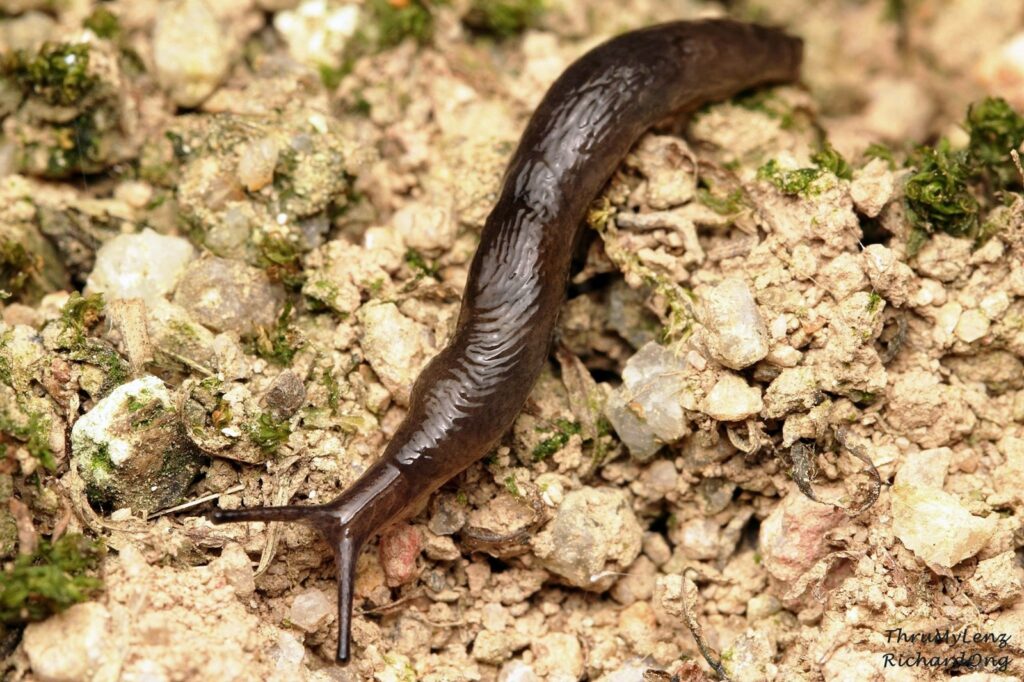
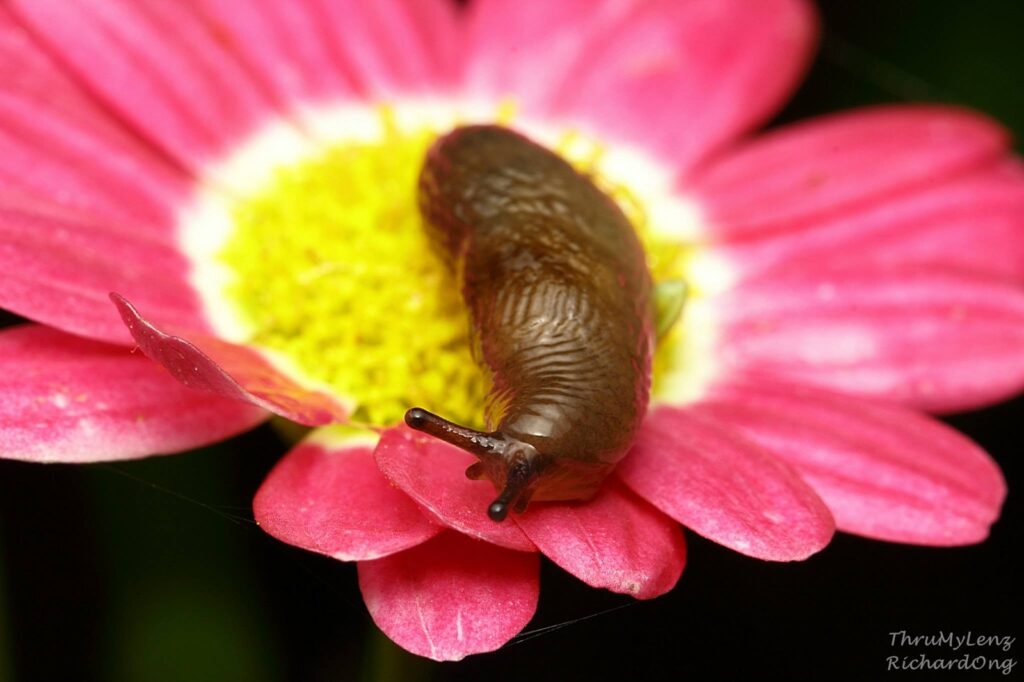
This small slug has a short mantle covering its upper surface toward the head, and a keeled tail. Its mantle has concentric furrows that create a “fingerprint” pattern, while mucous channels on the tail are generally longitudinal. The color of this animal varies greatly by population, often gray, brown, reddish, or black. The foot is light-colored and the slime clear and watery. Rather than being a sleek oval shape, its body sometimes appears a bit irregular or “lumpy” beneath the mantle.
Ecology
Deroceras laeve is often found in open areas (Hubricht, 1985) – back yards, fields, shrublands, young woods, or developed lands. In the north it can be found in alder swamps and more-established mesic forests. In winter this small slug changes its physiology to survive, its glucose content increasing 100 times, probably to prevent freezing (Storey et al., 2007). Other chemical changes suggest a switch to anaerobic metabolism in winter.
There are two sciomyzid flies that parasite only newly-hatched Deroceras species – Tetanocera plebeja and T. valida (Trelka and Foote, 1970).
Deroceras laeve can sometimes be a greenhouse or garden pest. The mollscicide methiocarb 2% was best for preventing D. laeve from eating strawberries in Manitoba, but was ineffective during reproductive bursts (Prystupa et al., 1987).
Taxonomy
Synonyms for D. laeve are many, and include Agriolimax campestris, A. hemphilli ashmuni, Limax laevis, L. gracilis, L. campestris, L. weinlandi, L. montanus, L. castaneus, L. hyperboreas, and L. hemphilli.
Distribution
Deroceras laeve is holarctic, and in the East lives from Hudson Bay, Canada to Central America (Pilsbry, 1948). While some North American populations are ancient, others may be more recently introduced from Europe. Records of this species may be confused with the invasive slug Deroceras invadens.
Conservation
NatureServe Global Rank: G5, Secure
Publication date: 12/2012, Updated 2/2018
