Image Usage Information

Image Usage Information
Family: Agriolimacidae
Common name: Gray Fieldslug
Discovery: Müller, 1774
Non-native
Identification
Length: 35-50 mm
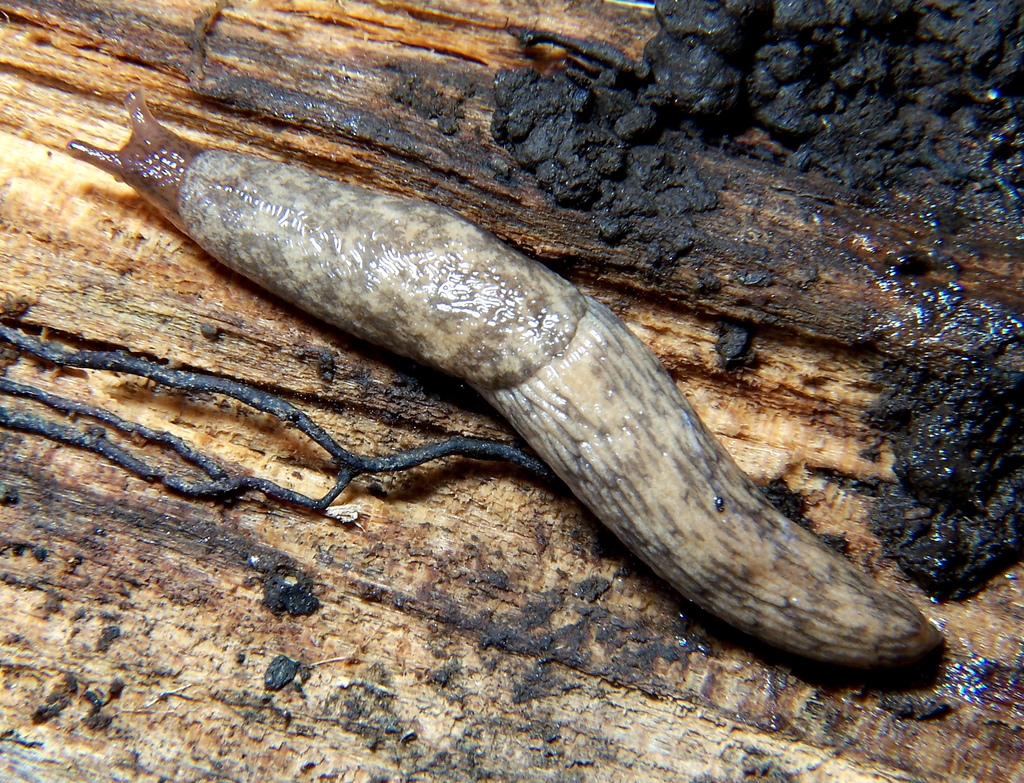
This pale slug has a keeled tail like others of its genus. Its mantle has concentric furrows that create a “fingerprint” pattern, while mucous channels on the tail run lengthwise. Its color above is white, cream, gray, or tan, with gray or black markings, darker tentacles, and a pale foot. The mucus is clear, becoming milky and thick if disturbed. The mantle covers approximately half of the slug’s length.
Ecology
It is often found in gardens and fields, and is a pest of commercial crops such as cauliflower, cabbage, potato, and others (Pilsbry, 1948). It also eats mushrooms, dead slugs, or earthworms. This species may reproduce throughout the warmer months, but more in the late summer and fall in the Northeast (Chichester & Getz, 1979).
A mating pair of slugs conducts a circular “nuptial dance” in which they follow each other and move their sarcobelum, a stimulating organ everted from the reproductive tract, over their partner’s body (Chichester & Getz, 1979). Mating occurs after 30 minutes or more. Eggs may number several dozen and hatch in 3-4 weeks. Adults die in the fall, so most D. reticulatum overwintering are new hatchlings.
Taxonomy
Synonyms for D. reticulatum include Agriolimax reticulatus, A. agrestis, Deroceras agreste, Limax reticulatus, L. agrestis, and L. tunicata.
Distribution
Deroceras reticulatum is a European native that has been introduced into North America. This slug is found in most of southern Canada and the northern United States (NatureServe, 2013). In Virginia it is reported from scattered locations – Northampton County as well as counties to the north and west.
Conservation
NatureServe Global Rank: G5, Secure.
Publication date: 1/2013
