
Image Usage Information
Family: Helicidae
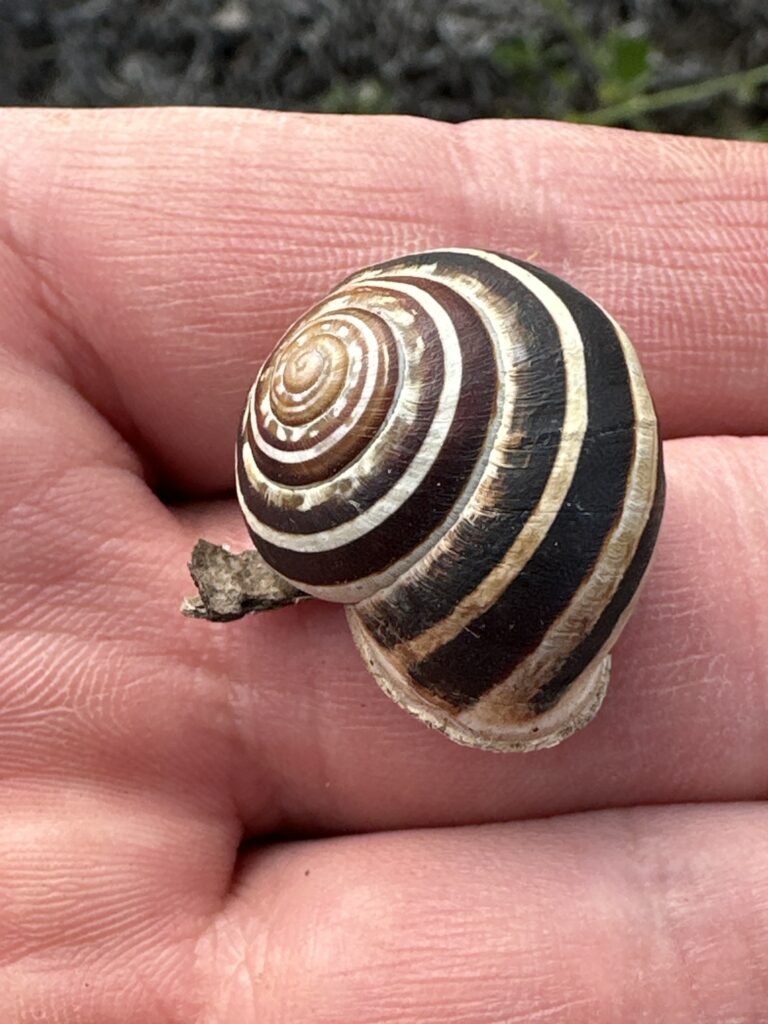
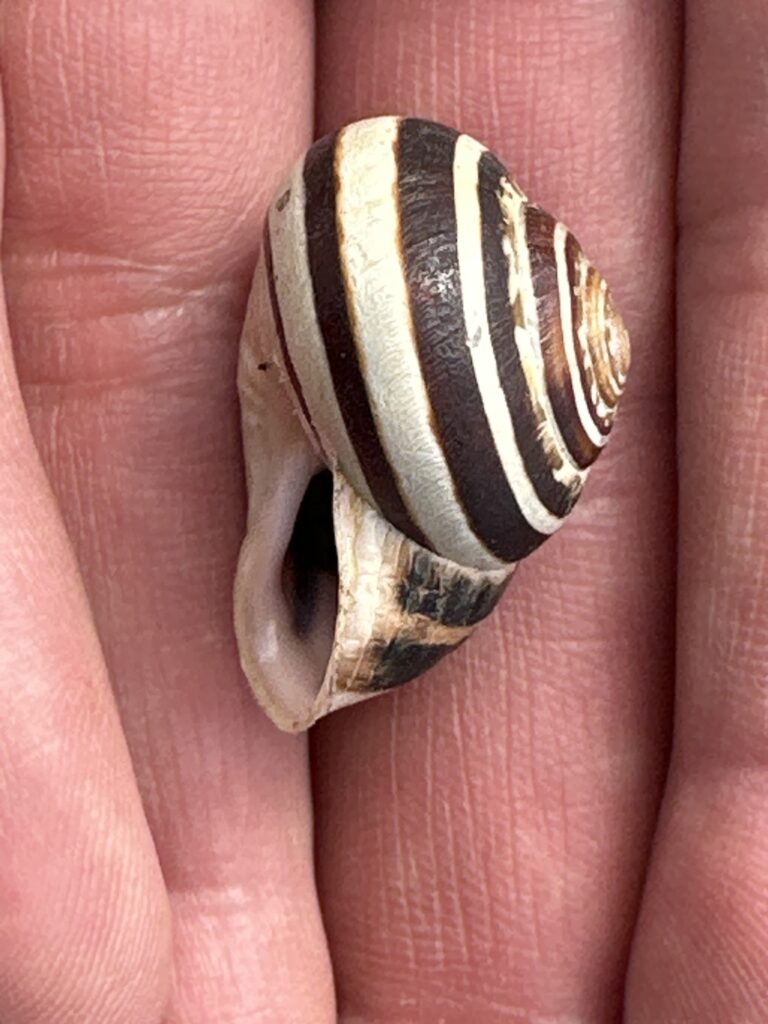
Common name: Chocolate-band Snail
Discovery: Müller, 1774
Non-native
Identification
Width: 22-30 mm
Height: 14-27 mm
Whorls: 5-6
This large edible Mediterranean snail has a thick, off-white shell with 1-5 brown bands. These bands vary in contrast and can be somewhat reticulated with white. The aperture lip is reflected, and the umbilicus closed. The surface is sculptured with growth wrinkles. The animal is grayish-brown, lighter below.
Ecology
Eobania vermiculata is found in fields, hedgerows, gardens, and vineyards (Kerney and Cameron, 1979). It climbs vegetation and fences to aestivate in hot daytime weather (Yildirim et al., 2004). Work in Greece found 75% of these snails laid eggs in their second year and died the following spring, while a few snails laid eggs into their third and fourth years (Lazaridou-Dimitriadou and Kattoulas, 1990). Mean clutch size was initially 70 but dropped to 30 in later years. Growth rates were highest in juveniles, and in periods of damp weather, especially after winter hibernation (Lazaridou-Dimitriadou and Kattoulas, 1990).
Due to factors such as invasion history and potential economic impact, E. vermiculata has been identified as having potential major pest significance in the United States (Cowie et al., 2009).
Taxonomy
Although putative Croatian subspecies from oceanic islands can be much smaller, this may be due solely to ecological differences rather than genetic uniqueness (Rađa et al., 2012). This species has also been known as Otala vermiculata (Pilsbry, 1939).
Distribution
There are museum records for this edible snail in various locations in the US urban East, West, and South.
Conservation
NatureServe Global Rank: G5, Secure.
