• Skip to primary navigation
  • Skip to main content
  • Skip to primary sidebar

Carnegie Museum of Natural History

One of the Four Carnegie Museums of Pittsburgh

  • Visit
    • Buy Tickets
    • Visitor Information
    • Exhibitions
    • Events
    • Dining at the Museum
    • Celebrate at the Museum
    • Powdermill Nature Reserve
    • Event Venue Rental
  • Learn
    • Field Trips
    • Educator Information
    • Programs at the Museum
    • Bring the Museum to You
    • Guided Programs FAQ
    • Programs Online
    • Climate and Rural Systems Partnership
  • Research
    • Scientific Sections
    • Science Stories
    • Science Videos
    • Senior Science & Research Staff
    • Museum Library
    • Science Seminars
    • Scientific Publications
    • Specimen and Artifact Identification
  • About
    • Mission & Commitments
    • Directors Team
    • Museum History
  • Tickets
  • Give
  • Shop

Euchemotrema fraternum

Image Usage Information

  • David Lang
  • CC BY-NC 4.0 DEED
  • Additional information about this specimen

Family: Polygyridae

Common name: Upland Pillsnail

Discovery: Say, 1824

Identification

Width: 9.0 -10.5 mm
Height: 5-7 mm
Whorls: 5+

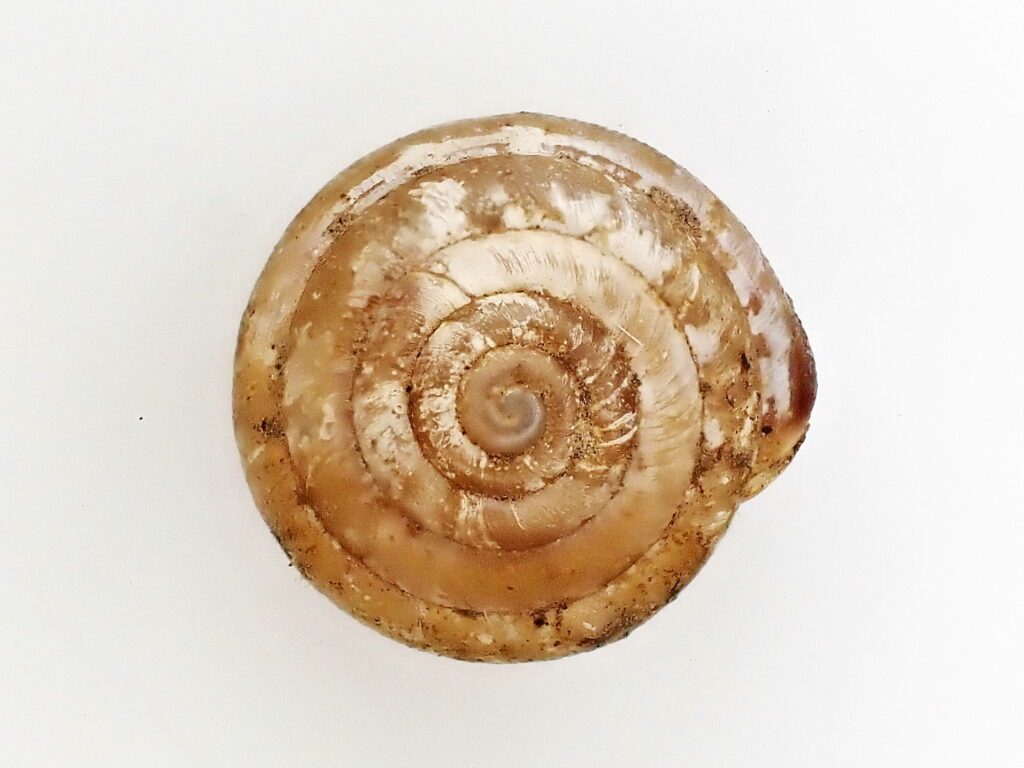
Euchemotrema fraternum is well-protected against predators, with a thick, round-ish, crush-resistant shell, and a narrow aperture. The shell is covered with fine bristles that may help to camouflage it with a dull, non-reflective texture, and by trapping dust and cobwebs. The aperture holds a single blade-like tooth, or lamella. The reflected lip nearly covers the umbilicus. Live Euchemotrema fraternum are dark brown or dark gray above.

This species is distinguished from E. leai by being more densely hairy, and by having a slit-like umbilicus, while the umbilicus of E. leai is approximately half to two-thirds covered.

Ecology

This animal inhabits relatively higher sites than its close relative Euchemotrema leai. It is a good climber for its small size, sometimes found on maple or beech trunks. It is most often encountered in leaf litter and log debris, and usually at low densities.

Taxonomy

Euchemotrema fraternum has also been known as Helix fraterna, H. convexa, H. monodon, Polygyra fraterna, P. f. var. albida, P. monodon fraternal, and S. monodon.

Distribution

Euchemotrema fraternum occurs from the Midwest and Middle Atlantic states, north to Minnesota and the Canadian Maritimes and south to Louisiana and Mississippi (Hubricht, 1985). In Virginia it is found in western and northern counties.

Conservation

NatureServe Global Rank: G5
In northern Maine this species seems to have declined significantly over the past century and is now uncommon (Nikola, 2008; Hotopp, pers. obs.).

sidebar

About

  • Mission & Commitments
  • Directors Team
  • Museum History

Get Involved

  • Volunteer
  • Membership
  • Carnegie Discoverers
  • Donate
  • Employment
  • Events

Bring a Group

  • Groups of 10 or More
  • Birthday Parties at the Museum
  • Field Trips

Powdermill

  • Powdermill Nature Reserve
  • Powdermill Field Trips
  • Powdermill Staff
  • Research at Powdermill

More Information

  • Image Permission Requests
  • Science Stories
  • Accessibility
  • Shopping Cart
  • Contact
  • Visitor Policies
One of the Four Carnegie Museums | © Carnegie Institute | Privacy Policy | Terms of Use | Accessibility
Rad works here logo