


Image Usage Information
Family: Euconulidae
Common name: Wild Hive
Discovery: Say, 1821
Identification
Width: 2.4-3.0 mm
Height: 2.2-3.5 mm
Whorls: 6-8
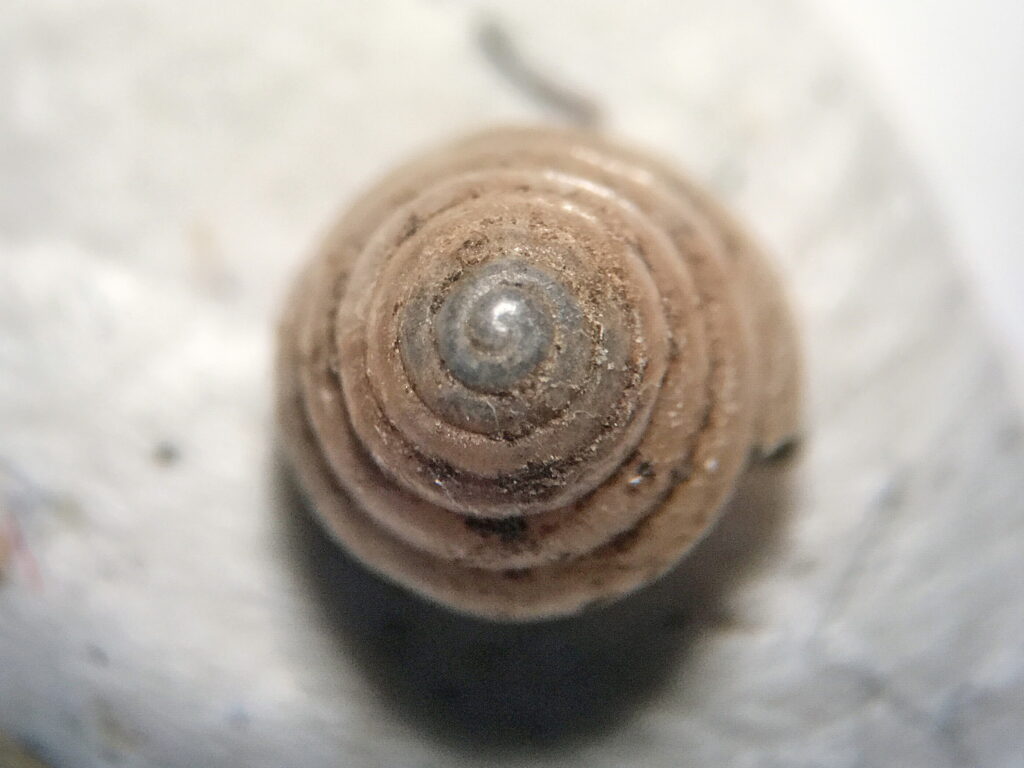
The shell of Euconulus chersinus is beehive-shaped, with a thin lip and closed umbilicus. The cross-hatched, fine radial and spiral striae give the shell surface a matte finish, rather than very glossy. Adult specimens are relatively taller than other Euconulus species. There are no internal teeth.
Recent genetics work suggests that shell characters may no longer be useful in distinguising between species in the group of nominal E. chersinus, E. dentatus, and E. trochulus (J.C. Nekola, pers. comm.).
Ecology
Euconulus chersinus can be found in moist leaf litter on wooded hillsides and steep valleys (Hubricht, 1985; Dourson, 2010).
Taxonomy
Taxonomy of the genus Euconulus is in a state of flux. Recent genetics research shows that Euconulus chersinus is part of a group of nominal species that also includes E. dentatus and E. trochulus (J.C. Nekola, pers. comm.). Previous shell morphology guidelines may no longer be useful to distinguish between the members of this group.
Synonyms for E. chersinus include Helix chersina and Conulus chersinus.
Distribution
This animal is found in the Southeast as far west as the Mississippi River (Hubricht, 1985). It is unclear to what extent Euconulus chersinus is found in Virginia – Hubricht (1985) did not report it in the state. It does occur in several counties of neighboring Kentucky (Dourson, 2010). Here we map the museum specimen records, but because beehive snails are difficult to identify there are undoubtedly some mistaken reports.
Conservation
NatureServe Global Rank: G5, Secure (pending taxonomic revision).
NatureServe State Rank: not ranked
