• Skip to primary navigation
  • Skip to main content
  • Skip to primary sidebar

Carnegie Museum of Natural History

One of the Four Carnegie Museums of Pittsburgh

  • Visit
    • Buy Tickets
    • Visitor Information
    • Exhibitions
    • Events
    • Dining at the Museum
    • Celebrate at the Museum
    • Powdermill Nature Reserve
    • Event Venue Rental
  • Learn
    • Field Trips
    • Educator Information
    • Programs at the Museum
    • Bring the Museum to You
    • Guided Programs FAQ
    • Programs Online
    • Climate and Rural Systems Partnership
  • Research
    • Scientific Sections
    • Science Stories
    • Science Videos
    • Senior Science & Research Staff
    • Museum Library
    • Science Seminars
    • Scientific Publications
    • Specimen and Artifact Identification
  • About
    • Mission & Commitments
    • Directors Team
    • Museum History
  • Tickets
  • Give
  • Shop

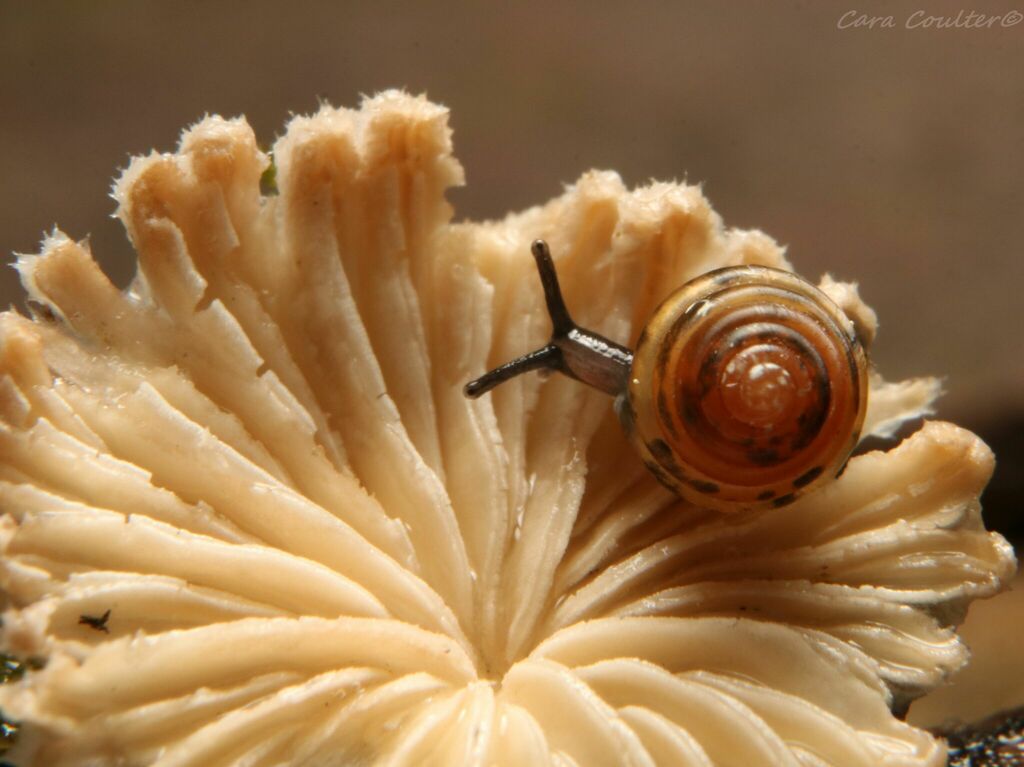
Euconulus polygyratus

Image Usage Information

  • Cara Coulter
  • CC BY-NC 4.0 DEED
  • Additional information about this specimen

Family: Euconulidae

Common name: Fat Hive

Discovery: Pilsbry, 1899

Identification

Width: 2.7-3.4 mm
Height: 2.3-2.8 mm
Whorls: 6+

The shell of Euconulus polygyratus is stout and wide, globosely conic, with tight whorls and a simple lip (Pilsbry, 1946). The shell is amber to brown with a silky surface texture. The final whorl of adult shells is well-rounded, while immature shells are more angular and difficult to identify. The shell is more tightly whorled, rounder and less glossy than E. fulvus, and relatively wider than E. chersinus.

Ecology

Euconulus polygyratus is a litter-dweller like its congeners. In northern Maine it is sparsely distributed but appears to favor habitats richer in calcium (from Nekola, 2008).

Taxonomy

Taxonomy of the Euconulus is in a state of flux. Genetics work in progress suggests E. polygyratus is a unique species (J.C. Nekola, pers. comm. 2/26/2018). Synonyms for E. polygyratus include E. chersinus polygyratus and Conulus chersinus polygyratus (Pilsbry, 1946).

Distribution

Euconulus polygyratus is found across the upper Midwest of the United States and Canada, east to New England and the Canadian Maritimes, and south in the Appalachian Mountains. It appears to be mistakenly identified as E. fulvus by Hubricht (1985) in the region’s southernmost states (J.C. Nekola, pers. comm. 2/26/2018).

Conservation

NatureServe Global Rank: G5, Secure.

sidebar

About

  • Mission & Commitments
  • Directors Team
  • Museum History

Get Involved

  • Volunteer
  • Membership
  • Carnegie Discoverers
  • Donate
  • Employment
  • Events

Bring a Group

  • Groups of 10 or More
  • Birthday Parties at the Museum
  • Field Trips

Powdermill

  • Powdermill Nature Reserve
  • Powdermill Field Trips
  • Powdermill Staff
  • Research at Powdermill

More Information

  • Image Permission Requests
  • Science Stories
  • Accessibility
  • Shopping Cart
  • Contact
  • Visitor Policies
One of the Four Carnegie Museums | © Carnegie Institute | Privacy Policy | Terms of Use | Accessibility
Rad works here logo