

Image Usage Information
Family: Gastrocoptidae
Common name: Slim Snaggletooth
Discovery: Pfeiffer, 1841
Identification
Height: ~2.1 mm
Width: ~0.9 mm
Whorls: 5
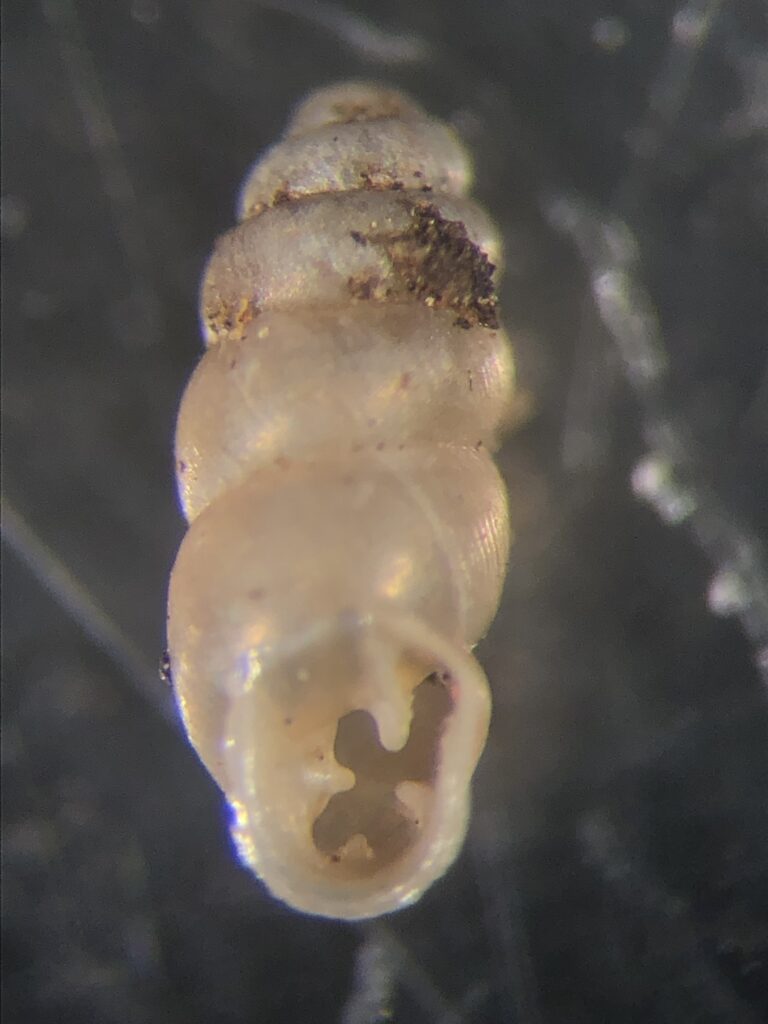
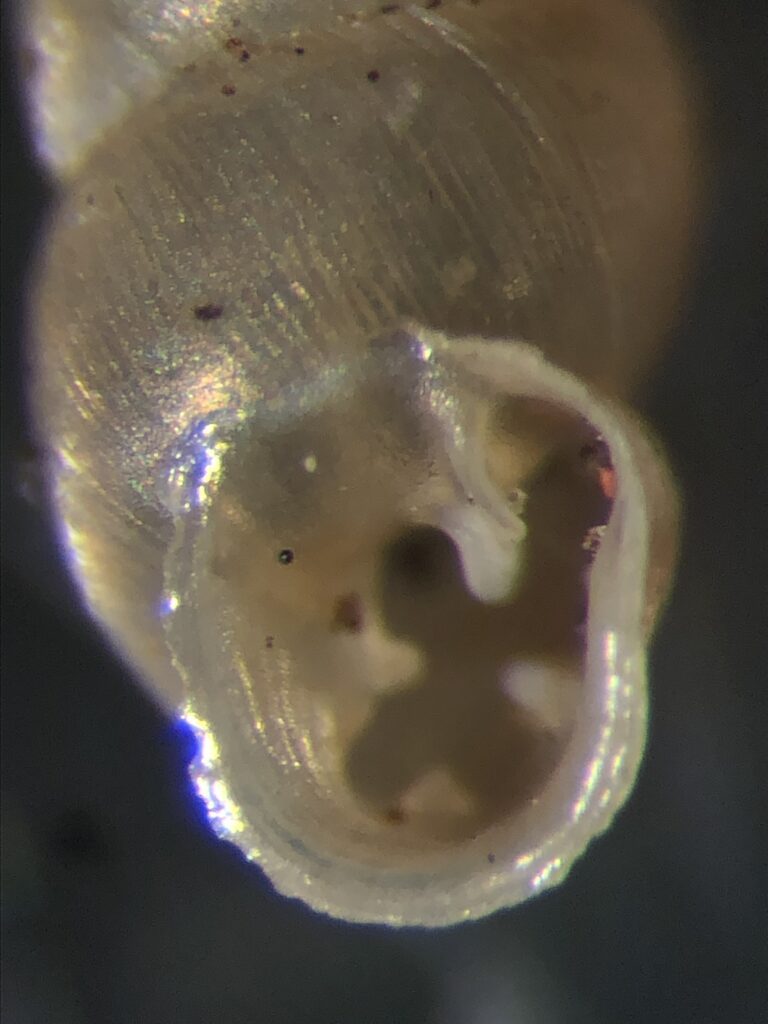
This animal is relatively small compared to its close relatives (less than 2.25 mm tall) and lacks a calcified thickening on the outside (palatal) wall of the aperture. Its shell color is a pale yellow-brown.
Ecology
In the southern Plains and desert Southwest, its populations are most often found in leaf litter accumulations under juniper and among grass tufts on xeric bedrock outcrops and riparian sand deposits. It is one of the most arid-tolerant snails of the desert, being found throughout southern Arizona and New Mexico in litter accumulations under low juniper, palo verde, or mesquite scrub (Bequaert & Miller, 1973; Metcalf & Smartt, 1997). Along the Gulf Coast, individuals occur in open woodlands, parklands, roadsides, and lawns (Nekola & Coles, 2010).
Taxonomy
Synonyms for this animal’s name include Pupa hordeacella, Bifidaria pellucida hordeacella, Gastrocopta pellucida hordeacella.
Distribution
Gastrocopta pellucida is primarily a southern species that is probably introduced in Virginia. It ranges from peninsular Florida west across the southern Gulf Coast to central Oklahoma, western Utah, and southern California. It occurs sporadically up the Atlantic Seaboard to Cape May, New Jersey and also extends south into the West Indies and Baja California and Tampico in Mexico (Pilsbry, 1948). Like G. cristata, its disjunct occurrence along the middle Atlantic seaboard may represent a recent range expansion related to human activities.
Although reported in New Jersey, we did not find specimen records.
Conservation
NatureServe Global Rank: G5, Secure.
NatureServe State Rank: Virginia, S1S3, Imperiled; New Jersey, S2S3, Imperiled. Not ranked in Maryland or Delaware.
Virginia’s wildlife action plan: Tier IV
