
Image Usage Information
Family: Gastrocoptidae
Common name: Comb Snaggletooth
Discovery: Say, 1822
Identification
Height: ~1.8 mm tall
Width: ~0.9 mm
Whorls: 5
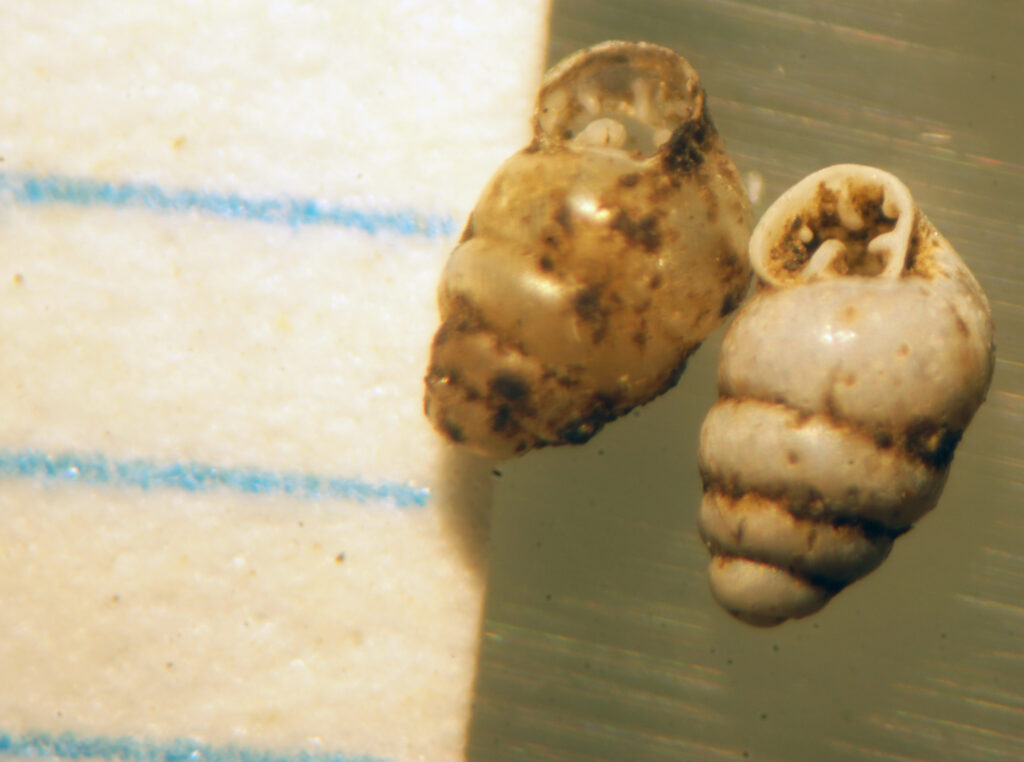
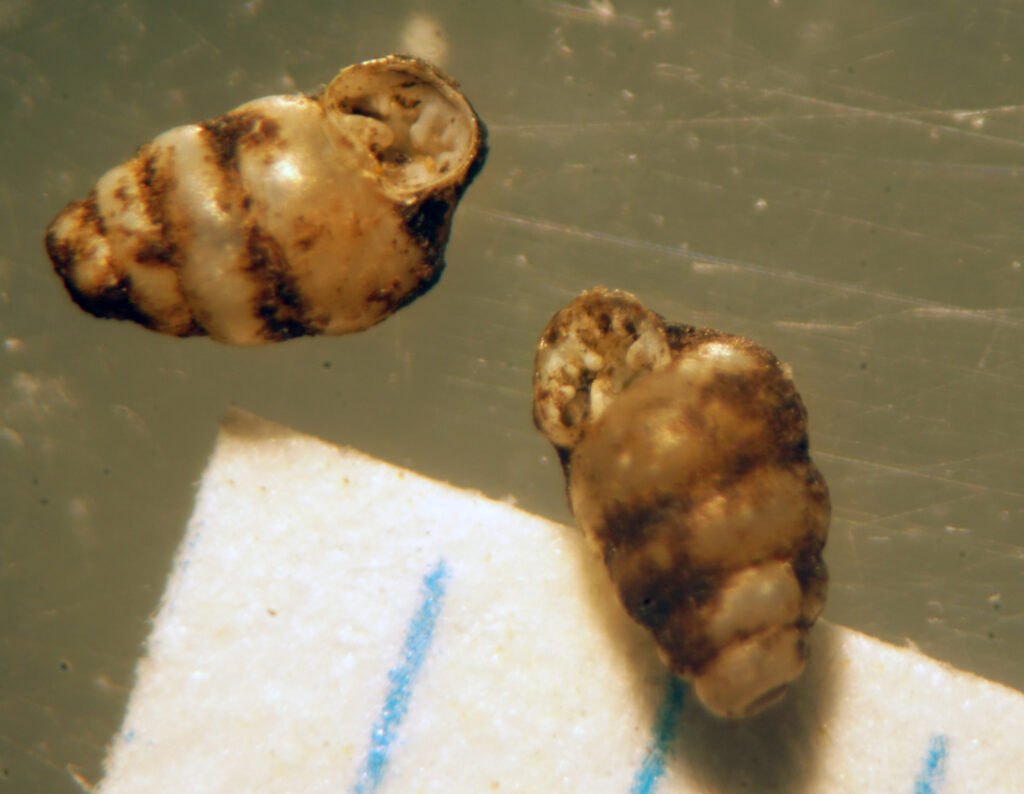
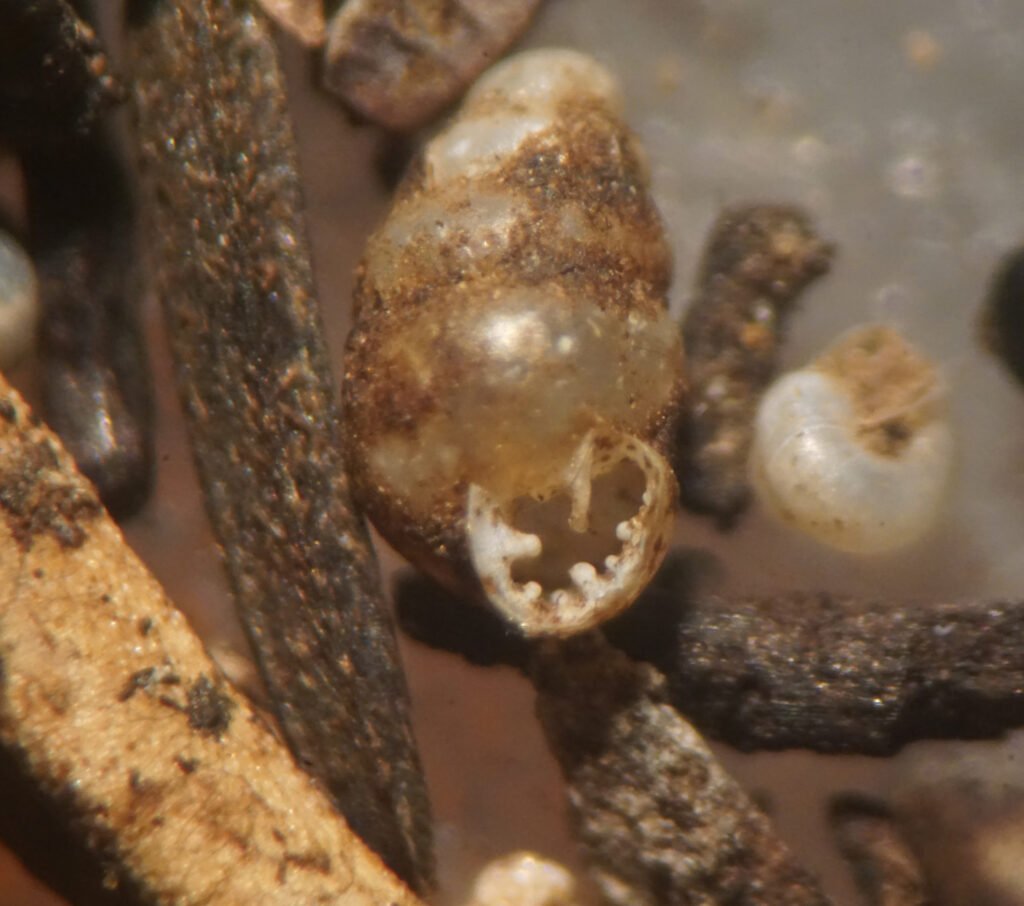
This species and its cousin Gastrocopta tappaniana differ from all other Virginia pupillid land snails by having a small (less than 2 mm) white-clear shell with a simple, peg-shaped angulo-parietal lamella at the top of the aperture. The number of other teeth in the aperture may vary. Gastrocopta pentodon shells can be distinguished from G. tappaniana by being relatively skinny – having a shell height/width ratio of at least 1.5.
Ecology
Gastrocopta pentodon is found in varied habitats over a huge area. It occurs in leaf litter accumulations in habitats that range from rich to acidic, dry to damp, and open to forested. Its habitats include sand savanna, carbonate cliffs, bedrock glades, tallgrass prairie, high elevation heath “balds,” and mesic upland forests (Nekola & Coles, 2010).
Taxonomy
Some authors have claimed that G. pentodon and G. tappaniana are simply a single species, with differences owing to different habitat conditions (e.g. Bequaert & Miller, 1973; Metcalf & Smartt, 1997). However, recent shell shape (Pearce et al., 2007) and genetic (Nekola et al., 2012) analyses show that these are separate species. Also, the presence of unique shell shapes in eastern North American specimens makes it possible that Gastrocopta pentodon will ultimately be shown to be a species complex.
Synonyms for this animal’s name include Vertigo pentodon, Pupa pentodon, Bifidaria pentodon, Gastrocopta carnegiei.
Distribution
Gastrocopta pentodon lives across most of eastern North America, from west Texas and extreme northeastern New Mexico to eastern Kansas and southern Manitoba, east to northern Maine and Miami, Florida (Nekola & Coles, 2010). It also ranges south across eastern Mexico to Guatemala (Pilsbry, 1948).
In Virginia this animal has been reported from most of the state. While not currently known from the Piedmont, this gap is almost certainly due to being overlooked, as it occurs in adjacent areas of Maryland and North Carolina.
Conservation
NatureServe Global Rank: G5, Secure.
