Image Usage Information
Family: Gastrocoptidae
Common name: Great Lakes Snaggletooth
Discovery: Sterki, 1909
Identification
Height: ~3.7 mm
Width: ~1.8 mm
Whorls: 6-7
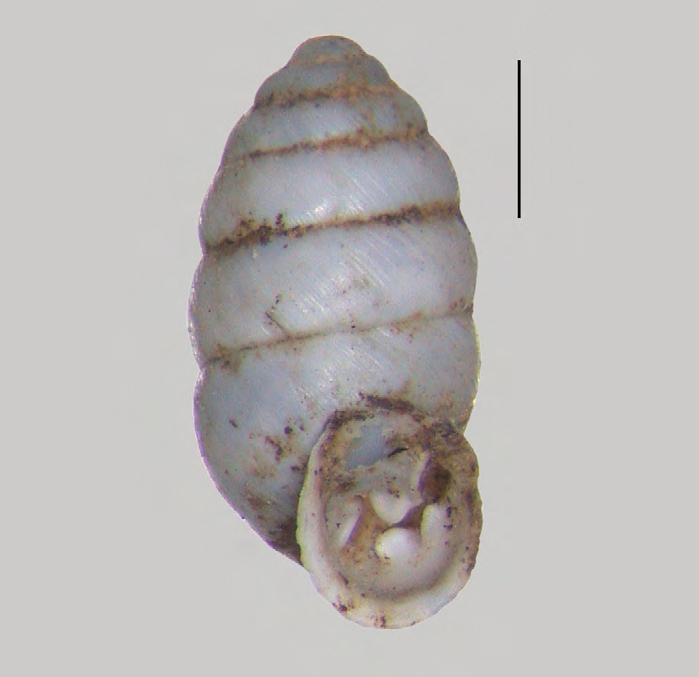
This species, along with Gastrocopta armifera and Gastrocopta clappi are distinguished from all other pupillid land snails by their tall, white-clear shells that are at least 3.5 mm tall. It is separated from G. armifera by possessing a vertical, sheet-like columellar lamella rather than a pyramidal structure. Its shell is also shorter and more slender. It is separated from G. clappi by having a larger, plate-like columellar lamella that is essentially vertical in placement, while in G. clappi this feature is strongly sloped towards the aperture mouth. Additionally, the lower palatal lamella in G. similis is stouter and more deeply inserted than in either G. armifera or G. clappi.
Ecology
Gastrocopta similis is found under stones, on bare soil, soil-covered cliff ledges and in decomposed grass thatch and red cedar litter accumulations across a wide variety of habitats ranging from xeric grasslands to mesic forest and fens. However, it is most frequently encountered in dry, gravelly prairie and bedrock glades.
In Virginia, this species is known from only a single dry, east-facing limestone cliff along the Maury River. This is 350-400 miles from the nearest sites in its primary range, in southwestern Indiana, northwestern Ohio, and New York State. At the Virginia site it co-occurs with abundant Gastrocopta armifera.
Taxonomy
Gastrocopta similis is the characteristic member of the subgenus Albinula in the upper Midwest. Individuals in Virginia possess a small basal lamella, and have a columellar lamella shape slightly different from other observed Gastrocopta similis populations, so Virginia populations may warrant further taxonomic research.
Distribution
This animal ranges across the central and northern plains from northeastern Oklahoma to North Dakota and east through the Great Lakes to southern Quebec and upstate New York. It has recently been found near the Maury River in Rockbridge County, Virginia.
Conservation
Global Rank: G5, Secure.
