• Skip to primary navigation
  • Skip to main content
  • Skip to primary sidebar

Carnegie Museum of Natural History

One of the Four Carnegie Museums of Pittsburgh

  • Visit
    • Buy Tickets
    • Visitor Information
    • Exhibitions
    • Events
    • Dining at the Museum
    • Celebrate at the Museum
    • Powdermill Nature Reserve
    • Event Venue Rental
  • Learn
    • Field Trips
    • Educator Information
    • Programs at the Museum
    • Bring the Museum to You
    • Guided Programs FAQ
    • Programs Online
    • Climate and Rural Systems Partnership
  • Research
    • Scientific Sections
    • Science Stories
    • Science Videos
    • Senior Science & Research Staff
    • Museum Library
    • Science Seminars
    • Scientific Publications
    • Specimen and Artifact Identification
  • About
    • Mission & Commitments
    • Directors Team
    • Museum History
  • Tickets
  • Give
  • Shop

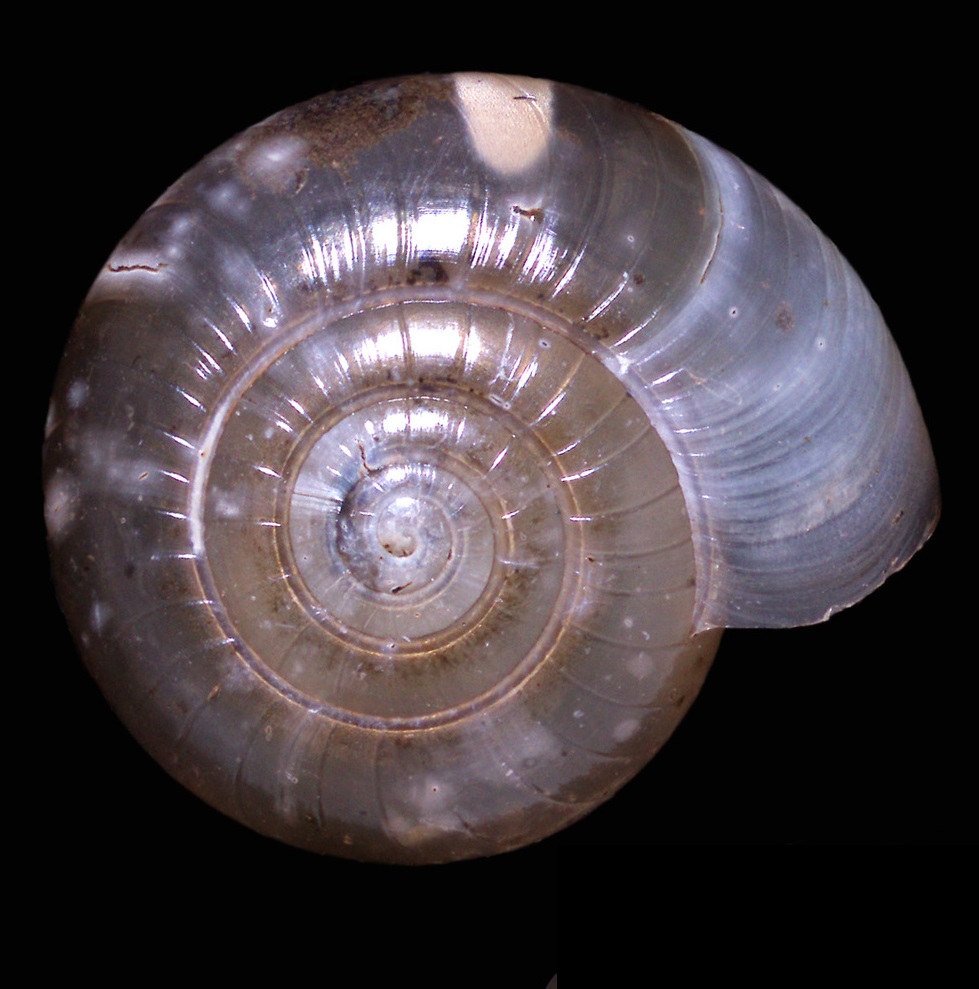
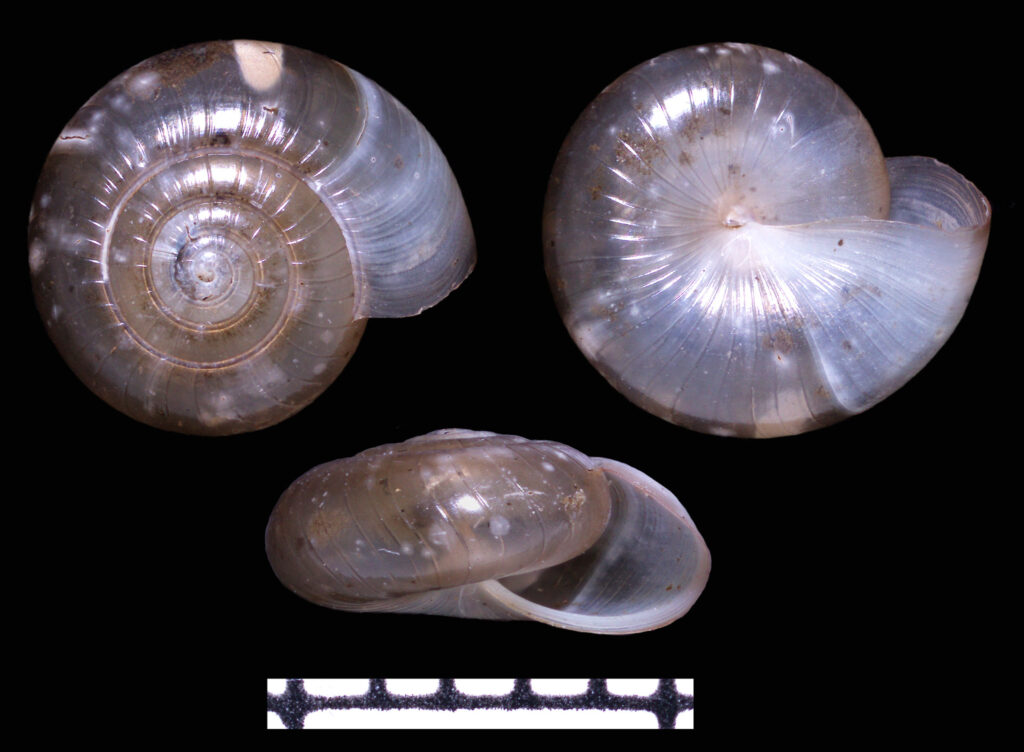
Glyphyalinia carolinensis

Image Usage Information

  • Waynevand
  • CC BY-NC 4.0 DEED
  • Additional information about this specimen

Family: Gastrodontidae

Common name: Spiral Mountain Glyph

Discovery: Cockerell, 1890

Identification

Width: 10-12 mm
Height: 4.4-5.5 mm
Whorls: 5.0-5.5

Glyphyalinia carolinensis is a very large glyph with a depressed shell that has moderately expanding whorls. The slightly expanding lip at the inner edge of the aperture nearly fills the umbilicus leaving only a small perforation. The shell is translucent light brown, sometimes tinged with hazel or pink. Whorls are sculptured with widely and uniformly spaced impressed lines that parallel the nearly imperceptible growth lines. This sculpture is strong apically and continues on the base diminishing near the umbilicus. The shell is also sculptured with spiral engraved lines that are visible with magnification. The dorsal surface of the animal is blue-grey.

Ecology

Glyphyalinia carolinensis is usually found in moist leaf litter on river bluffs and less often on mountainsides.  This species is found on neutral to calcareous soils and appears to be a calciphile (Nekola, 2010).

Taxonomy

This animal has also been called Zonites carolinensis, Z. caroliniensis, Vitrea carolinensis, Retinella carolinensis, and V. carolinensis var. wetherbyi.

Distribution

Glyphyalinia carolinensis ranges across the southern Appalachian Mountains from west-central Virginia to the North Carolina and Tennessee border. In Virginia the species is distributed from Rockbridge County to the southwest corner of the state.

Conservation

NatureServe Global Rank: G4, Apparently Secure.

sidebar

About

  • Mission & Commitments
  • Directors Team
  • Museum History

Get Involved

  • Volunteer
  • Membership
  • Carnegie Discoverers
  • Donate
  • Employment
  • Events

Bring a Group

  • Groups of 10 or More
  • Birthday Parties at the Museum
  • Field Trips

Powdermill

  • Powdermill Nature Reserve
  • Powdermill Field Trips
  • Powdermill Staff
  • Research at Powdermill

More Information

  • Image Permission Requests
  • Science Stories
  • Accessibility
  • Shopping Cart
  • Contact
  • Visitor Policies
One of the Four Carnegie Museums | © Carnegie Institute | Privacy Policy | Terms of Use | Accessibility
Rad works here logo