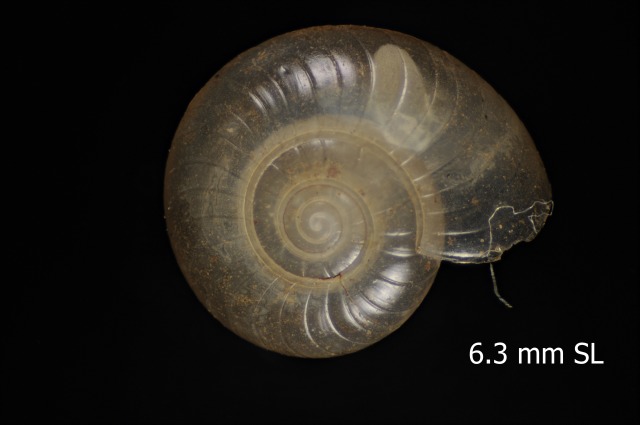


Image Usage Information
Family: Gastrodontidae
Common name: Brilliant Glyph
Discovery: H.B. Baker, 1930
Identification
Width: ~6.3 mm
Height: ~2.8 mm
Whorls: ~4.9
Glyphyalinia praecox is an average-sized glyph with a depressed, almost flat-spired, shell with gradually expanding whorls. The slightly expanding lip at the inner edge of the aperture nearly fills the umbilicus, leaving only a small perforation. The shell is translucent bronze colored, sometimes tinged with green. Whorls are sculptured with widely and uniformly spaced impressed lines that parallel the nearly imperceptible growth lines. This sculpture is strong above and continues to the umbilicus. Under magnification the shell is also sculptured with widely spaced but strong spiral engraved lines.
The dorsal surface of this animal is grayish, fading to yellowish-white. Internally, both the penial retractor muscle and epiphallus join the penis sub-apically and the apical chamber of the penis contains papillae that are not thorn-shaped.
Ecology
Glyphyalinia praecox is found in moist leaf litter in a wide variety of habitats including large river flood plains and talus piles near seepages. These habitats although varied are notable for being reliably moist. This is corroborated in Tennessee, where this species was significantly associated with medium to high soil moisture content, as well as leaf litter microhabitat (Coney et al, 1982).
Taxonomy
This species has also been known as Retinella praecox.
Distribution
This species is widely distributed from northwestern Virginia to near the Gulf Coast of Mississippi. In Virginia the species is reported from Highland County on the West Virginia border. Additional surveys are likely to add distribution records along much of the far western part of the state.
Conservation
NatureServe Global Rank: G4, Apparently Secure.
NatureServe State Rank: Virginia, S1S3, Imperiled. West Virginia, S1,Critically Imperiled.
Virginia’s wildlife action plan: Tier IV
