
Image Usage Information
Family: Gastrodontidae
Common name: Maryland Glyph
Discovery: Dall, 1898
Identification
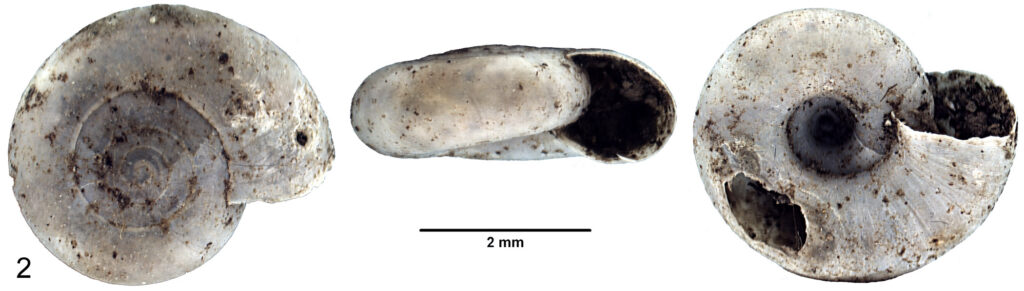
Width: 3.9-4.0 mm
Height: 1.7-1.8
Whorls: 4.5
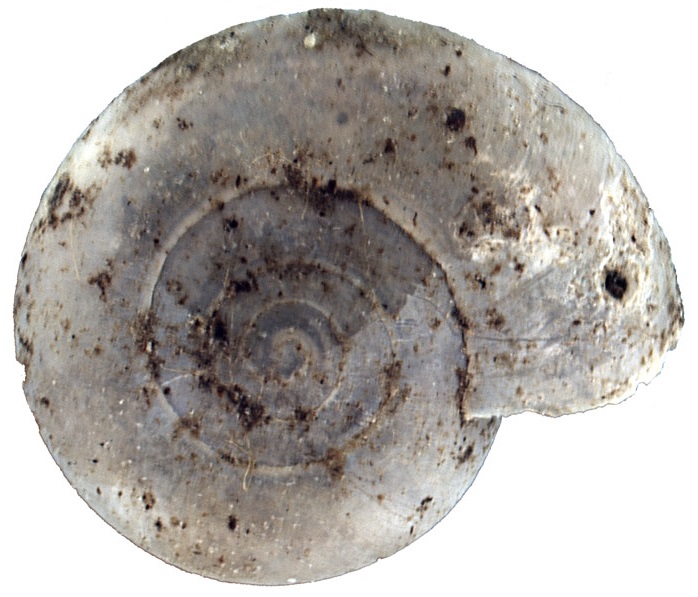
Glyphyalinia raderi has a moderately small sized shell, for the genus, with a nearly flat spire and a very wide umbilicus that is nearly a third of the shell width. The whorls of the shell increase slowly and regularly until the final whorl which expands slightly more rapidly. Whorls are sculptured with somewhat irregular growth lines on the apical surface which weaken on the basal surface which is evenly rounded. The shell color is waxy light brown in somewhat fresh dead specimens but may appear different in life. The genital anatomy of this species is not known.
Ecology
This rare species is known from fewer than 20 occurrences and although recently-dead shells are reported, it has apparently never been seen alive. It is found among limestone rocks or talus, especially in leaf litter with high calcium content (Pearce, 2008), and it appears to be a calciphile. The species may burrow (Hubricht, 1985) explaining the lack of observations and difficulty finding living animals.
Taxonomy
This species is has also been called Retinella raderi and Vitrea raderi. It is named for Mr. Rader of Cumberland, Maryland, who was interested in mollusks (in Pilsbry, 1946).
Distribution
Glyphyalinia raderi is found in southern Pennsylvania, West Virginia, eastern Kentucky, western Maryland and Virginia. In Virginia the species is found in the Ridge and Valley region from the Shenandoah Valley west. Because the species is small and appears to burrow it is extremely difficult to monitor or even to locate, making conservation assessments very difficult. The species is believed to be extirpated from one of its former sites in Maryland.
Conservation
NatureServe Global Rank: G2, Imperiled.
NatureServe State Rank: Maryland, SH, Historic; Pennslylvania, S1S2, Critically Imperiled; Virginia, S1S2, Critically Imperiled; West Virginia, S2, Imperiled.
Virginia’s wildlife action plan: Tier II
