• Skip to primary navigation
  • Skip to main content
  • Skip to primary sidebar

Carnegie Museum of Natural History

One of the Four Carnegie Museums of Pittsburgh

  • Visit
    • Buy Tickets
    • Visitor Information
    • Exhibitions
    • Events
    • Dining at the Museum
    • Celebrate at the Museum
    • Powdermill Nature Reserve
    • Event Venue Rental
  • Learn
    • Field Trips
    • Educator Information
    • Programs at the Museum
    • Bring the Museum to You
    • Guided Programs FAQ
    • Programs Online
    • Climate and Rural Systems Partnership
  • Research
    • Scientific Sections
    • Science Stories
    • Science Videos
    • Senior Science & Research Staff
    • Museum Library
    • Science Seminars
    • Scientific Publications
    • Specimen and Artifact Identification
  • About
    • Mission & Commitments
    • Directors Team
    • Museum History
  • Tickets
  • Give
  • Shop

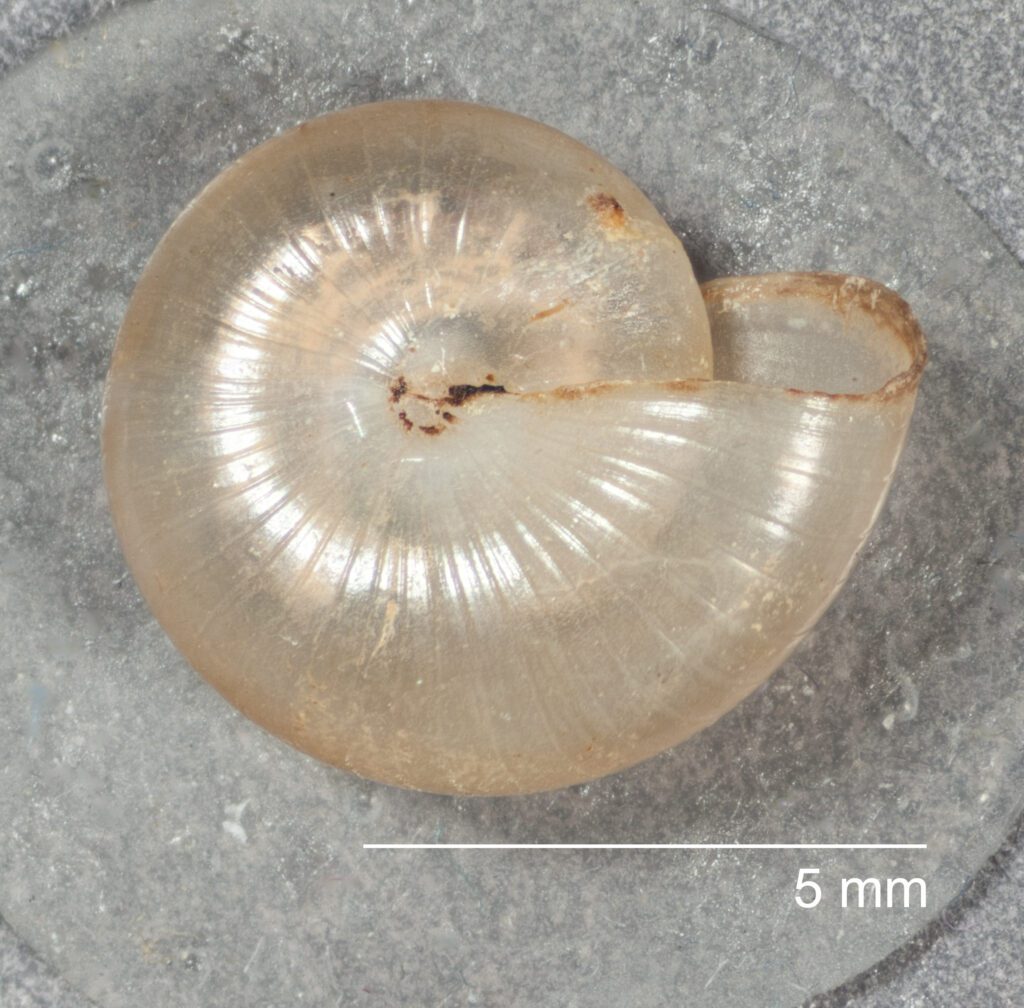
Glyphyalinia rimula

  • Field Museum of Natural History
  • CC BY-NC 3.0 DEED
  • Field Museum Copyright Information
  • For additional information about this specimen, please contact: Rüdiger Bieler, Curator (rbieler@fieldmuseum.org)

Family: Gastrodontidae

Common name: Tongued Glyph

Discovery: Hubricht, 1968

Identification

Width: ~7.7 mm
Height: ~4 mm
Whorls: ~5

The fragile shell of Glyphyalinia rimula is a depressed heliciform with a glossy, coppery color and 5 loosely coiled whorls. A tongue-like callus at the columella partially covers the rimate umbilicus. Widely-spaced transverse striae are well-developed, with weakly defined spiral striae.   

Ecology

This species is found in leaf litter of mixed hardwood forests on hillsides, in ravines, sometimes in caves, and even in kudzu tangles. In Tennessee, it is found in cedar woods and along river bluffs.

Taxonomy

Described by Hubricht in 1968, this species has no other known synonyms.

Distribution

Glyphyalinia rimula is currently known in the Northeastern United States from one county in southwestern West Virginia, where it may be extirpated. It is documented in two other states, Kentucky and Tennessee.

Conservation

NatureServe Rank: G3, Vulnerable.
NatureServe State Rank: West Virginia, NR, not ranked.

sidebar

About

  • Mission & Commitments
  • Directors Team
  • Museum History

Get Involved

  • Volunteer
  • Membership
  • Carnegie Discoverers
  • Donate
  • Employment
  • Events

Bring a Group

  • Groups of 10 or More
  • Birthday Parties at the Museum
  • Field Trips

Powdermill

  • Powdermill Nature Reserve
  • Powdermill Field Trips
  • Powdermill Staff
  • Research at Powdermill

More Information

  • Image Permission Requests
  • Science Stories
  • Accessibility
  • Shopping Cart
  • Contact
  • Visitor Policies
One of the Four Carnegie Museums | © Carnegie Institute | Privacy Policy | Terms of Use | Accessibility
Rad works here logo