
Image Usage Information
Family: Haplotrematidae
Common name: Gray-foot Lancetooth
Discovery: Say, 1821
Identification
Width: 11-21 mm
Height: 5-10 mm
Whorls: 5+
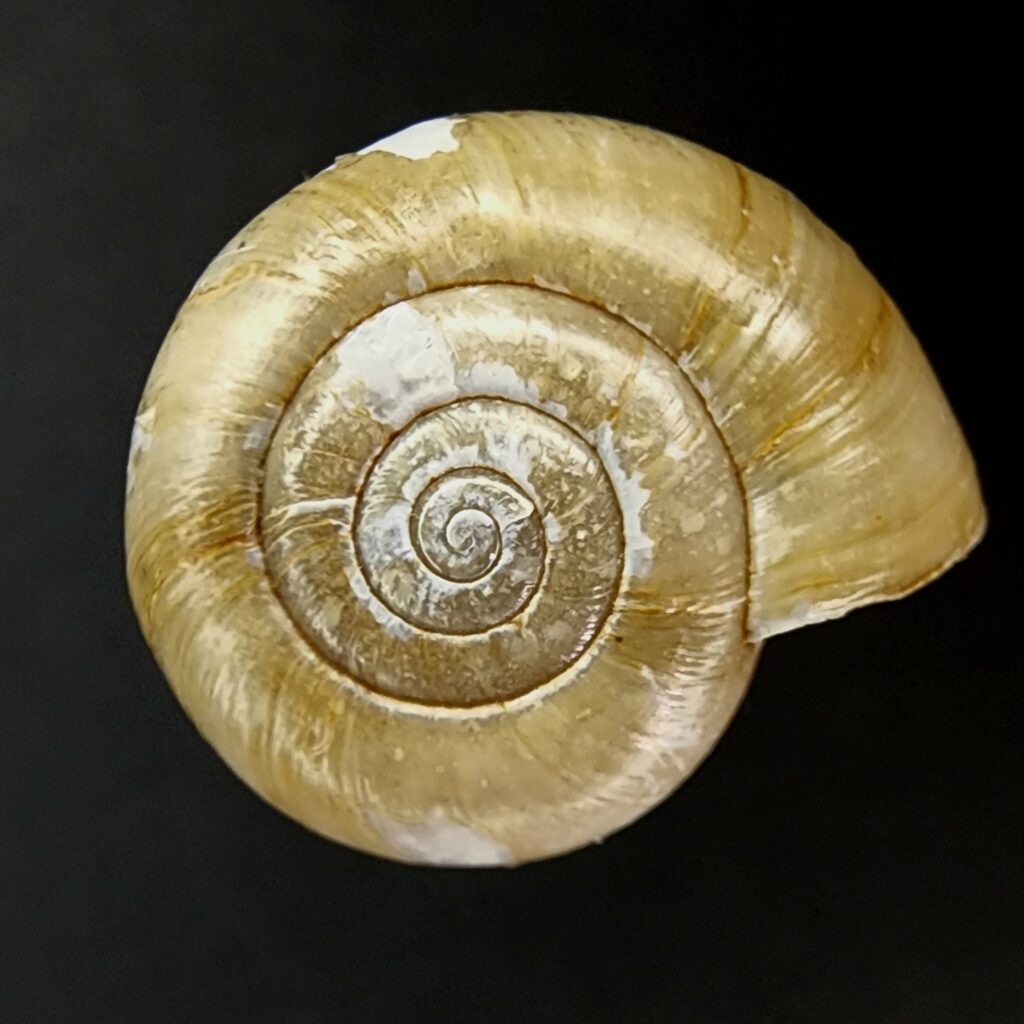
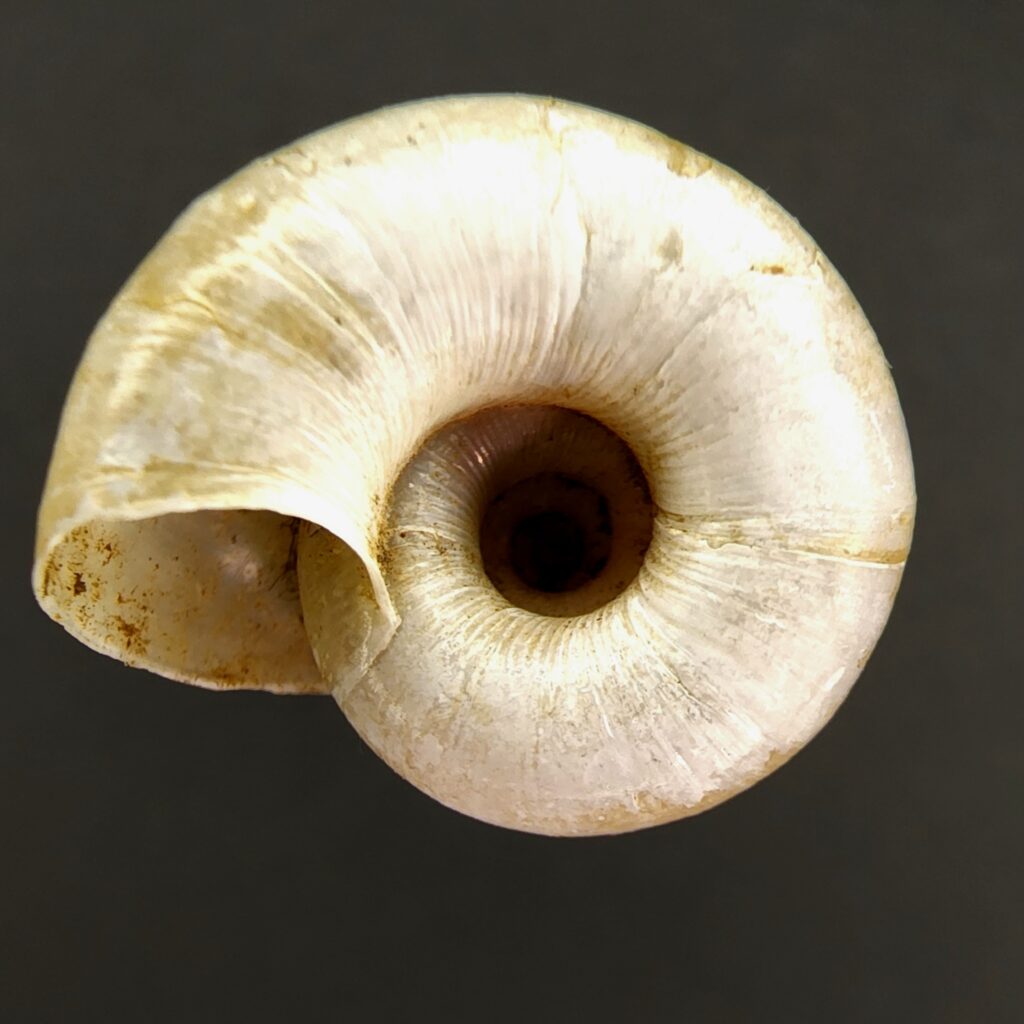
The large shell of Haplotrema concavum has tubercular whorls and a wide umbilicus. The oval-shaped aperture is thickened and rather gently reflected. Irregular radial striae cover the shell and occasionally fine spiral lines may be visible. Immature shells can be confusing, but its size, open umbilicus, and rounded whorls are a give-away. Adults may continue to grow, so shells often show more than one growth interruption.
Ecology
Haplotrema concavum is a common land snail found in forest leaf litter. It has also been reported in caves in Tennessee (Lewis, 2005). Work in Tennessee forest found that this animal was significantly associated with limestone substrata, very steep slopes, leaf litter and log microhabitats, and late stages of forest succession (Coney et al, 1982). Haplotrema concavum is a predator that hunts small worms and other snails, but will also eat vegetation. It has also been observed consuming dead shells, likely for the calcium (Hubricht, 1985).
This predator can track snail prey by following its slime trail, and may drag its victim to leaf or rock cover before consumption (Atkinson, 2000; Shearer and Atkinson, 2001). In a comparison of its preference between five prey species, Succinea ovalis, which has a large aperture and thin shell, was attacked most often, while Strobilops labyrinthica, with its thick shell and narrow aperture, was least preferred (Pearce and Gaertner, 1996).
Taxonomy
Synonyms for H. concavum include Circinaria concava, Haplotrema (Geomene) concavum concavum, Helix concava, H. dissidens, H. planorboides, Macrocyclis concava, and Selenites concava var. minor.
Distribution
This snail is widespread across the Eastern United States and Canada. In Virginia it is reported from counties throughout the state.
Conservation
NatureServe Global Rank: G5, Secure.
