

Image Usage Information
Family: Helicodiscidae
Common name: Shaggy Coil
Discovery: Grimm, 1967
Identification
Width: 3.0-4.5 mm
Height: 1.0-1.5 mm
Whorls: 4.5+
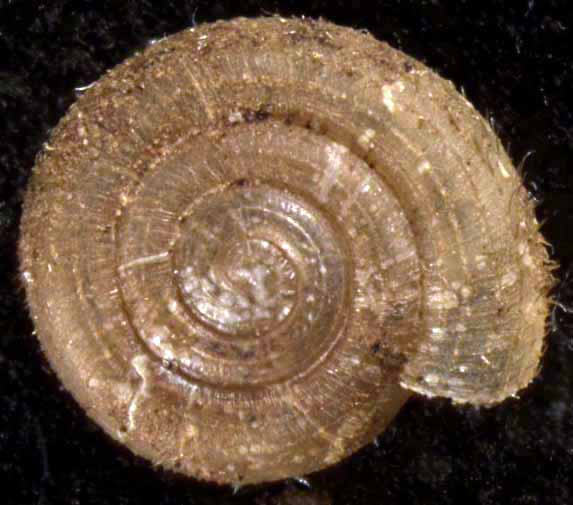
The shell of Helicodiscus diadema is disk-like, with a flat spire and a wide, shallow umbilicus nearly half the diameter of the shell. The rounded whorls are sculptured with growth wrinkles, intersected by spiral lirae, on which fine, curved “hairs” can be barely seen. Sparkling dew trapped on these hairs led Grimm (1967) to name this species for a diadem, or royal headband. These processes are worn off on older shells.
The final whorl of the shell descends slightly towards the rounded aperture. Near the aperture there are sets of three teeth – two long, radially-oriented teeth on the basal and outer walls, and one cupped tooth on the parietal wall – and there may be two or three sets.
Ecology
Helicodiscus diadema is found on thinly-wooded hillsides and among limestone talus and rubble. It appears to be active at the surface only during damp periods.
The snail’s ephemeral appearance at the stony soil surface and within a quarry is confusing, with Grimm (1967) suggesting it is fossorial, while the fine processes upon its shell suggest an adaptation to open, dry habitats. Research into this species’ autecology is needed.
Taxonomy
While Grimm’s description notes three separate locations for this species, recent work suggests that two of these sites may have been misidentified subfossil shells of other helicodiscids (K.P. Hotopp, J.C. Nekola, T.A. Pearce, pers. obs.). There are no synonyms of H. diadema.
Distribution
Helicodiscus diadema is an endemic known only from a certain valley in Alleghany County, Virginia.
Conservation
This land snail apparently persists only in a de facto refuge on a limestone hillside, in a valley with historic agricultural activity and small-scale rock quarrying. The landowner has kindly cooperated with previous survey work.
A better understanding of H. diadema habitat use might help to conserve the population, locate additional colonies, or aid propagation.
NatureServe Global Rank: G1, Critically Imperiled.
NatureServe State Rank: Virginia, S1, Critically Imperiled.
Virginia State Status: Endangered. Virginia’s wildlife action plan: Tier I
