• Skip to primary navigation
  • Skip to main content
  • Skip to primary sidebar

Carnegie Museum of Natural History

One of the Four Carnegie Museums of Pittsburgh

  • Visit
    • Buy Tickets
    • Visitor Information
    • Exhibitions
    • Events
    • Dining at the Museum
    • Celebrate at the Museum
    • Powdermill Nature Reserve
    • Event Venue Rental
  • Learn
    • Field Trips
    • Educator Information
    • Programs at the Museum
    • Bring the Museum to You
    • Guided Programs FAQ
    • Programs Online
    • Climate and Rural Systems Partnership
  • Research
    • Scientific Sections
    • Science Stories
    • Science Videos
    • Senior Science & Research Staff
    • Museum Library
    • Science Seminars
    • Scientific Publications
    • Specimen and Artifact Identification
  • About
    • Mission & Commitments
    • Directors Team
    • Museum History
  • Tickets
  • Give
  • Shop

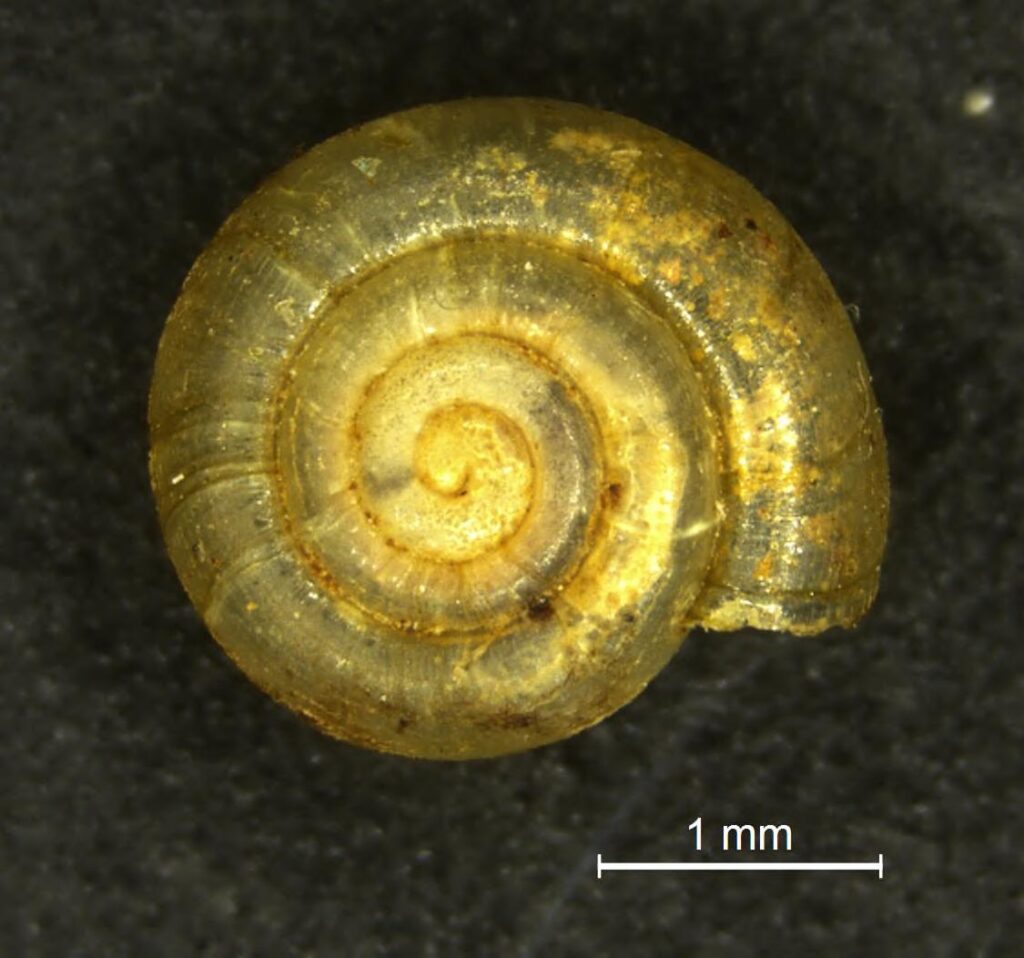
Helicodiscus hadenoecus

Image Usage Information

  • University of Michigan Museum of Zoology, Division of Mollusks
  • Public Domain
  • For additional information about this specimen, please contact: Taehwan Lee (taehwanl@umich.edu)

Family: Helicodiscidae

Common name: Cricket Coil

Discovery: Hubricht, 1962

Identification

Width: 2-3 mm
Height: 1-1.5 mm
Whorls: 4

The flattened, opaque shell of Helicodiscus hadenoecus has deep sutures and a microsculpture of spiral fringes upon its periostracum (outer protein coating). The fringes appear on both the top and base of the shell, excluding the embryonic whorl. The umbilicus is open and deep, about one-third the diameter of the entire shell. This shell lacks denticles or “teeth” within the aperture.

Ecology

Helicodiscus hadenoecus was initially described as a cave species, where it appears to feed on the guano of cave crickets in lightless zones (Hubricht, 1962; Lewis, 2005). In Tennessee it has been found in leaf litter and around logs (Coney et al, 1982). In Virginia it is found in rich forest habitats at the foot of bluffs along the New River, where shells are usually buried in 10 cm of soil or deeper (Hotopp, pers. obs.).

Taxonomy

There are no synonyms for this species’ name.

Distribution

This snail is known from Virginia, Kentucky, Tennessee, and Alabama. It has only been found as a subfossil in Virginia, along the New River in Pulaski County, where shells may be found with old shells of the federally-listed snail Polygyriscus virginianus.

Conservation

NatureServe Global Rank: G3
NatureServe State Rank: Virgininia, SH, Historic

Helicodiscus hadenoecus is listed as possibly extirpated in Virginia, and is considered vulnerable in its other three states to the south. Snail surveys in southern Virginia caves may encounter extant colonies.

sidebar

About

  • Mission & Commitments
  • Directors Team
  • Museum History

Get Involved

  • Volunteer
  • Membership
  • Carnegie Discoverers
  • Donate
  • Employment
  • Events

Bring a Group

  • Groups of 10 or More
  • Birthday Parties at the Museum
  • Field Trips

Powdermill

  • Powdermill Nature Reserve
  • Powdermill Field Trips
  • Powdermill Staff
  • Research at Powdermill

More Information

  • Image Permission Requests
  • Science Stories
  • Accessibility
  • Shopping Cart
  • Contact
  • Visitor Policies
One of the Four Carnegie Museums | © Carnegie Institute | Privacy Policy | Terms of Use | Accessibility
Rad works here logo