

Image Usage Information
Family: Helicodiscidae
Common name: Rubble Coil
Discovery: Hubricht, 1975
Identification
Width: 4-5 mm
Height: 1.5-2.0 mm
Whorls: 5+
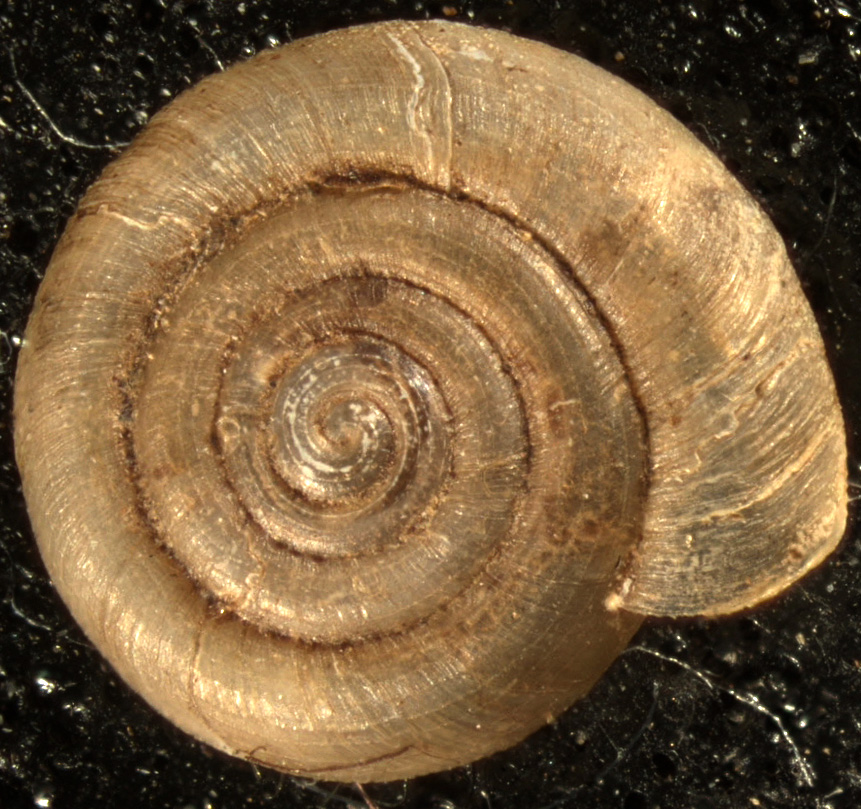
The whorls of the disk-like Helicodiscus lirellus are flattened so that almost no spire is visible. Coarse growth wrinkles are intersected by fine spiral lirae. The final whorl of H. lirellus bears one or two sets of teeth – each set has a long, radial lamella on the outer wall, another on the basal wall, and a third on the parietal wall. The parietal lamella is cupped, facing toward the aperture.
Separate parietal teeth, rather than a single, larger lamella with a notch, distinguish this animal from H. multidens. Its dished parietal lamella is unlike the simpler parietal tooth of H. triodus, and it lacks the tiny hair-like projections of H. diadema. The animal is white and apparently blind.
Ecology
Recent fieldwork shows that Helicodiscus lirellus is found among leaf litter and limestone stones or talus, or in rich shale scree, upon steep, forested slopes (Hotopp, unpublished data). These slopes are associated with the Maury River and Kerr’s Creek in the upper James River watershed.
Taxonomy
There are no synonyms for this species’ name.
Distribution
Helicodiscus lirellus is known only from Rockbridge County along the Maury River and Kerr’s Creek corridors.
Conservation
NatureServe Global Rank: G1
NatureServe State Rank: Virginia, S1, Critically imperiled
Virginia’s wildlife action plan: Tier I
Sites with H. lirellus tend to be de facto refuges created by steep slopes, cliffs and talus of little agricultural or development potential (Hotopp, unpublished data). A few have apparently old trees as well. All of the known sites are upon private land.
Some H. lirellus sites are represented only by subfossil shells. Additional survey work may encounter new populations along other tributaries.
