• Skip to primary navigation
  • Skip to main content
  • Skip to primary sidebar

Carnegie Museum of Natural History

One of the Four Carnegie Museums of Pittsburgh

  • Visit
    • Buy Tickets
    • Visitor Information
    • Exhibitions
    • Events
    • Dining at the Museum
    • Celebrate at the Museum
    • Powdermill Nature Reserve
    • Event Venue Rental
  • Learn
    • Field Trips
    • Educator Information
    • Programs at the Museum
    • Bring the Museum to You
    • Guided Programs FAQ
    • Programs Online
    • Climate and Rural Systems Partnership
  • Research
    • Scientific Sections
    • Science Stories
    • Science Videos
    • Senior Science & Research Staff
    • Museum Library
    • Science Seminars
    • Scientific Publications
    • Specimen and Artifact Identification
  • About
    • Mission & Commitments
    • Directors Team
    • Museum History
  • Tickets
  • Give
  • Shop

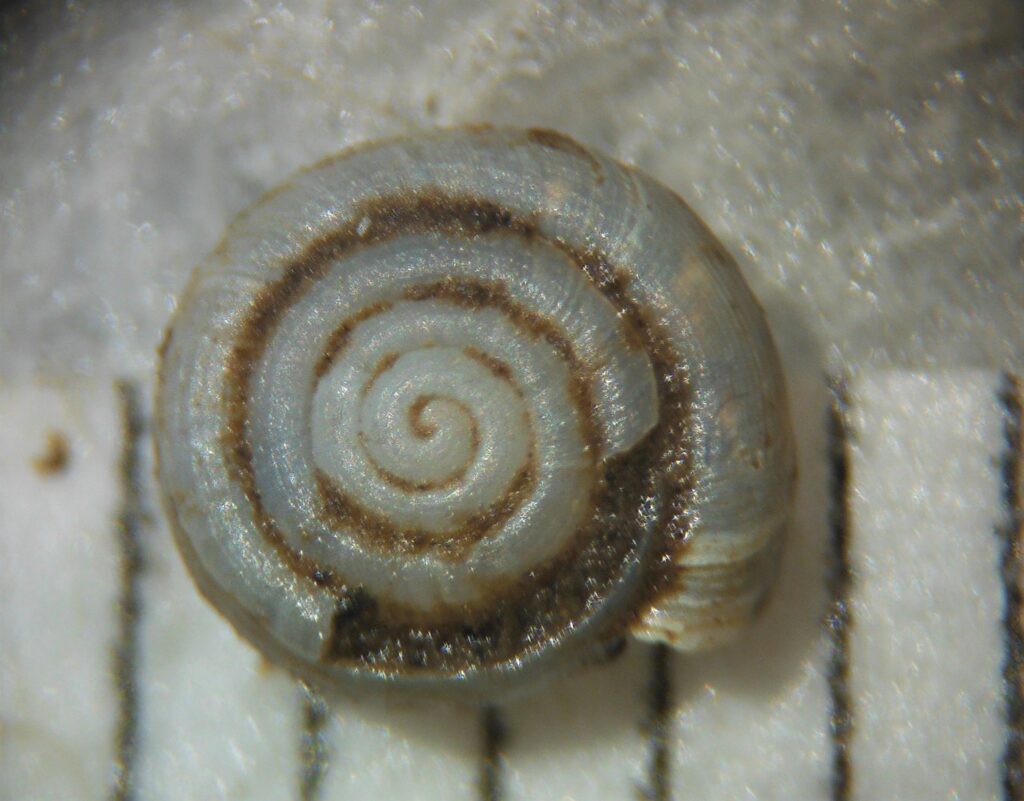
Helicodiscus notius

Image Usage Information

  • Barb Graham
  • CC BY-NC 4.0 DEED
  • Additional information about this specimen

Family: Helicodiscidae

Common name: Tight Coil

Discovery: Hubricht, 1962

Identification

Width: 3-4 mm
Height: 1.5-2.0 mm
Whorls: 5+

Helicodiscus notius has a shallow, open umbilicus, nearly half the diameter of its entire shell. Spiral lirae decorate the surface of the shell, including the embryonic whorl. Two cone-shaped teeth may usually be found on the basal wall of the final whorl and two on the outer wall. Sometimes a third pair of teeth may be present. As a juvenile, the disk-like shell of Helicodiscus notius is translucent; as a mature adult, it is opaque. The sutures are deep.

Ecology

Compared with Helicodiscus parallelus, H. notius prefers drier habitats. It may be found around logs and in the leaf litter of late-stage forests and occasionally in caves, but only where leaf litter has been washed or blown in (Hubricht, 1962). In Tennessee it has been noted in close association with limestone substrata (Coney et al, 1982).

Taxonomy

This species’ shell is not clearly distinguishable from Helicodiscus parallelus or H. shimeki and its described characters are so subtly different as to raise questions about its taxonomic validity. This species is also known as Helicodiscus notius notius.

Distribution

Helicodiscus notius is reported throughout the Southeastern and Central United States.

Conservation

NatureServe Global Rank: G5Q

sidebar

About

  • Mission & Commitments
  • Directors Team
  • Museum History

Get Involved

  • Volunteer
  • Membership
  • Carnegie Discoverers
  • Donate
  • Employment
  • Events

Bring a Group

  • Groups of 10 or More
  • Birthday Parties at the Museum
  • Field Trips

Powdermill

  • Powdermill Nature Reserve
  • Powdermill Field Trips
  • Powdermill Staff
  • Research at Powdermill

More Information

  • Image Permission Requests
  • Science Stories
  • Accessibility
  • Shopping Cart
  • Contact
  • Visitor Policies
One of the Four Carnegie Museums | © Carnegie Institute | Privacy Policy | Terms of Use | Accessibility
Rad works here logo