Image Usage Information
Family: Helicinidae
Common name: Cherrystone Drop
Discovery: Say, 1831
Identification
Width: 5.5-7.5 mm
Height: 4-6 mm
Whorls: 4+
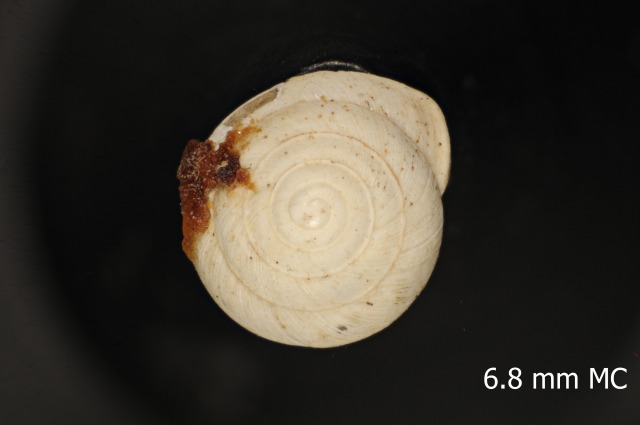
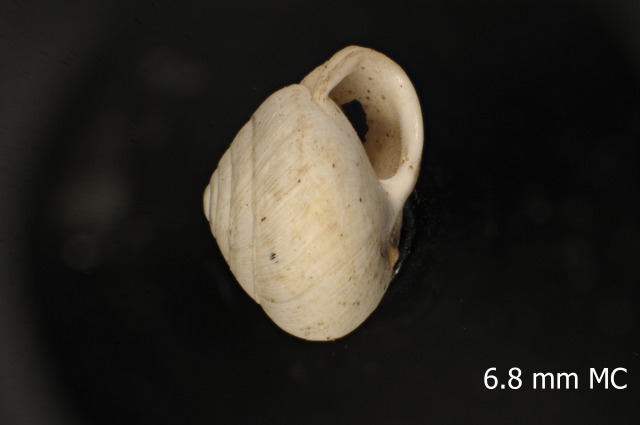
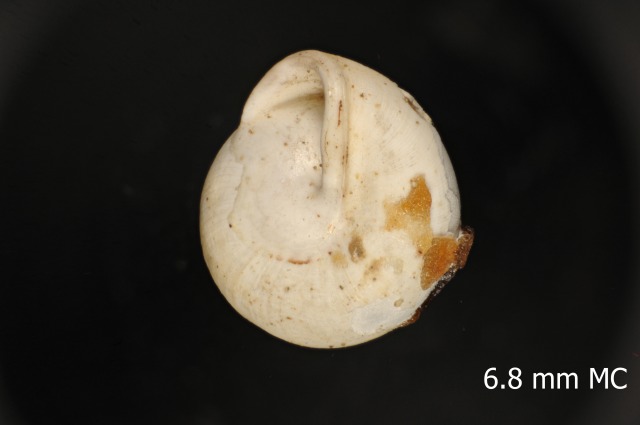
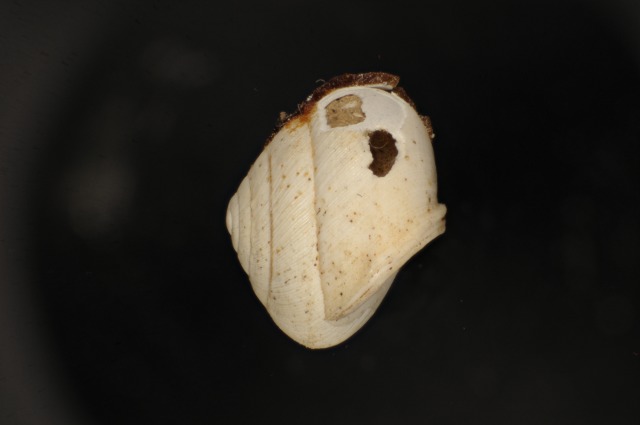
The thick shell of Hendersonia occulta is about the size of a cherry pit, with a cone-shaped spire formed by flattened whorls. The sutures are not impressed, and under magnification may appear keeled. The periphery is angled between top and bottom. The aperture may be rounded or somewhat triangular-shaped. Radial striae cover the surface, becoming fainter on the base and obsolete near the umbilicus and aperture. The aperture has a thick lip, and the umbilicus is closed.
Shells of H. occulta may be lightly colored, tinted reddish-brown, yellowish, or even pale green or blue. Old shells are bleached white.
Ecology
This snail tends to live in calcium-rich habitats, sometimes in large colonies. Some forest sites are mesic and shaded, while others can be dry and glady. It lives in leaf litter, coming out in damp weather to crawl on leaves, logs, and rocks. In unglaciated parts of the Midwest, where it occurs more frequently, it is found on floodplains. In the Appalachians, where it is more scattered, it lives on talus slopes, in ravines, and on mountainsides (Hubricht, 1985).
Taxonomy
This animal has also been known as Helicina occulata, H. occulina, Helicina occulta, H. o. rubella, and H. rubella.
Distribution
Hendersonia occulta’s range is separated into two general areas – the Midwest and the Appalachians. It is found from Minnesota and Missouri in the Midwest, and in the Appalachians from Pennsylvania to North Carolina. It is generally uncommon in the East, although Shenandoah National Park in Virginia is home to what is probably the single largest colony of the species.
Conservation
NatureServe Global Rank: G4
NatureServe State Rank: Maryland, S2, Imperiled; Pennsylvania, S2, Imperiled, Virginia, S3, Vulnerable; West Virginia S2, Imperiled
Virginia’s wildlife action plan: Tier IV
Hendersonia occulta is a calciphile that can be an indicator of other uncommon species and high-quality limestone habitats.
