
Image Usage Information


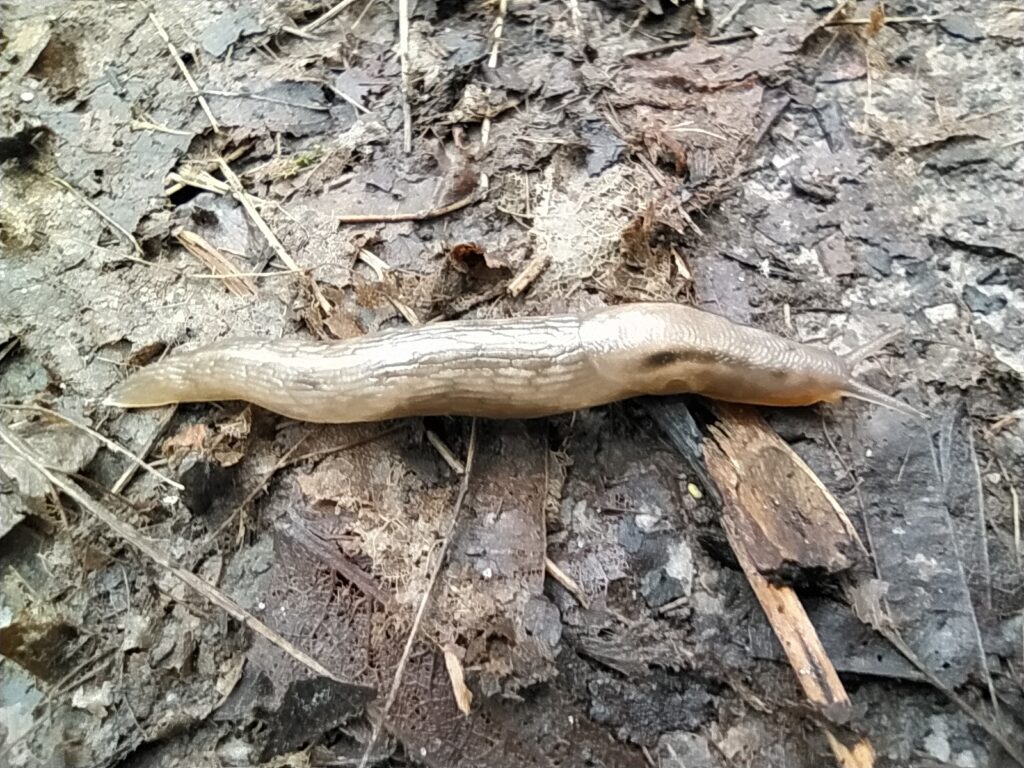
Image Usage Information
Family: Limacidae
Common name: Tree Slug
Discovery: Müller, 1774
Non-native
Identification
Length: 50-80 mm
The body of L. marginata is translucent pale gray to yellow, with two dark longitudinal bands (maybe broken into spots) on the dorsum. Two dark lines on the mantle form a lyre shape, and an indistinct dark line lies in between them. There is a short, pale keel toward the tail tip. The sole is gray-white. The slug produces clear body mucus, and when a potential predator perturbs it, the slug releases plentiful watery mucus (Quick, 1960; Kerney & Cameron, 1979; Abbes et al., 2010).
Lehmannia marginata and Ambigolimax valentiana are externally very similar-looking, but A. valentianus is yellowish and paler, has dorsal bands that are closer together, and possesses different genitalia. L. marginata may be confused with young Limax maximus, but L. marginata has a striped mantle and is translucent (Kerney & Cameron, 1979).
Ecology
Slugs may be found in forests and on open ground. They rest under the bark of dead trees, under damp rocks on clay soil (Kerney & Cameron, 1979; Abbes et al., 2010), and when available, on vertical rocks or live tree trunks, especially beech and hornbeam (Cameron, 1978; Wiktor, 1996). They tend to climb tree trunks in wet weather (Quick, 1960). Foods include live plants, wood (Jennings & Barkham, 1975), and especially lichen (Grimm et al., 2009).
The lifespan is three years, with slugs reaching maturity during their second year (Wiktor, 1996). These slugs can rappel down a mucus thread, particularly when they are young (Quick, 1960).
Taxonomy
The many synonyms of this species include Limax marginatus, L. scopulorum, L. salicium, L. limbatus, L. arborum, L. livonicus, L. scandens, L. arboreus, L. glaucus, L. arboretum, L. helveticus, L. altilis, and Lehmannia bielzi.
Distribution
Lehmannia marginata is a European species that has localities scattered across the southern and northeastern US and southwestern-most Canada. Museum site records for the northeast US include Delaware and West Virginia (Cabell and Wood Counties). (Note that L. marginata was often used incorrectly as the name of Ambigolimax valentiana in older North American literature [Grimm et al., 2009].)
Conservation
NatureServe Global Rank: G5, Apparently secure.
