

Image Usage Information
Family: Limacidae
Common name: Yellow Gardenslug, Yellow Cellar Slug
Discovery: Linnaeus, 1758
Non-native
Identification
Length: 75-100 mm
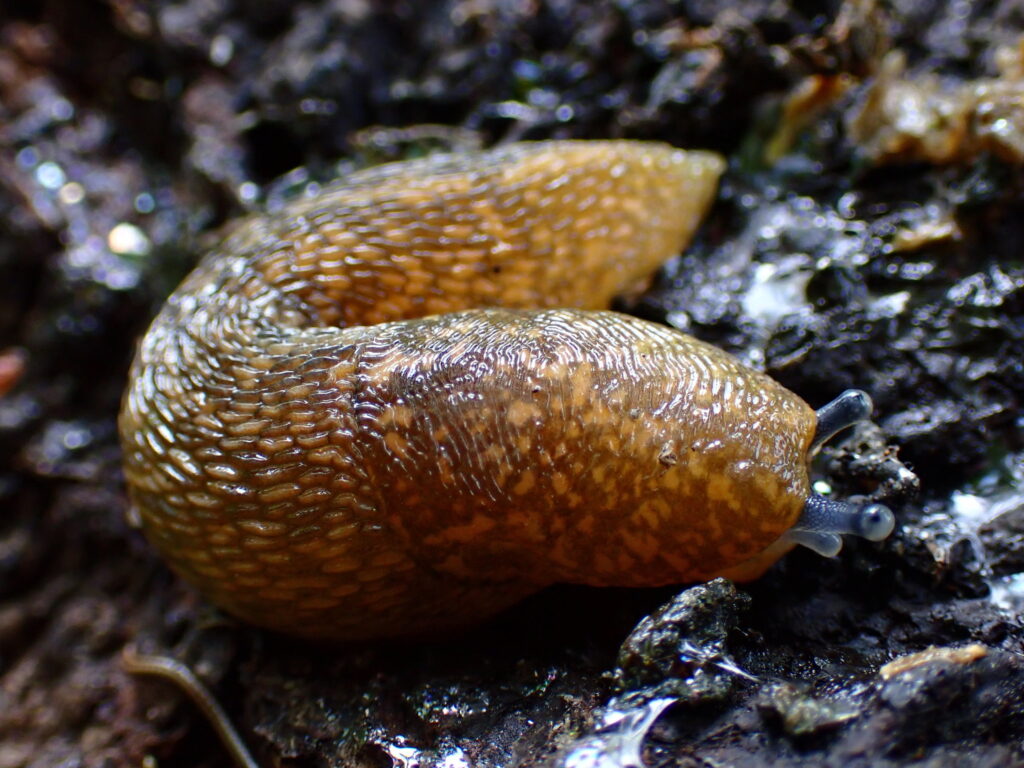
The body of L. flavus is yellowish to orange-pink with gray-green mottling, and its tail has a short keel. The tentacles are light blue-gray. Its sole is yellow-white with clear mucus, and the body mucus is yellow (Herbert, 1997; Kerney & Cameron, 1979).
Limacus flavus is similar to L. pseudoflavus and L. maculatus. However, L. pseudoflavus is grayer and has darker markings, coarser tubercles, and gray tentacles (Kerney & Cameron ,1979), and L. maculatus is darker in color, and internally, its spermatheca connects to its penis (Wiktor et al., 2000).
Ecology
Limacus flavus is a synanthropic slug that was probably native to the forests of the Mediterranean region (Wiktor et al., 2000; Heller 2009). Internationally, it occupies disturbed habitats, gardens, waste piles, and buildings, and it takes shelter under logs and discarded waste (Herbert, 2010). Slugs are omnivorous, consuming dead and living plants (especially roots and fruit), algae, lichens, fungi, and domestic waste (Graham, 1955; Wiktor et al., 2000; Herbert, 2010).
In Britain, L. flavus mates in late summer to February, and it lays eggs in September and February (Quick, 1960).
Taxonomy
Synonyms include Limax flavus, L. variegatus, L. megalodontes, Limacus breckworthianus, and Deroceras (Agriolimax) melasma.
Distribution
Limacus flavus is a Mediterranean species that has been introduced to some of the southern, midwestern, and Northeastern US, as well as to southeastern Canada and Washington. In the Northeast, L. flavus has been found in mostly urban areas of New Jersey (Hudson Co.), New York (Bronx, Albany, and Columbia Counties), Pennsylvania (Allegheny, Philadelphia, and Chester Counties), and Maryland (Kent Co.).
Conservation
NatureServe Global Rank: G5, Apparently secure.
