• Skip to primary navigation
  • Skip to main content
  • Skip to primary sidebar

Carnegie Museum of Natural History

One of the Four Carnegie Museums of Pittsburgh

  • Visit
    • Buy Tickets
    • Visitor Information
    • Exhibitions
    • Events
    • Dining at the Museum
    • Celebrate at the Museum
    • Powdermill Nature Reserve
    • Event Venue Rental
  • Learn
    • Field Trips
    • Educator Information
    • Programs at the Museum
    • Bring the Museum to You
    • Guided Programs FAQ
    • Programs Online
    • Climate and Rural Systems Partnership
  • Research
    • Scientific Sections
    • Science Stories
    • Science Videos
    • Senior Science & Research Staff
    • Museum Library
    • Science Seminars
    • Scientific Publications
    • Specimen and Artifact Identification
  • About
    • Mission & Commitments
    • Directors Team
    • Museum History
  • Tickets
  • Give
  • Shop

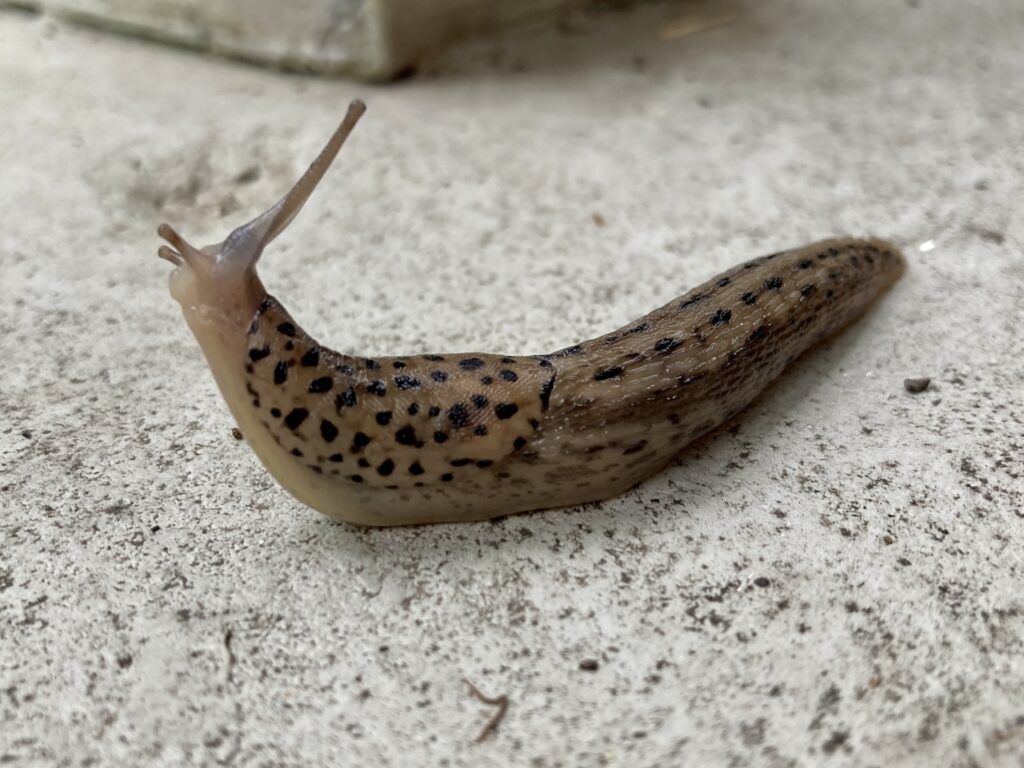
Limax maximus

Image Usage Information

  • maryrebeccau
  • CC BY-NC 4.0 DEED
  • Additional information about this specimen

Image Usage Information

  •  Nadja Baumgartner
  • CC BY-NC 4.0 DEED
  • Additional information about this specimen

Family: Limacidae

Common name: Giant Gardenslug

Discovery: Linnaeus, 1758

Non-native

Identification

Length: 100 – 200 mm

The introduced Limax maximus has a mantle covering the anterior portion of its dorsum (back). In this slug the mantle actually encloses a small vestigial shell. While the mantle is darkly spotted or marbled, the slug’s posterior has two or three dark longitudinal stripes (Kerney & Cameron, 1979). Its upper color varies from brownish green to gray, and its sole (underside) is whitish. The posterior has a “keel,” or ridge. Its slime is sticky and colorless, and its penis, which might be observed during mating, is pale blue. It is native to Europe.

Ecology

This giant non-native slug prowls gardens, yards, sidewalks, or old homesites in the woods, typically at night. It is omnivorous, generally eating plant material but also feeding upon other slugs. It conducts aerial mating, in which a pair of slugs mates while suspending themselves from a mucus strand attached to a tree branch or other object.

Up to several dozen eggs are laid under rocks or logs in the fall (Chichester & Getz, 1973). Eggs in the laboratory hatched in three to four weeks. Individuals may live four years.

Taxonomy

Distribution

Conservation

NatureServe Global Rank: G5
NatureServe State Rank: SNA

sidebar

About

  • Mission & Commitments
  • Directors Team
  • Museum History

Get Involved

  • Volunteer
  • Membership
  • Carnegie Discoverers
  • Donate
  • Employment
  • Events

Bring a Group

  • Groups of 10 or More
  • Birthday Parties at the Museum
  • Field Trips

Powdermill

  • Powdermill Nature Reserve
  • Powdermill Field Trips
  • Powdermill Staff
  • Research at Powdermill

More Information

  • Image Permission Requests
  • Science Stories
  • Accessibility
  • Shopping Cart
  • Contact
  • Visitor Policies
One of the Four Carnegie Museums | © Carnegie Institute | Privacy Policy | Terms of Use | Accessibility
Rad works here logo