Image Usage Information
Family: Achatinidae
Common name: Giant African Land Snail
Discovery: Bowdich, 1822
Introduced species
Identification
Width: ~120 mm
Height: 50-200 mm
Whorls: 7-10
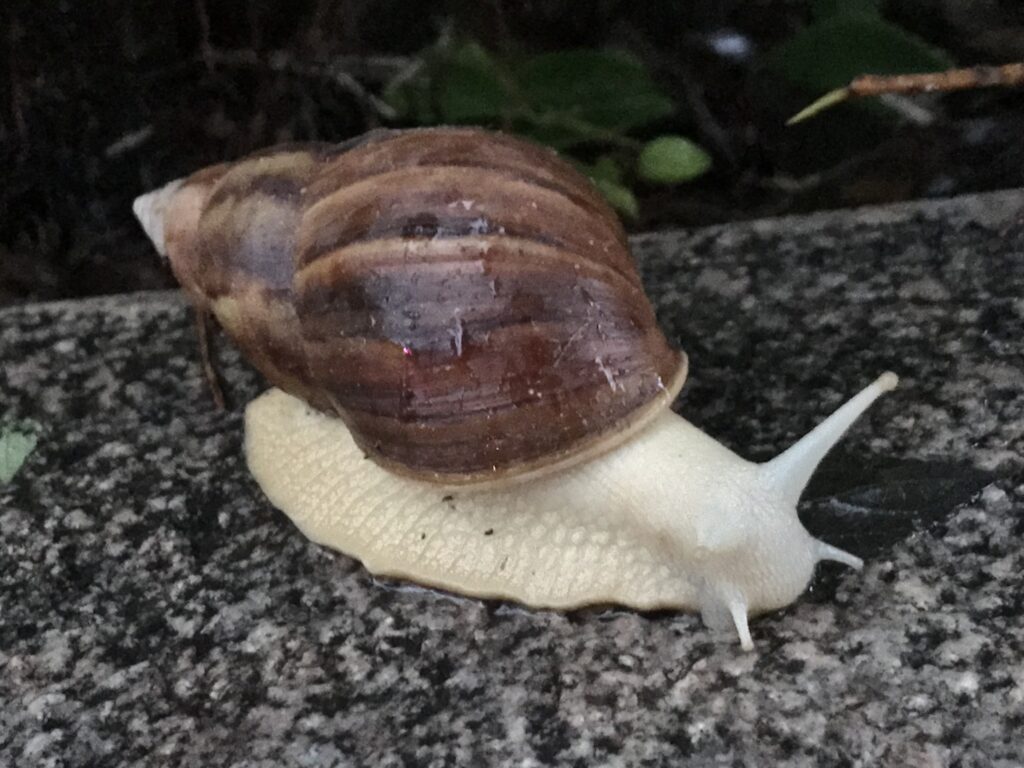
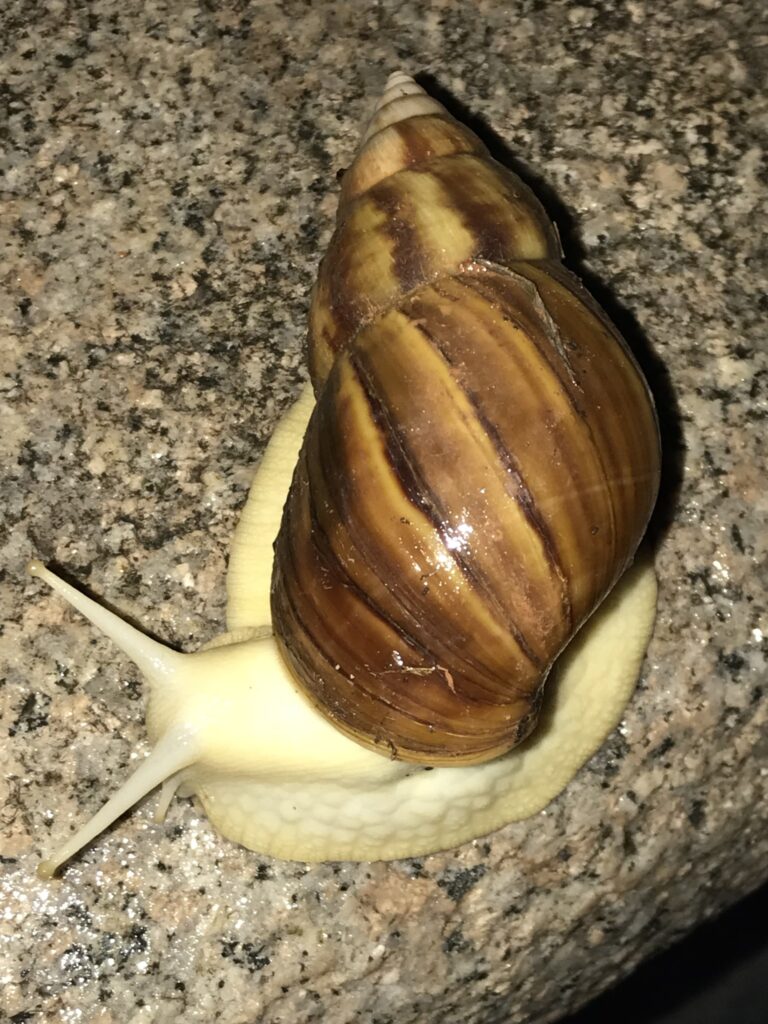
This tropical snail’s shell is cone-shaped, often marked with alternating radial bands of brown and tan (White-McLean, 2011). The aperture is simple, thickened along the columella, and the umbilicus is closed. The live animal may vary in color from tan to dark brownish. This species is conspicuously larger than other land snails in the Northeast.
Ecology
Lissachatina fulica is one of the planet’s best-known land snails. It is large, prolific, widely introduced, and easily kept in captivity. The species is cultivated for food, the pet trade, and mucus production for skin treatments. It is frequently used as a model animal for anatomical, physiological, and medical research (e.g. Mukherjee et al., 2017).
This land snail is primarily an herbivore, feeding upon a wide variety of plants including bananas, cotton, bread fruit, hemp, coffee, cocoa, rubber tree, various legumes, and many others (in Godan, 1979). However, it can be cannibalistic, and has been observed preying upon other gastropods as well (Meyer et al., 2009).
Lissachatina fulica has been introduced to many tropical islands, often with disastrous effects. In Hawaii and elsewhere, the predatory land snail Euglandina rosea introduced to control L. fulica has caused mass extinction of native snails through predation (e.g. Civeyrel and Simberloff, 1996).
The invasiveness potential of L. fulica in the U.S. is ranked relatively highly (Cowie et al., 2009). Modelling of potential L. fulica invasion areas in India identified 2 million km2 at moderate risk to very high risk of invasion (Rekha Sarma et al., 2015). In South America, widespread introductions are reported and large areas of the coasts, highlands, and Amazon River basin have invasion potential (Borrero et al., 2009). Higher relative humidity is an important predictive factor in the model.
Lissachatina fulica is an intermediate host for the rat lungworm Angiostrongylus cantonensis, which can be transmitted to people, causing a form of meningitis (Stockdale Walden et al., 2015). Work in Florida shows this parasite is also carried by some other species of land snails, both native and introduced (Stockdale Walden et al., 2017).
Taxonomy
A synonym is Achatina fulica. There are several subspecies and congeners.
Distribution
Lissachatina fulica is native to East Africa, but has been spread around Earth’s tropical zone. In the United States there are populations in Hawaii and Florida. In Pittsburgh, Pennsylvania, an immature individual was found outside in a public park, in summer 2003 (Tim Pearce, pers. observation).
Conservation
NatureServe Rank: G5, Secure.
Importation of this non-native species is regulated by the U.S. Dept. of Agriculture (Anonymous, 2017). The State of Florida has an ongoing eradication program.
Publication date: 12/2017
