

Image Usage Information
Family: Helicodiscidae
Common name: Oldfield Coil
Discovery: R.T. Lowe, 1852
Identification
Width: 2-2.5 mm
Height: 1.25 mm
Whorls: 4+
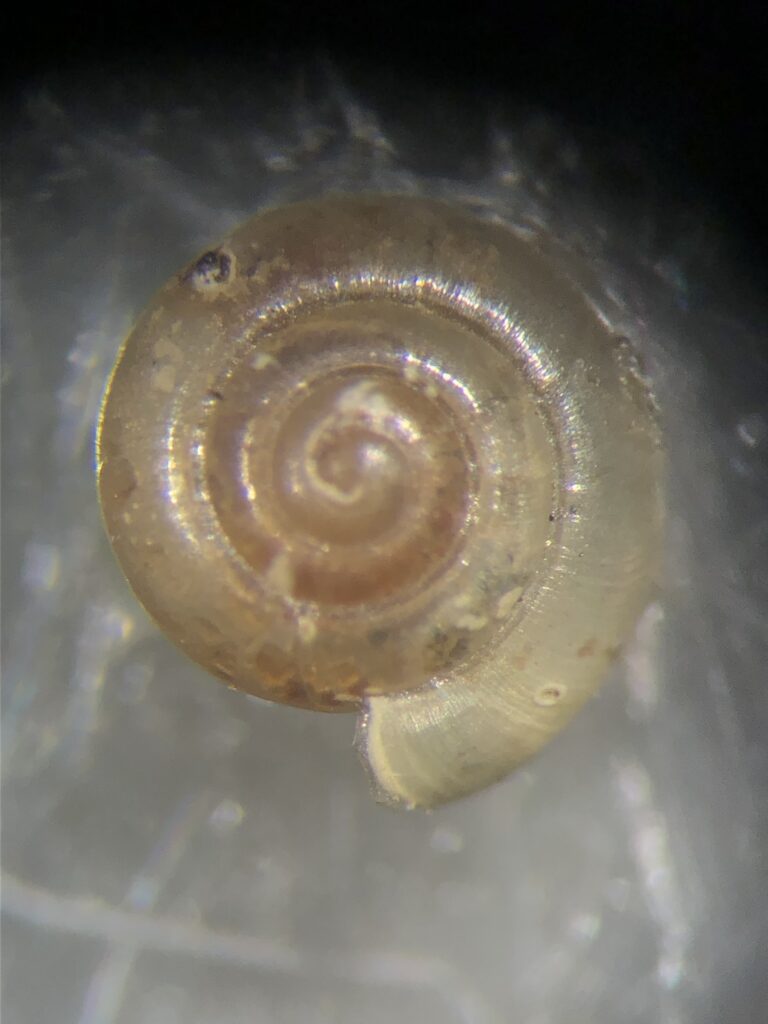
The rounded whorls of the shell of Lucilla scintilla gradually increase in size as they grow outward. The final whorl descends slightly towards the aperture, which has a subtly reflected, though still rather narrow, lip. It is marked by vein-like lines that are usually darker in color than the rest of the translucent shell. The suture is well-impressed, and some growth lines can be seen on the final whorl. This shell lacks spiral lirae.
In eastern Europe where this species and its relative L. singleyana are introduced, they are distinguished by shell color, size, and shape (Horsák et al, 2009). The shell of Lucilla scintilla is yellowish, smaller, and flatter than L. singleyana. Both Lucilla species have a smooth and glossy shell surface, while Hawaiia species exhibit a crosshatch of fine striae.
Ecology
This animal prefers open, grassy areas. It is most frequently encountered in fields, meadows, and along roads and railroads. On occasion it may also be found in caves (Hubricht, 1985). In Europe, it and L. singleyana are reported to live in small holes and cracks up to a meter deep in the soil (Kerney, 1999).
Taxonomy
Lucilla scintilla has also been known as Helicodiscus inermis, H. intermedius, and H. singleyanus inermis.
Distribution
Lucilla scintilla has been reported from the Middle Atlantic, Southeastern, and Midwestern United States. In Virginia, it is listed as a vulnerable species.
Conservation
NatureServe Global Rank: G4, Apparently Secure.
NatureServe State Rank: Virginia, S2S4, Imperiled to Apparently Secure; West Virginia SH, Historic.
