

Image Usage Information
Family: Philomycidaae
Common name: Changeable Mantleslug
Discovery: Hubricht, 1951
Identification
Length: 60-100 mm
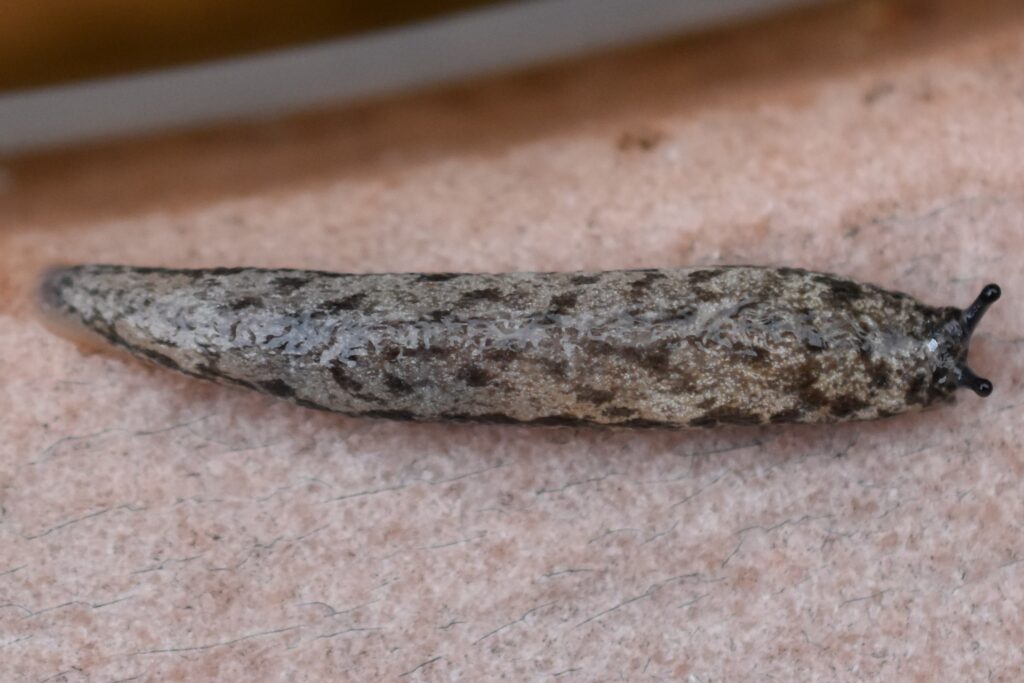
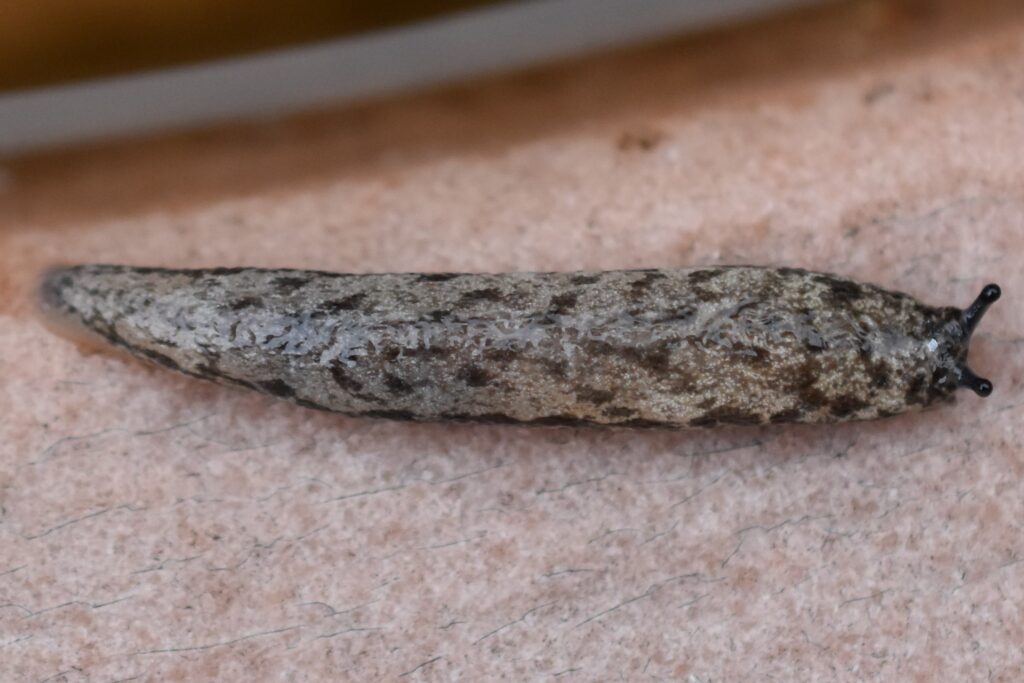
Megapallifera mutabilis is a large slug with a mantle that covers the entire dorsal surface. The mantle is tan to tan-grey with irregular mottling of slightly darker brown spots. These spots usually coalesce to form two bands near the lateral edges of the mantle as well as spots or broken bands bordering the center of the mantle. The lateral and central bands are sometimes connected by poorly defined chevron shaped bands that run slightly forward from the center band to the lateral band. The mantle pattern is more variable and less clearly-defined than that of Megapallifera wetherbyi. Like other Megapallifera and Pallifera (and unlike Philomycus) there is no “dart” to aid reproduction.
Ecology
This slug is found in a wide variety of habitats – from upland forests to anthropogenic habitats – where they are often observed crawling on smooth-barked trees at night and during wet weather. These slugs aestivate under loose bark, and in moist depressions and holes in trees, where they often aggregate in groups of several individuals. This species probably feeds on the fungus, algae, and lichens found on wood and stones (Hubricht, 1985).
Megapallifera mutabilis is among the most arboreal of terrestrial mollusks. In the Northeast during damp weather this slug can be found feeding upon the thin film of algae high on tree trunks or snags, often out of reach (Hotopp, pers obs).
Taxonomy
There are no known synonyms.
Distribution
Megapallifera mutabilis is a widespread species that is found throughout eastern North America from Ontario to near the Gulf Coast west to eastern Texas. This species is found throughout Virginia from the coastal plain to the ridge and valley. However, because of the difficulty in identifying philomycid slugs, distribution records are widely scattered.
Conservation
NatureServe Global Rank: G5
