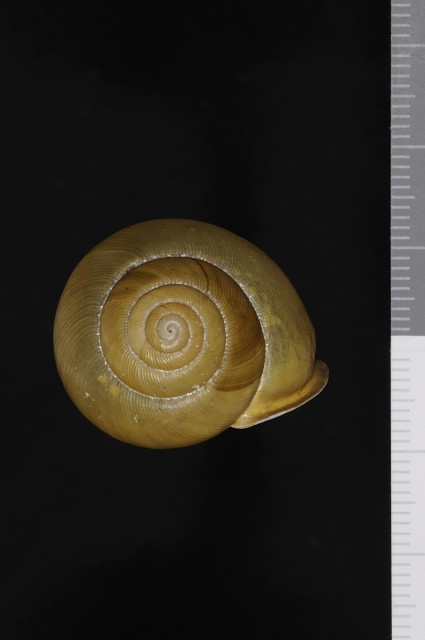
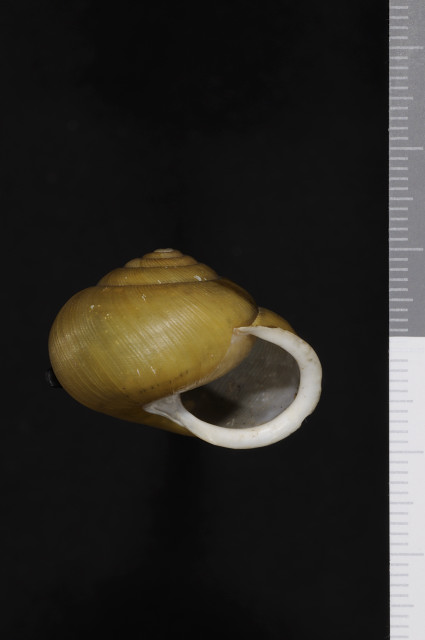

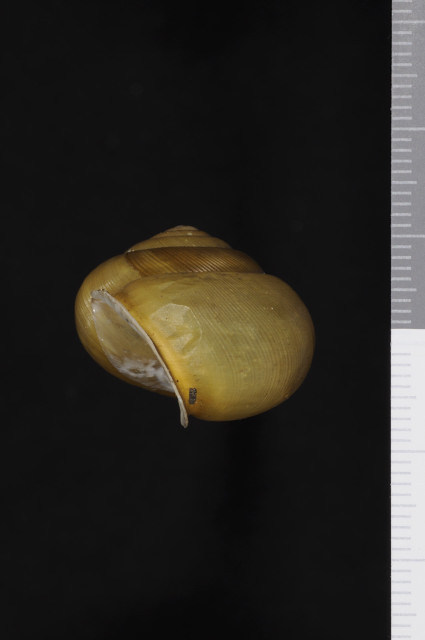
Image Usage Information
Family: Polygyridae
Common name: Balsam Globe
Discovery: W.G. Binney, 1879
Identification
Width: 21-25 mm
Height: 15-18 mm
Whorls: 5+
The shell of Mesodon andrewsae is rounded and extremely thin, with tiny radial striae. The final whorl is very large in comparison to the others, and it alone comprises about half of the snail’s overall size. There are typically no denticles in the wide, slightly reflected aperture, although some forms may have a small parietal tooth. It is typically an olive-green color, though some forms are reddish, or may have a reddish band above the periphery (Hubricht, 1985).
Ecology
Mesodon andrewsae inhabits high mountains above 2,000’.
Taxonomy
Synonyms for M. andrewsae include: Mesodon andrewsae intermedius, M. andrewsi, and Polygyra andrewsae.
Distribution
This southern Appalachian Mountain endemic was previously reported from West Virginia to Tennessee and North Carolina (Hubricht, 1985).West Virginia records may represent an undescribed species that is a bit lower and glossier than more southerly M. andrewsae (Dourson, 2015). In Virginia, M. andrewsae is found in only a few southwestern counties. However, in the Great Smoky Mountains the former subspecies M. a. altivagus has been elevated to species level (Emberton, 1991), so it is unclear whether its current range still includes these southernmost counties. In fact, there remains uncertainty about the distinction between M. andrewsae and M. altivagus (Emberton, 1991), and between M. andrewsae and the more widespread southeastern species M. normalis (Pilsbry, 1900; previously M. andrewsae normalis).
In Virginia, Mesodon andrewsae is reported only from Grayson and Smith Counties.
Conservation
NatureServe Global Rank: G3, Vulnerable
NatureServe State Rank: Virginia, S1, Critically Imperiled; West Virginia, SNR, not ranked
Virginia’s wildlife action plan: Tier II
