

Image Usage Information
Family: Polygyridae
Common name: White-lip Globe
Discovery: Say, 1816
Identification
Width: 17-28 mm
Height: 11-18 mm
Whorls: 5+
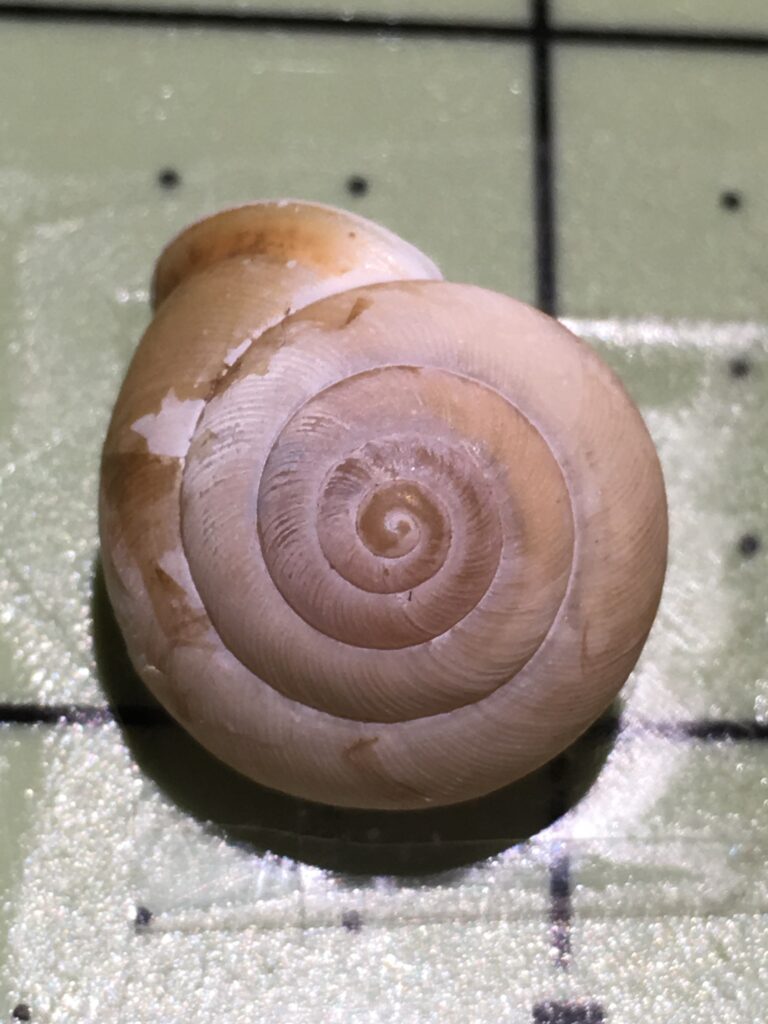
This snail’s rounded shell is a bit smaller and thinner than the largest Polygyrids, and it has a unique umbilicus. Its reflected lip partly covers this opening, leaving a slit-like gap. It often has a small parietal tooth, but this tooth is sometimes absent, even within entire populations (which may be mistakenly named as the, possibly spurious, Mesodon clausus), so it is a poor character for identification.
Ecology
M. thyroidus can be patchy in occurrence, found on richer soils at lower elevations along river floodplains, wetlands, and limestone ledges. It is occasionally found in cultivated gardens and in meadows (Hubricht, 1985), and is believed to eat mainly fungi (Wolf & Wolf, 1939). In Virginia this species was found in various oak and maple habitats (Burch, 1956).
In Illinois, overwintering M. thyroidus developed a relatively thin and clear epiphragm, and oriented aperture-up, partially buried in soil (Blinn, 1963). They became active during brief periods of warm weather. Summer activity of this species was in the vicinity of fragmented log mold. Most individuals matured in two years. The growth of immature M. thyroidus was suppressed by adults of the same species in a field cage experiment, apparently through resource competition (Pearce, 1997).
Taxonomy
Synonyms for this species include Helix thyroidus, H. thyroides, H. t. var. pulchella, Mesodon leucodon, M. thyroides, Polygyra thyroidus, and P. thyroides.
Distribution
Mesodon thyroidus is widely distributed in the south, midwestern and eastern United States. It is found in most Virginia counties. The putative species Mesodon clausus may be depauperate specimens of M. thyroidus lacking the parietal lamella, and therefore a potential synonym.
Conservation
NatureServe Global Rank: G5, Secure
