• Skip to primary navigation
  • Skip to main content
  • Skip to primary sidebar

Carnegie Museum of Natural History

One of the Four Carnegie Museums of Pittsburgh

  • Visit
    • Buy Tickets
    • Visitor Information
    • Exhibitions
    • Events
    • Dining at the Museum
    • Celebrate at the Museum
    • Powdermill Nature Reserve
    • Event Venue Rental
  • Learn
    • Field Trips
    • Educator Information
    • Programs at the Museum
    • Bring the Museum to You
    • Guided Programs FAQ
    • Programs Online
    • Climate and Rural Systems Partnership
  • Research
    • Scientific Sections
    • Science Stories
    • Science Videos
    • Senior Science & Research Staff
    • Museum Library
    • Science Seminars
    • Scientific Publications
    • Specimen and Artifact Identification
  • About
    • Mission & Commitments
    • Directors Team
    • Museum History
  • Tickets
  • Give
  • Shop

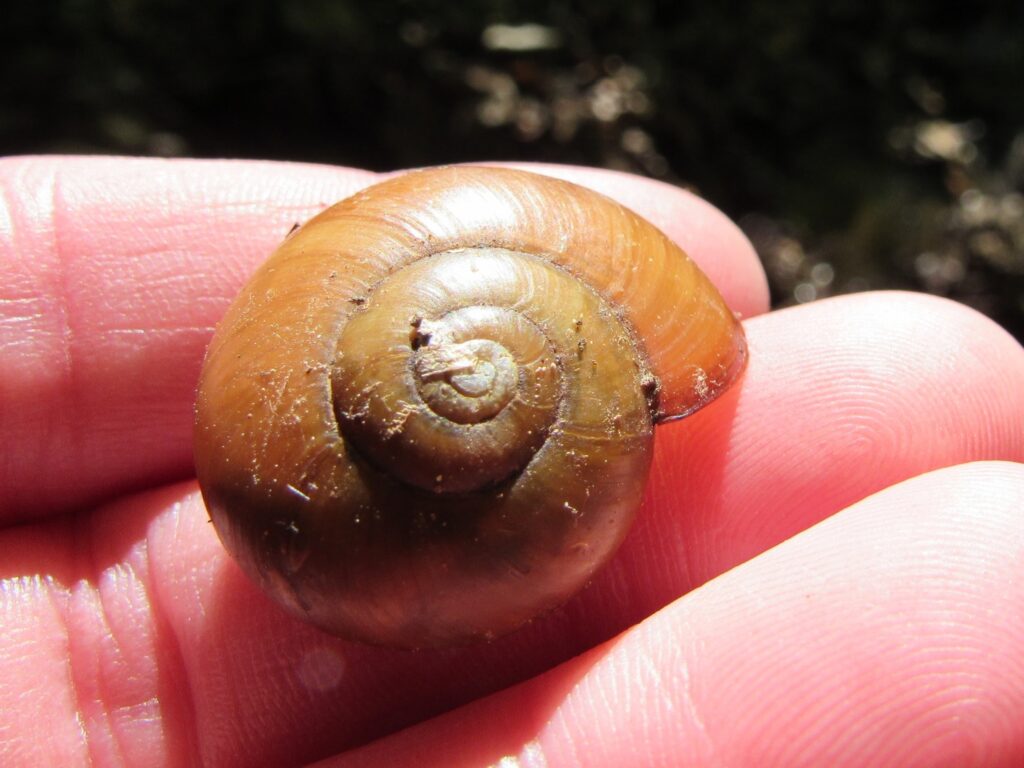
Mesomphix cupreus

Image Usage Information

  • Carrie S. Holt
  • CC BY-NC 4.0 DEED
  • Additional information about this specimen

Family: Gastrodontidae

Common name: Copper Button

Discovery: Rafinesque, 1831

Identification

Width: 22 -25 mm
Height: 12 – 15 mm
Whorls: 4+

The shell of Mesomphix cupreus is large, glossy, and robust. Its color is golden-brown to deep brown, and it typically has a very dark aperture edge. The shell microsculpture lacks papillae and instead may have a fine sandpaper texture, sometimes with spiral grooves (striae). The umbilicus is relatively large for its genus. Similar shells of large immature polygyrids are more transparent (in live animals), have fine radial ridges, and lack the dark lip edge.  Virginia specimens tend to be larger than those from farther north.

Ecology

This species is a denizen of damp forest leaf litter, sometimes near logs, in mature upland forests. Walton (in Pilsbry, 1948) reports it feeding upon other land snails.

Taxonomy

Synonyms for M. cupreus are: Helix fuliginosa, Mesomphix cupreus politus, Omphalina cuprea, O. fuliginosa, Zonites cupreus form sinistrorsus, and Zonites fuliginosus.

Distribution

The range of M. cupreus extends from western New England, New York, and Michigan, south to Tennessee and North Carolina. In the Mid-Atlantic it is not found near the coast. In Virginia it is found in the western mountains and hills.

Conservation

NatureServe Global Rank: G5, Secure

sidebar

About

  • Mission & Commitments
  • Directors Team
  • Museum History

Get Involved

  • Volunteer
  • Membership
  • Carnegie Discoverers
  • Donate
  • Employment
  • Events

Bring a Group

  • Groups of 10 or More
  • Birthday Parties at the Museum
  • Field Trips

Powdermill

  • Powdermill Nature Reserve
  • Powdermill Field Trips
  • Powdermill Staff
  • Research at Powdermill

More Information

  • Image Permission Requests
  • Science Stories
  • Accessibility
  • Shopping Cart
  • Contact
  • Visitor Policies
One of the Four Carnegie Museums | © Carnegie Institute | Privacy Policy | Terms of Use | Accessibility
Rad works here logo