

Image Usage Information
Family: Polygyridae
Common name: Whitelip
Discovery: Say, 1817
Identification
Width: 25-31 mm
Height: 16-19 mm tall
Whorls: 5+
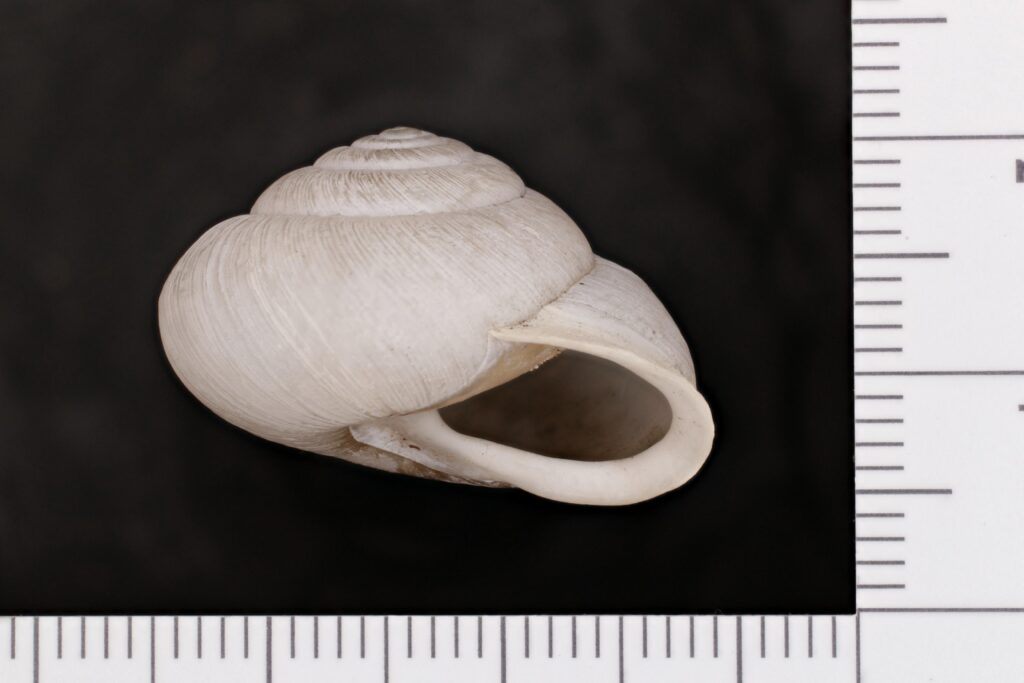
Neohelix albolabris is one of the largest and most familiar native Eastern land snails. The aperture of its large shell has a reflected edge which extends underneath into a callus that covers the umbilicus. The shell is covered with a sculpture of fine ridges and there are no denticles or “teeth” in the aperture.
Ecology
This species hides in leaf litter or among rocks or logs in forests. It is most often found in mesic habitats, often on mid-to-lower forest slopes with coarse woody debris, but can be frequent near calcareous outcrops as well. It can be found in streamside hemlock stands in northern New England, and is especially fond of rotten sugar maple or beech logs in hardwood or mixed forest. It is also found at forest edges and in some cases occurs in grassy areas such as roadsides (Hubricht, 1985).
In a field study of N. albolabris distribution in an Ohio hardwood forest, this animal was found near larger rocks and was most active in periods of warmer temperatures and rainfall (Emberton, 1980). A field experiment in Michigan discovered that young N. albolabris had slower growth rates in the presence of adults, due to competition for food or water (Pearce, 1997). In a beech-hemlock stand in New York, Calosoma sp. beetles were a common predator of this snail (Ingram, 1950).
Taxonomy
Neohelix albolabris profile – taxonomy: start with new paragraph: Once considered a single widespread species, this animal has recently been divided into a few cryptic “sister species” based upon reproductive anatomy and genetic analysis (Emberton, 1988). In Virginia, typical N. albolabris is generally found in most of the state, while the subtly rounder-shelled Neohelix solemi is on the coast and the slightly larger-shelled Neohelix major lives in the far west. Older reports of N. albolabris may no longer be accurate.
Synonyms for N. albolabris include: Helix albolabris, H. rufa,Mesodon albolabris, M. a. var. dentate, Polygyra albolabris, P. a. goodrichi, P. a. var. minor, P. redii, and Triodopsis albolabris.
Distribution
The global range of Neohelix albolabris was generally considered to be from southern Canada, through Wisconsin to northern Mississippi, east to the high elevations of Georgia, and north to Maine. However, the recent discovery of cryptic “sister” species along the Atlantic Coast and to the south-west (as distinguished by mating anatomy and protein analysis; Emberton, 1988), suggests its range may be primarily the upper Midwest, north, northeast, and inland east. In Virginia it is apparently the whitelip snail of the state’s central-to-western counties.
Conservation
NatureServe Global Rank: G5, Secure
