Image Usage Information
Family: Succineidae
Common name: Chittenango Ambersnail, Chittenango Ovate Ambersnail
Discovery: Pilsbry, 1908
Identification
Width: ~10.5-11.5 mm
Height: ~19-24 mm
Whorls: ~3.5
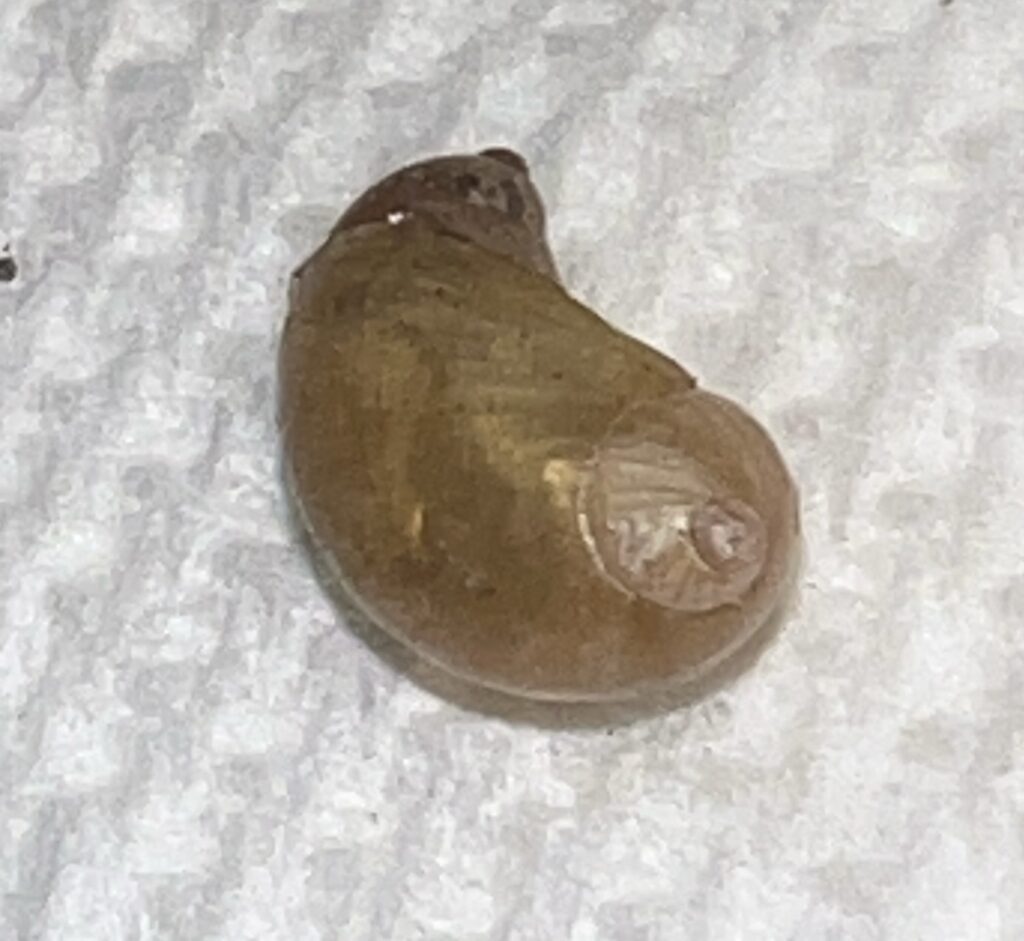
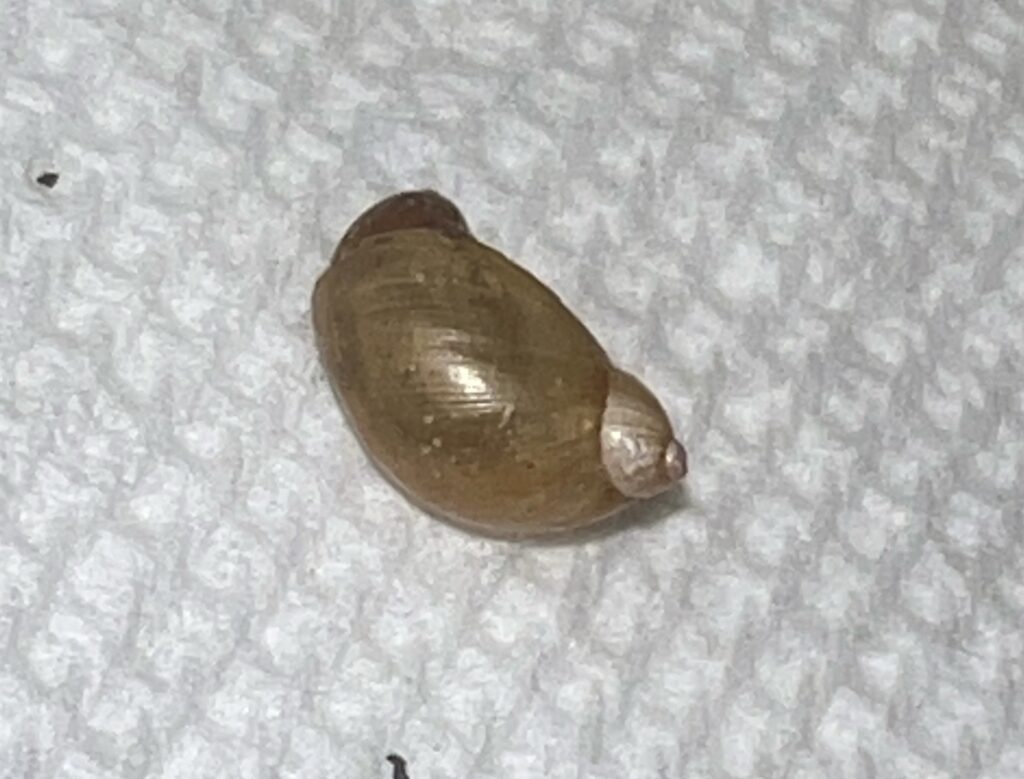
The shell of this animal is fragile and elongate, with a relatively tall spire (Pilsbry, 1948). The wide aperture is more than half of total shell length. The shell suture is deep, and its microsculpture is mainly growth wrinkles. The shell is translucent yellow or whitish. It has a taller spire and flatter final whorl than the more common Novisuccinea ovalis (Say, 1817).
Distinguishing shells of this species is difficult, especially for immature animals (in Breisch and Niver, 2006). After N. chittenangoensis reach a length of 6-9 mm they exhibit a unique black spot on the dorsal surface of the posterior foot (Thomee, 1986). The live animal is pale yellow with gray eyestalks and a faint gray side stripe.
Ecology
This rare ambersnail lives upon vegetated limestone ledges in a high-humidity “spray zone” habitat near a 50 m-tall waterfall. This early seral habitat is likely maintained by annual flooding and winter ice. The snails become active in May, mate in May to July, and lay eggs in June and July (Thomee, 1986; Breisch and Niver, 2006).
At the falls, eggs number 8-14 in clusters, laid at the base of plants, under dead vegetation or in damp soil, and hatch in 2-3 weeks (in Breisch and Niver, 2006). Molloy (1995) noted as many as 29 eggs laid in captivity. Novisuccinea chittenangoensis is most abundant near seeps, and most active on mornings with low light, no wind, and relative humidity >85% (Thomee, 1986). Inactive snails may be found attached with a dried-mucus epiphragm to green plants. Lifespan in the wild is estimated at 2-2.5 years.
Though they may feed briefly upon various items, the preferred food of captive Novisuccinea chittenangoensis is partially-decomposed hardwood leaf litter (Gilbertson in Platt, 2015; S.U.N.Y. College of Environmental Science and Forestry, 2017).
Novisuccinea chittenangoensis occurs with a non-native ambersnail, probably related to the European Succinea putris (Linnaeus, 1758), (referred to as Sp. B: Hoagland and Davis, 1987; Campbell et al., 2014) and certainly confused with it by earlier researchers (e.g. Pilsbry, 1948). These two species each have a differently-timed life cycle, which may facilitate their co-existence (Campbell et al., 2014). However, other workers note the circumstantial evidence of declining N. chittenangoensis numbers concurrent with expansion of other succineid populations at the falls (e.g. Molloy, 1995).
Genetic microsatellites of N. chittenangoensis show that snails on a given ledge tend to be more closely related to one another than to snails on other ledges (King et al., 2012).
Taxonomy
Novisuccinea chittenangoensis is part of a family whose taxonomy is incompletely understood. Solem (1976) considered this animal a form of N. ovalis due to anatomical similarities. Analysis of allozymes of succineids at Chittenango Falls and elsewhere did not find differences between the common N. ovalis and N. chittenangoensis, but did find differences in reproductive anatomy and shell shape judged worthy of species designation (Hoagland and Davis, 1987).
This animal has been previously known as Succinea ovalis chittenangoensis and Succinea chittenangoensis.
Distribution
Novisuccinea chittenangoensis’ global native range is Chittenango Falls, New York, although there are several misleading reports from other states (e.g. Hubricht, 1985). There are two captive populations as well.
Conservation
NatureServe Rank: G1, Critically Imperiled. NatureServe State Rank: New York, S1.
Federally Threatened; New York State Endangered
This species lives within a fenced-off protection zone in Chittenango Falls State Park. It has been the subject of recovery work by the U.S. Fish & Wildlife Service, New York Dept. of Environmental Conservation, State University of New York College of Environmental Science & Forestry (S.U.N.Y.-E.S.F.), the Rosamond Gifford Zoo, and other partners (e.g. Anonymous, 2017).
Identified threats include: trampling by visitors; other succineid species that may interfere with or otherwise impact the population; water pollution, flooding or drought; cliff erosion and rockslides; predators such as salamanders and parasitic flies; and stochastic effects associated with small population size (e.g. Breisch and Niver, 2006; Platt, 2015).
The federal recovery plan seeks to stabilize the population at the falls and establish captive populations (Breisch and Niver, 2006). To augment populations of this rare animal, captive bred N. chittenangoensis from S.U.N.Y.-E.S.F. were released at Chittenango Falls in 2014 and 2017. Molloy (1995) visited other area waterfalls and developed a snail habitat ranking system.
